

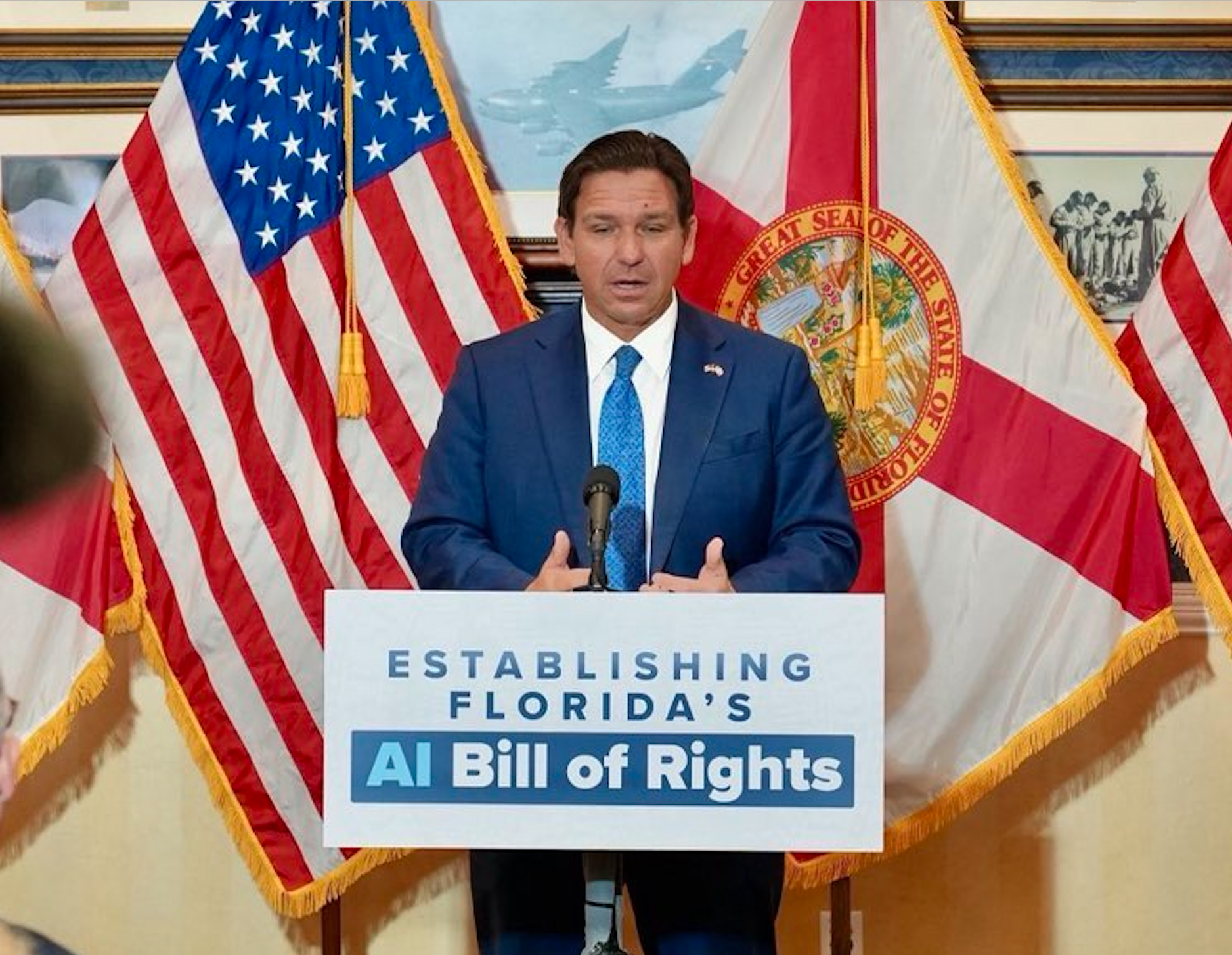
Florida Gov. Ron DeSantis is pushing for a set of regulations on artificial intelligence in Florida, despite an executive order from President Donald Trump to limit states’ powers to enact such policies. DeSantis this month has unveiled what he called an ‘AI Bill of Rights’.
Though Trump is pushing to restrict states’ rights to regulate AI, DeSantis is confident that the policies he’s proposing will not cause conflict with the federal government. “Even reading it very broadly, I think the stuff we’re doing is going to be very consistent,” DeSantis said, according to Politico. “But irrespective, clearly, we have a right to do this.”
Donald Trump’s Executive Order
Last week President Donald Trump enacted an executive order titled ‘Ensuring a National Policy Framework for Artificial Intelligence’. In the order, he called for the United States to be a global leader in artificial intelligence.
“I revoked my predecessor’s attempt to paralyze this industry and directed my Administration to remove barriers to United States AI leadership,” Trump wrote in the order. “My Administration has already done tremendous work to advance that objective, including by updating existing Federal regulatory frameworks to remove barriers and encourage adoption of AI applications across sectors.”
The United States is presently far outpacing any other nation in both government and private investment in AI.
Trump also called on U.S. Attorney General Pam Bondi to create an AI Litigation Task Force which would sue states who enacted laws which are inconsistent with the goal to “sustain and enhance the United States’ global AI dominance through a minimally burdensome national policy framework for AI”, as defined in Section 2 of the order.
Bondi’s task force seems poised to battle it out in court with states who’ve already taken steps to regulate artificial intelligence. According to the International Association of Privacy Professionals (IAPP), these states include California, Colorado, New York, Texas, and Utah. State AI regulation seems to transcend political affiliation…for now.
The Ron DeSantis ‘AI Bill of Rights’
“Our AI proposal will establish an Artificial Intelligence Bill of Rights to define and safeguard Floridians’ rights—including data privacy, parental controls, consumer protections, and restrictions on AI use of an individual’s name, image or likeness without consent,” DeSantis said earlier this month.
Though he’s indicated he’s not picking a fight with Trump’s Justice Department, Gov. Ron DeSantis’ sweeping list of proposed AI regulations would transform the role it plays in Florida’s digital economy.
DeSantis shared the following graphic outlining his plans for AI regulation.

Alongside DeSantis’ proposal, the Florida legislature is currently considering a policy requiring insurance companies to deny claims only using a ‘qualified human’, and not an AI program or algorithm. This builds upon one of DeSantis’ nine policy proposals.
The Florida governor is also pushing back against the idea of Congress passing regulations on state governments that carry more power than Trump’s executive order.
“Congress hasn’t proposed any coherent regulatory scheme but instead just wanted to block states from doing anything for 10 years, which would be an AI amnesty,” DeSantis said on social media. “I doubt Congress has the votes to pass this because it is so unpopular with the public.”
AI, Your Utility Bill, and Emissions
One of the most tangible impacts the rise of artificial intelligence has had on the American consumer is one Gov. DeSantis touched on toward the end of his proposals: the rising costs of utilities due to AI data processing.
The amount of electricity needed to facilitate AI models is enormous. Leading AI providers such as OpenAI largely do not disclose the exact energy load required to run their systems, with that information being protected as a trade secret.
Still, we do have an indication of how AI is causing Americans’ bills to go up. According to the Energy Information Administration (EIA), artificial intelligence is causing electricity costs to start rising at a higher rate than inflation. That hasn’t happened in decades. The retail price of residential electricity reportedly increased by 7.4% from September 2024 to September 2025.
Also of concern is the carbon emissions being created by AI processing centers. According to a study by the Massachusetts Institute of Technology (MIT), one supercomputing center in Memphis, Tennessee is operating using methane gas generators which are allegedly in violation of the Clean Air Act of 1963. That facility is being run by Elon Musk to facilitate X, his social media giant which integrates the AI model known as Grok.
Because of the need to run AI data centers uninterrupted year-round, the facilities tend to rely on fossil fuels for 60% of their energy. This is supplemented by 20% nuclear energy and 20% assorted renewable energy, according to MIT’s report.
Artificial intelligence is not only dependent on high-pollution energy sources, it uses an increasingly massive amount of electricity. Data centers accounted for 4.4% of the total electricity consumption in the United States as of 2023, with that number projected to triple by 2028. That increased strain is already leading to a higher demand for electricity, and thus higher utility rates for everyday Americans.
“By 2030-2035, data centers could account for 20% of global electricity use, putting an immense strain on power grids,” said Mahmut Kandemir, Professor of Computer Science and Engineering at Penn State University.
DeSantis and Trump’s Contrasting Priorities
Where one man sees concern, another sees opportunity. The tone of President Donald Trump’s statements on artificial intelligence indicate he intends to seize the chance for the United States to become a global leader in AI. As this technology becomes an increasingly enormous part of the global economy, it presents a new and vital battleground for America’s economic rivalry with China.
Meanwhile, Gov. Ron DeSantis is voicing a focus on the effects AI could have on everyday Floridians. What could stimulate the economy on the national and global scale DeSantis argues could create crises of privacy, cost of living, and security.
Though the two leaders have yet to posture themselves in direct opposition to one another, the prevailing response to the rise of AI will have massive implications in American life for decades to come. And with the issue not yet bound by the polarization of hyper-partisanship, prominent elected officials within the same party still have the political capital to battle it out on AI without risking partisan ostracization.
The fates of Trump’s executive order and DeSantis’ AI Bill of Rights may already be one of the most important political storylines for Floridians and Americans in 2026.