
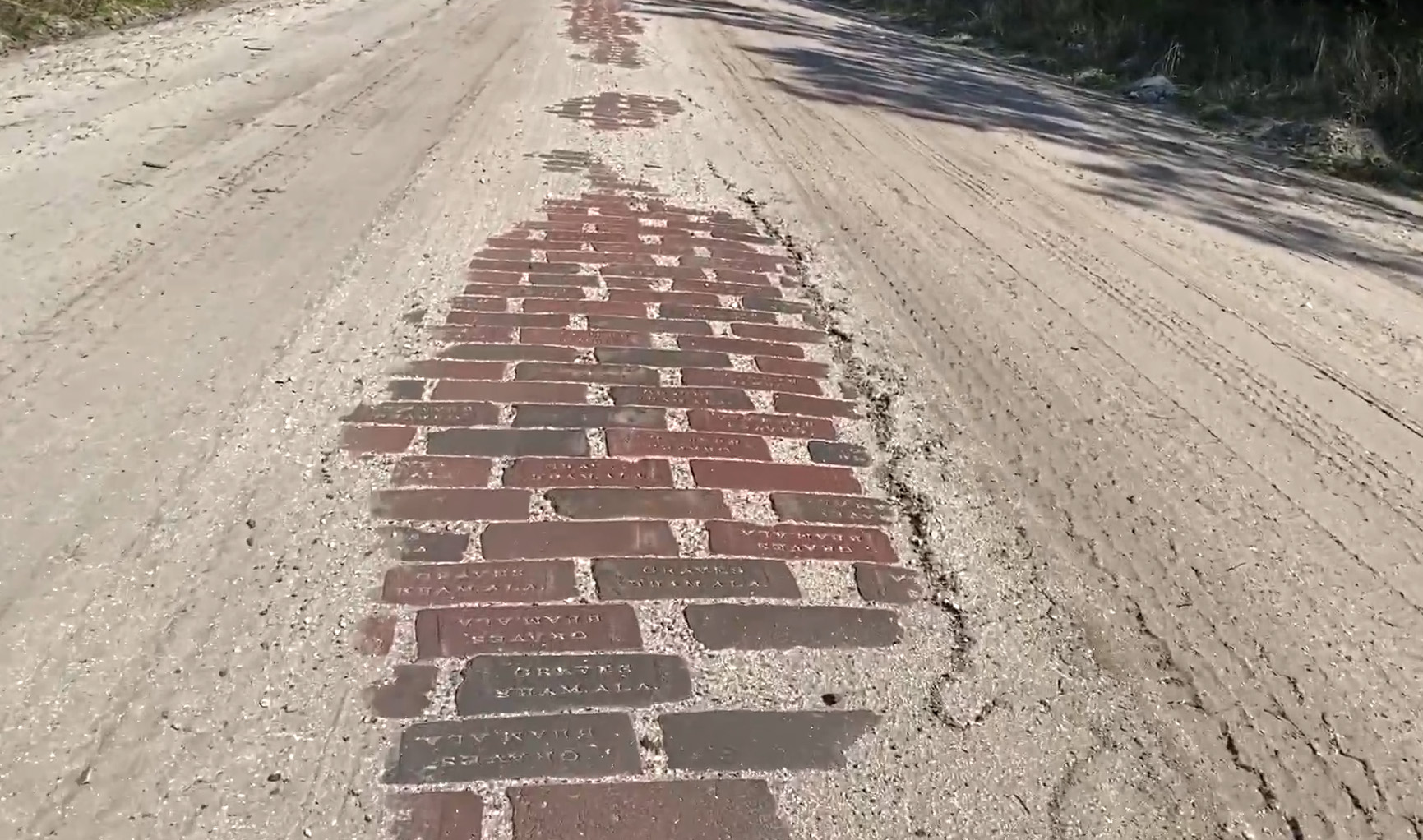
Drive a few miles west of Bunnell on County Road 13, past the small farms and quiet crossroads of Espanola, and the pavement under your tires gives way to brick. The bricks are rust-red, weathered by more than a century of Florida sun, and stamped on their faces with the words “GRAVES B’HAM ALA” for the Birmingham, Alabama company that produced most of them. The road narrows to nine feet wide, barely enough for a single vehicle. If another car appears coming the other way, one of you will need to pull off into the scrub to let the other pass.
This is the Old Brick Road, one of the few remaining stretches of the original Dixie Highway anywhere in Florida, and possibly the longest preserved section in the entire state. It runs roughly nine miles north from Espanola through the scrub forests and pine flatwoods of Flagler County, crossing the St. Johns County line and continuing for two more miles to County Road 204 near the former settlement of Spuds. It is older than Flagler County itself. It is listed on the National Register of Historic Places. And in 2025, it is once again at the center of a fight over whether modern development can coexist with one of northeast Florida’s most distinctive historical landmarks.
This is the story of how the Old Brick Road came to be, why it survived when nearly every other stretch of the Dixie Highway was paved over or destroyed, and what happens to it next.
A Road Built Before the County Existed
The story of the Old Brick Road begins in April 1914, when Isaac I. Moody, the Bunnell-area land developer who would later go on to found Flagler Beach, announced the approval of a $650,000 bond issue for a new highway to connect Hastings in St. Johns County south through Espanola to Bunnell, and then east to Ocean City Beach, the coastal settlement that would later be renamed Flagler Beach.
The timing was significant. Flagler County did not yet exist. The land that would become the county was still divided between St. Johns County to the north and Volusia County to the south. The bond issue was a joint effort of those two counties to build a modern paved road through what was then sparsely settled wilderness, much of it covered in dense Big Cypress Swamp and Pringle Swamp wetlands.
Construction began in 1914 and major paving was completed in 1915 by the Wilson Company, with significant assistance from the McCrary Company for the section through Espanola. The engineers laid the road parallel to the Florida East Coast Railway tracks, which had run through the area since the late 1880s. In Espanola, the highway followed First Street West, an alignment that required general store owner W.N. Mattox to relocate two of his buildings out of the right-of-way after a dispute that was eventually resolved by withholding $2,000 of the McCrary Company’s final payment.
The pavement was made of vitrified bricks, primarily from the Graves Brick Company of Birmingham, Alabama, with some bricks supplied by the Southern Clay Manufacturing Company of Tennessee. The road was nine feet wide, with curbstones on either side. After laying the bricks, the contractors used a steam-powered road roller to smooth the surface, replaced any broken bricks, and added shell to the shoulders.
When Flagler County was formed in 1917 by carving territory from St. Johns and Volusia, completing the roadway was one of the new County Commission’s first official actions. The remaining work was done in part by convict labor, a common practice in early 20th-century Southern road construction.
The Old Brick Road was the first grouted brick road built in Florida, according to historical records.
The Dixie Highway Vision
The Old Brick Road was not just a local project. It was a segment of the Dixie Highway, a massive private-public partnership organized in 1914 to connect the Midwest with Florida. The Dixie Highway was the brainchild of Carl G. Fisher, the entrepreneur who had previously founded the Indianapolis Motor Speedway, where the famous “brickyard” track gave him both the experience and the inspiration for building large-scale paved roads.
Fisher’s Dixie Highway Association brought together state governors, business leaders, and local governments from ten states to plan and fund a network of paved roads stretching from Chicago to Miami. On April 3, 1915, the governors of the participating states met in Chattanooga, Tennessee, and each appointed two commissioners to determine the route. At its peak, the Dixie Highway network covered more than 5,000 miles of paved road across ten states.
For Florida, the Dixie Highway was transformative. Before the road was completed, automobile travel between northern cities and Florida’s east coast was virtually impossible. After it was completed, “Tin Can Tourists” in Model T Fords began driving down from as far away as Chicago to vacation in what was, for many of them, an exotic tropical wilderness.
One historical record from 1915 documented 453 cars using the Dixie Highway in Florida during a single September. Among the early travelers were Henry M. Leland, president of the Cadillac Automobile Company, who drove one of his new Cadillac Eights between Jacksonville and Daytona Beach in 1916, and J.F. Belland of Washington, D.C., who walked the Dixie Highway between Hastings, Espanola, and Bunnell on a 1915 publicity tour of the United States. The Graham brothers, automobile dealers from Maine, drove the route in December 1915 in one of their new touring cars.
Espanola, situated roughly midway along the brick-paved section, became a key rest stop. The small town had a hotel, restaurant, barbershop, post office, and several other businesses. The arrival of the Dixie Highway turned what had been a remote turpentine and farming settlement into a brief but real tourist destination.
The Road’s Brief Heyday and Long Decline
The boom did not last long.
When U.S. Highway 1 was completed from St. Augustine to Bunnell in 1926, the Dixie Highway through Espanola was effectively bypassed. The new road was wider, smoother, and offered a more direct route between St. Augustine and the southern coast. Tourists shifted to the new highway almost immediately. The hotels, restaurants, and businesses in Espanola began to close. The town began its long, slow fade from a real community to the quiet handful of homes and small farms it remains today.
The Dixie Highway Association itself was disbanded in 1927, with much of the original network absorbed into other state and federal routes. Throughout the late 1920s and 1930s, most of Florida’s brick Dixie Highway sections were either torn out and paved over with asphalt or simply abandoned. The brick segment from Bunnell east to Flagler Beach was destroyed and replaced with what is now State Road 100. Many of the salvaged bricks were given to local settlers, who used them for fireplaces, patios, and small paving projects across Flagler County.
The Espanola-to-Spuds section survived primarily because nobody bothered to remove it. The route passed through some of the least developed land in northeast Florida. Logging trucks and the occasional curious motorist became its main users. The road remained a state-maintained route until the 1960s, when responsibility reverted back to Flagler County.
Through the second half of the 20th century, the Old Brick Road sat in the scrub forests of west Flagler County and southern St. Johns County, slowly being worn down by logging trucks but otherwise mostly forgotten.
National Register Status and the GRAVES Bricks
On April 20, 2005, the Dixie Highway-Hastings, Espanola and Bunnell Road was added to the U.S. National Register of Historic Places, formally recognizing its significance as one of the few remaining segments of the original brick Dixie Highway anywhere in Florida. Other surviving brick segments exist near Maitland (around Lake Lily), in Hobe Sound, and a small marker section near Loughman on the Osceola-Polk county border, but none approach the length of the Flagler-St. Johns stretch.
According to Flagler County Attorney Sean Moylan, the Old Brick Road is “the longest such road in the state of Florida today.”
The Old Brick Road is also part of Florida’s Heritage Crossroads, a network of designated historic routes that runs through Flagler, Volusia, and St. Johns counties.
The most distinctive physical feature of the road is its bricks themselves. The vast majority of the bricks were manufactured by the Graves Brick Company of Birmingham, Alabama, and many are stamped with the words “GRAVES B’HAM ALA.” A smaller number of bricks were produced by the Southern Clay Manufacturing Company of Tennessee and bear that company’s name. The bricks have darkened over the past 110 years from their original rust-red to a deeper rusty brown, and some have cracked, shifted, or sunk into the underlying roadbed.
Removing bricks from the road is illegal. Signs at the southern entrance to the road in Espanola read “Travel at own risk” and “Removing Bricks is Illegal.” Despite the prohibition, some bricks have been salvaged over the years for use in local projects. The gymnasium at Bunnell Elementary School was built using bricks originally from the Old Brick Road, a piece of architectural recycling that has its own preservation history.
Driving the Road Today
The Old Brick Road is open to the public and can be driven from end to end. The southern entrance is accessible from Espanola via County Road 13, just north of Bunnell. Take County Road 13 to Espanola, turn right onto the paved road, and after roughly a quarter-mile the asphalt ends and the brick begins. The road continues north for approximately 9 miles, crossing the St. Johns County line and ending at County Road 204 near Flagler Estates.
Driving it requires some preparation. The road is 9 feet wide, which means it accommodates only one vehicle at a time. If another car approaches from the opposite direction, one of you will need to pull off the road. The surface is uneven, with bumps, occasional sand drifts, and sections damaged by logging truck use. Most travel writers and visitors recommend driving the road in a vehicle with reasonable ground clearance, such as a pickup truck, SUV, or sturdy passenger car. The road has been driven in standard passenger cars including Toyota Corollas and Honda HRVs, but slowly and carefully.
Most days, you will not encounter another vehicle. The road runs through scrub pine and palmetto, with virtually no development for the entire 9-mile stretch. The setting is genuinely transportive. With a little imagination, the experience approximates what it might have been like to drive the Dixie Highway in the 1910s and 1920s, when this segment was the only paved route through this part of Florida.
For visitors interested in the broader historical context, Bulow Plantation Ruins Historic State Park is a short drive south of Espanola, and Washington Oaks Gardens State Park is east along the coast. The Old Brick Road forms a natural part of a half-day or full-day Old Florida historical driving tour.
The Modern Threat
In February 2025, the Old Brick Road became the subject of renewed attention at the local government level. Flagler County is actively exploring ways to protect the road from increasing threats, particularly from logging trucks and the eventual development of the surrounding land.
The threat is significant. The 22,000-acre area west of U.S. 1 that includes much of the surrounding land is slated for a major development by Raydient, the real estate development arm of timber company Rayonier. The proposed Master Planned Development would build up to 22,000 homes in the area over the coming decades. Raydient’s current operations on the land include active logging, and logging trucks are the primary users of the Old Brick Road today. According to Flagler County officials and observers, the logging trucks have caused significant damage to sections of the historic pavement.
In addition to the development pressure, the county has been negotiating with Raydient and the City of Palm Coast over a joint agreement that would have allowed several at-grade crossing points across the Old Brick Road for new infrastructure. Crossings would require removing or burying brick in those locations, with corresponding damage to the surrounding roadbed. The Flagler County Commission rejected key parts of the joint agreement, citing concerns about preserving the road’s historical integrity.
In May 2025, Palm Coast Mayor Mike Norris asked the Palm Coast City Council to support a memorandum of agreement with Raydient that would grant the Palm Coast Historical Society and the Flagler County Historical Society access to study the 22,000-acre development area for historic sites, with the Old Brick Road as a central concern. The council unanimously approved Norris’s request.
According to City Attorney Sean Moylan, the county’s preferred approach is to “work with landowners such as Rayonier, and developers, to carve out an alternate road to carry logs between CR 204 in St. Johns and Espanola.” A connection from the development to the Palm Coast Industrial Park near Matanzas and U.S. 1 would be a logical alternative route for logging traffic, allowing the Old Brick Road to be preserved as a historical and recreational landmark rather than a working logging route.
As of mid-2025, the future of the road remains a work in progress. The county, the city, the developer, and the historical societies are all engaged in ongoing negotiations about how to balance development with preservation.
Why the Old Brick Road Matters
The Old Brick Road is one of those rare pieces of American infrastructure that has survived almost entirely by accident. The road was not preserved deliberately. It was simply ignored long enough that it became too historically valuable to destroy. By the time anyone thought to protect it, it had become one of the last remaining examples of its kind in the country.
That accidental preservation is part of what makes it special. Visitors who drive the road today are not walking through a sanitized historic site or a reconstructed museum exhibit. They are driving on the same bricks that Henry Leland’s 1916 Cadillac Eight rolled over on its way to Daytona Beach, that J.F. Belland walked on his 1915 publicity tour, that the Tin Can Tourists in their Model T Fords used to reach what was, for most of them, the first paved road they had ever seen in the South. The bricks are imperfect, weathered, and authentic. The experience is the closest thing in Florida to time travel.
The Old Brick Road also tells a specific Florida story. It is the story of a road built before the county existed, by two counties working together, with bonds approved by a man who would later found a beach town, using bricks made in Alabama, paved by a steam roller, partly by convict labor. It is the story of a road that briefly transformed a rural northeast Florida community into a tourist stop and then watched that community fade when a newer, faster road took its place. It is the story of a road that survived neglect, logging trucks, hurricanes, and now active development pressure.
It is also a road that may still be lost. Despite the National Register listing, despite the Heritage Crossroads designation, despite the recent county and city attention, the Old Brick Road remains vulnerable. The bricks are loose. The roadbed is sinking in some sections. Logging trucks still use it. Development is coming. Whether the road survives another century depends on decisions being made right now by Flagler County officials, the Palm Coast City Council, the Florida Department of Transportation, Raydient and Rayonier, and the historical societies trying to ensure the road’s continued protection.
For now, the bricks are still there. The “GRAVES B’HAM ALA” stamps are still visible. The road is still drivable. And anyone who wants to experience a stretch of authentic, unsanitized Old Florida history can still take County Road 13 north out of Espanola, watch the pavement give way to brick, and drive the nine miles that the Tin Can Tourists drove a century ago. Just slowly. And with a little luck, alone.
Sources
[1] Flagler County Historical Society. “The Old Brick Road.”
[2] Wikipedia. “Dixie Highway-Hastings, Espanola and Bunnell Road.”
[3] FlaglerLive. “Flagler County Seeks to Protect Old Brick Road from Logging Trucks and Palm Coast Development.” February 13, 2025.
[4] Historical Marker Database. “Old Brick Road Historical Marker.”
[5] Florida Backroads Travel. “Espanola, Florida and the Old Brick Road.”
[6] Abandoned Florida. “Visit the Historic Old Dixie Highway.”
[7] Florida Traveler. “Florida’s Old Brick Road – The Dixie Highway.” September 20, 2023.
[8] National Register of Historic Places, Reference Number 05000378, listed April 20, 2005.