

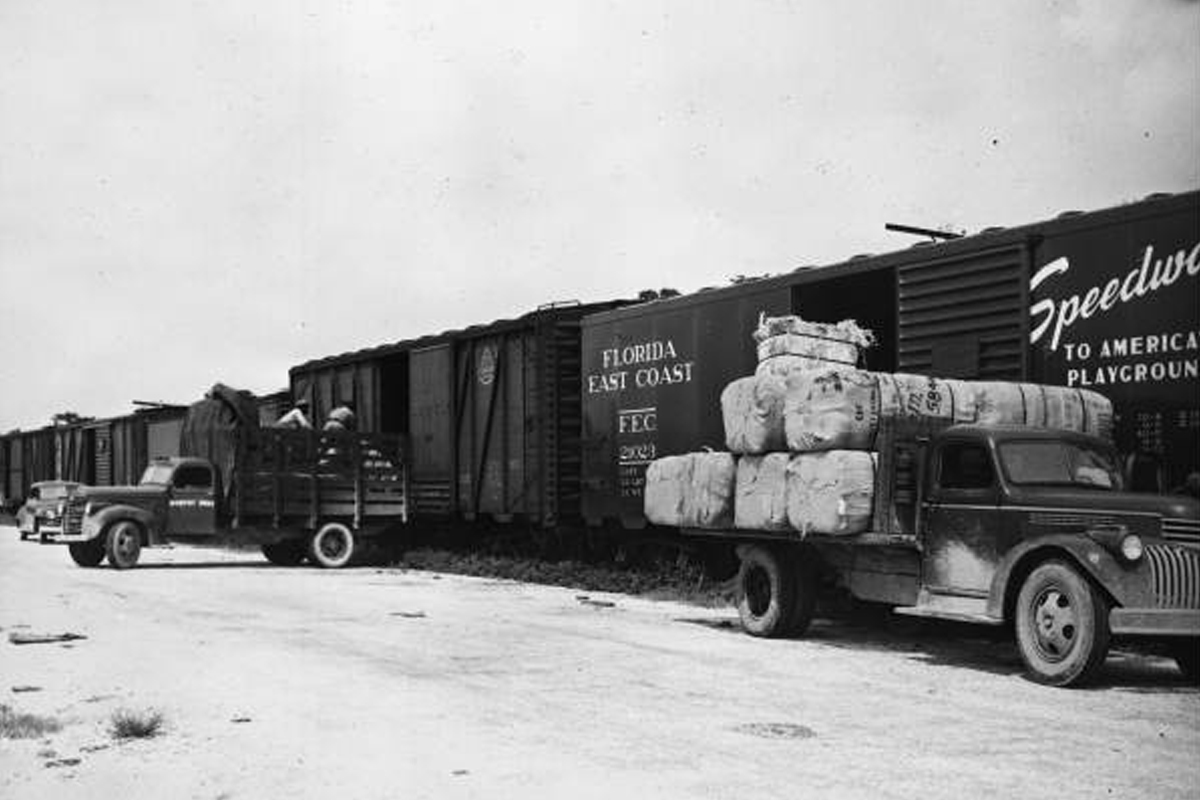
Modern Flagler County has a quiet relationship with the Florida East Coast Railway. Trains still rumble through Bunnell every day, hauling freight between Jacksonville and Miami on a route Henry Flagler first pieced together in the 1880s. Most residents barely notice. The crossings flash their lights, the locomotives blow their horns, and the rest of the county goes about its business.
But the relationship was not always so quiet. For nearly four decades, from roughly 1888 to 1925, the Florida East Coast Railway was the single most important institution in what would eventually become Flagler County. The railroad determined which towns existed and which didn’t. It shaped the county’s economy, its commercial geography, its labor patterns, and its political center. It made Bunnell the county seat. It supported lost towns like Korona, Espanola, Dupont, and Favoretta. It hauled the cypress, the turpentine, the citrus, the potatoes, and the cattle that the local economy depended on. It carried in the families who would homestead the area and the speculators who would attempt to sell it.
And then, in 1925, the railroad rerouted itself, and a quarter-century of carefully built local commerce began to disappear.
This is the story of the Florida East Coast Railway in Flagler County, the rise of the railroad era, the lost towns it created, and the rerouting that ended the old order forever.
Before the Railroad
Before Henry Flagler arrived, the land that would become Flagler County was almost entirely cut off from the broader American economy. The Atlantic coast was wild and largely undeveloped. The interior was pine forest, swamp, and isolated cattle ranches. There were no significant ports, no major towns, and no reliable way to move goods to or from northern markets.
The few settlers who had come to the area in the late 19th century survived on a combination of cattle, citrus, small-scale farming, and turpentine harvesting. Most goods moved by boat along the Intracoastal Waterway or by horse-drawn wagon over the few primitive roads. Letters and newspapers arrived erratically. The region’s economic potential was real but locked behind a transportation bottleneck that no individual settler or local government could break.
That changed when Flagler began assembling the railroad that would eventually become the FEC.
The Flagler Era Begins (1885 to 1888)
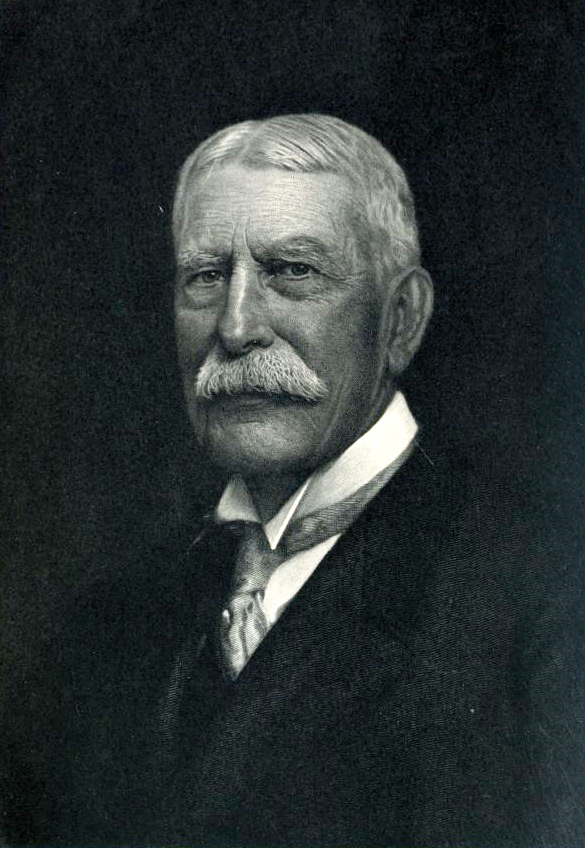
Henry Morrison Flagler, the Standard Oil co-founder turned Florida developer, arrived in St. Augustine in 1883 with his second wife Ida Alice. He fell in love with the old Spanish city and decided to build a grand hotel there, the Hotel Ponce de Leon, which would eventually open in 1888. Flagler quickly realized that his hotel would fail without reliable rail access, and so he began acquiring the small, undercapitalized railroads that already existed in the area.
The earliest of these was the St. Johns Railway, originally chartered in 1858 and running between St. Augustine and a steamboat landing on the St. Johns River at Tocoi. Flagler acquired it around 1885. Over the next several years, he also acquired the St. Augustine and Palatka Railway, the St. Johns and Halifax River Railroad, and others. By 1888, he had standardized the gauges of the various lines and was operating them as a single system.
That 1888 date is the start of the Flagler era as it relates to the future Flagler County. From St. Augustine, the unified railroad now ran southwest to East Palatka on the St. Johns River, then turned back southeast through what is today Hastings, San Mateo, and into the area that would become Bunnell, before continuing on to Daytona. This circuitous inland route, with its detour to East Palatka, was the original main line. It would remain the main line for the next 37 years.
The route was set. The trains were running. And along the line, in the dense pine forests and scrub of what was still, technically, southern St. Johns County and northern Volusia County, settlements began to spring up.
The Birth of Bunnell (1897 to 1903)
The most consequential settlement on the new railroad in what would become Flagler County was the small stop the FEC simply called Bunnell Stop.
In late 1897, a man named Alvah Alonzo Bunnell arrived from somewhere north and established a cypress sawmill next to the FEC tracks. The location was strategically perfect. Flagler’s wood-burning steam locomotives required an enormous, steady supply of cypress and pine to keep moving. The land around Bunnell’s chosen site was rich in exactly the kind of timber the railroad needed. Bunnell built his mill, then a small store to serve it, and signed a supply contract with the FEC.
The arrangement worked. Within a few years, Bunnell Stop appeared on the railroad’s official maps. The Florida East Coast Railway’s own infrastructure investments encouraged the settlement to grow. By 1903, the community had a U.S. Post Office. By 1909, Isaac Moody, J.R. Sloan, and J.F. “Major” Lambert had formed the Bunnell Development Company to plat streets, sell lots, and recruit settlers from the north. The town was officially incorporated in 1913. By 1917, when the Florida Legislature created Flagler County by combining sections of St. Johns and Volusia counties, Bunnell was the obvious choice for county seat.
None of that would have happened without the railroad. Bunnell didn’t grow up around a river, or a port, or a natural resource that demanded local refining. It grew up around the FEC tracks. The railroad made the town possible, then the town made the county possible, then the county was named after the railroad’s builder.
The original F.E.C. Railway Depot at Bunnell, on the corner of Railroad Street and the surrounding commercial district, became the central commercial structure of the early city. Many of Bunnell’s earliest businesses, including the Bunnell Mercantile Company, the Bunnell State Bank, the Halcyon Hotel, and the lumber mill of Ed Johnson, were located near the tracks specifically because the depot was where commerce arrived and departed.
The Lost Towns the Railroad Built
Bunnell was the most successful settlement to grow up along the FEC’s original mainline through Flagler County, but it wasn’t the only one. The railroad supported a dozen smaller communities, several of which thrived briefly before disappearing entirely after the 1925 rerouting.
Espanola sat on the original mainline northwest of Bunnell. The FEC’s narrow-gauge predecessor, originally built by Utley James White, was eventually purchased by Flagler and converted to standard gauge as part of the FEC system. Espanola grew up around the railroad and the turpentine and stave-mill operations of George W. Deen, Lawrence Sidney Cody, and Joseph Barrett Boaz. By the early 1900s, the town had a hotel, a post office, a garage, a cafe, and a population approaching 100. The Dixie Highway later reached Espanola in 1916, briefly extending its commercial life beyond the railroad. Today, Espanola has fewer than 100 residents, and the FEC tracks no longer run through the area at all.
Korona was established in 1914 by Polish immigrant families recruited from Chicago, Detroit, and other northern cities through advertisements placed by the Bunnell Development Company in The Bunnell Home Builder, a monthly newsletter. The chartered Dixie Flyer train brought Polish prospects from Chicago to Bunnell for $41.89 round trip. Once arrived, the families settled along what was at the time the active FEC mainline route between Bunnell and Daytona. The Polish settlers built St. Mary Catholic Church (now on the National Register of Historic Places), the White Eagle Hotel, and a small farming community that depended entirely on rail access for moving its potatoes, vegetables, and supplies.
Dupont was the home base of Utley James White, a relocated Illinois businessman who built a sprawling lumber operation along the FEC tracks in the early 1900s. White’s mills employed more than 250 Black workers in addition to his white employees, and he built tram roads and a narrow-gauge railroad spur connecting Dupont to Haw Creek and beyond. In 1912, the Dupont Land Company of Scranton, Pennsylvania bought out White’s interests. The Dupont Land Company also operated a 16-room hotel overlooking the railroad tracks, six miles south of Bunnell on what is now U.S. 1, specifically to host prospective land buyers arriving by train.
Favoretta was a smaller town just south of Korona on the FEC mainline. George Moody, the older brother of Flagler Beach founder Isaac Moody, served as the first postmaster and was the most prominent early developer. Favoretta supported lumber and turpentine operations and a sawmill, and depended entirely on the railroad to ship its products to market.
Haw Creek sat on the western edge of the county, connected to the FEC mainline via Utley J. White’s narrow-gauge railroad through Dupont. All the bridge timbers for the Florida East Coast Railway’s Key West Extension, completed in 1912, were cut from the Haw Creek section and manufactured in White’s mills, then loaded onto trains and shipped south to be installed across the open ocean spans of the Overseas Railroad.
Codyville (now Cody’s Corner) was settled by the Cody brothers, Walter and Larry, who operated a shingle mill there and depended on the railroad for distribution.
Other small settlements that grew along or near the original FEC mainline included Andalusia, Bimini, Black Point, Dinner Island, Mound Grove, Roy, Shell Bluff, Tipperary, and Tomasello. Most are now gone or reduced to a road sign and a handful of homes. Each existed because the railroad existed.
The Economy the Railroad Created
The Florida East Coast Railway in Flagler County was, at its peak, a working-class transportation backbone for several intertwined industries.
Cypress and pine lumber moved north on FEC freight trains to feed the construction boom in cities like Jacksonville, Atlanta, and points beyond. The lumber for Flagler’s own Overseas Railroad bridges came from Flagler County mills.
Turpentine and naval stores moved north and to seaport facilities to supply the broader American chemical and shipping industries. The turpentine industry was one of the largest employers in the county through the early 1900s, with camps at Bulow Still, Deen Still, and St. Joseph Still all dependent on FEC connections.
Citrus and potatoes moved north to feed urban markets in the Northeast and Midwest. Flagler County’s potato economy in particular was significant enough that the county seal still features a potato to this day. The crops moved on FEC refrigerated cars to reach markets that would have been unreachable in any reasonable shipping window without the railroad.
Cattle moved north on dedicated cattle trains to packing plants in Jacksonville and Georgia. The Florida cracker cattle ranching tradition predated statehood, but it was the railroad that made the industry economically viable at scale.
Settlers and visitors moved south on passenger trains, drawn by aggressive marketing campaigns from the Bunnell Development Company, the Dupont Land Company, the Florida Farms Development Company, the Bulow Cypress Company, and other speculators. Many arrived planning to visit and stayed to homestead. Many more bought parcels by mail without ever visiting and resold them years later.
By 1923, the FEC was running five daily passenger trains in each direction between Jacksonville and Miami. By 1924, that had increased to eight. Two of those daily trains, the Havana Special and the Key West Express, continued all the way to Key West.
This was the peak of the railroad’s importance to Flagler County. It would not last.
The 1925 Moultrie Cutoff
Throughout the early 1920s, the Florida land boom drove unprecedented traffic on the FEC. The railroad was overwhelmed. Trains backed up. Sidings were inadequate. The aging single-track main line, with its inland detour to East Palatka and back, was a bottleneck in an increasingly capacity-constrained system.
The FEC’s solution was dramatic. In 1925, the railroad completed the Moultrie Cutoff, a 29-mile, almost arrow-straight new line connecting St. Augustine directly to a point just north of Bunnell. The cutoff bypassed the entire inland detour through East Palatka and shaved 20 miles off the main line distance.
For the FEC’s mainline operations, the Moultrie Cutoff was a triumph. The system gained capacity, speed, and reliability all at once. Through trains between Jacksonville and Miami could now run a meaningfully shorter and faster route. Combined with the 1926 double-tracking project that added a second mainline track from Jacksonville to Miami, the Moultrie Cutoff transformed the FEC into a modern Class I railroad capable of handling the traffic that the Florida land boom and the post-WWII tourism boom would generate.
For the small towns that had grown up along the original mainline through East Palatka, San Mateo, and parts of inland Flagler County, the Moultrie Cutoff was a disaster.
The original main line through East Palatka was downgraded to branch status, called the Palatka Branch. The trains continued running, but at much lower frequency and with declining commercial significance. Rails between Bunnell and San Mateo were pulled up shortly after 1925, severing several of the small mill and turpentine settlements from the broader rail network entirely. Towns that had existed primarily because the FEC mainline ran through them found themselves on a slowly-dying secondary line. The bridge over the St. Johns River near Palatka was eventually removed in 1942 as a navigational hazard. The track from East Palatka to Bunnell was abandoned in 1972. Track from East Palatka to Hastings was abandoned in 1983. The remainder from Hastings was abandoned in 1988.
The settlements suffered accordingly. Espanola, Dupont, Favoretta, Codyville, Tipperary, Andalusia, Bimini, and most of the other small communities that had grown up in the railroad era began their long, slow decline almost immediately.
A Quirky Visible Reminder
One genuinely fascinating physical artifact of the 1925 rerouting is still visible to anyone paying attention to FEC infrastructure today.
The mileposts on the modern FEC main line still reflect the original 1888-to-1925 route through East Palatka. When the Moultrie Cutoff was added in 1925, the FEC chose not to renumber its mileposts. The result is that, traveling south through Flagler County today, the mileposts abruptly jump from milepost 67 to milepost 86.4 at Bunnell, accounting for the 20 miles of railroad that no longer exist on the current route.
That 20-mile gap in the milepost numbers is the railroad’s permanent monument to the towns the rerouting left behind. Engineers operating FEC freight trains today still reference those original mileposts, more than a century after the last train ran the East Palatka detour.
What Survived
Bunnell survived the Moultrie Cutoff. The new line passed directly through the town, in fact slightly closer to the central business district than the original route had. The FEC Railway Depot at Bunnell continued operating as the central commercial hub. The railroad’s investments in track, sidings, and signals through Bunnell actually increased after 1925 as the rerouted main line became the busier and more important corridor.
Korona also survived, though just barely. The Polish settlement was located along what became the rerouted main line, so Korona did not experience the dramatic abandonment that Espanola and Dupont did. The town still appears today as an unincorporated community using a Bunnell mailing address, anchored by the historic St. Mary Catholic Church.
Favoretta survived as a place name. The state road sign for Favoretta still stands today on U.S. 1, just south of Korona, marking what was once a real town.
The rest of the lost towns mostly didn’t survive. Espanola continues as a tiny unincorporated community of fewer than 100 residents. Dupont, Codyville, Tipperary, and the others are now barely visible on the landscape, identifiable mostly through historical records, family genealogies, and the occasional state road sign.
The Late Era and Modern FEC
After 1925, the Florida East Coast Railway settled into its modern role: a freight-dominant Class I railroad running between Jacksonville and Miami with the Moultrie Cutoff as its mainline through Flagler County. Passenger service continued for decades but became increasingly secondary as automobile travel and U.S. 1 (completed from St. Augustine to Bunnell in 1926) and later Interstate 95 took over the role of moving people.
The Lehigh Portland Cement Company, which operated a plant on what is today Colbert Lane in Palm Coast from 1952 to 1965, built its own dedicated rail spur in 1953 connecting Flagler Beach to Dorena, just north of Bunnell, as a cement-shipping line. That spur and the cement plant it served are gone now, both casualties of the plant’s 1965 closure. The land was eventually purchased by ITT in 1968 as part of the assemblage that became Palm Coast.
FEC passenger service was discontinued in 1968. Freight service continued throughout the 20th century and into the 21st. The railroad has changed ownership multiple times, including a 2007 acquisition by Fortress Investment Group for over $3 billion. Today, the modern FEC operates as a freight-focused Class I shortline, hauling intermodal traffic, automobiles, and bulk freight between Jacksonville and Miami on essentially the same Moultrie Cutoff route established in 1925. Brightline, the privately-operated passenger service, runs on the southern portion of the FEC tracks and connects Miami, Fort Lauderdale, West Palm Beach, and Orlando, but does not currently serve Flagler County.
What the Railroad Made Possible
It is easy, looking at modern Flagler County with its master-planned communities, its golf courses, its retirement subdivisions, and its booming population, to forget how much of all of this rests on the foundation the Florida East Coast Railway built between 1888 and 1925.
Without the FEC, there would have been no Bunnell. Without Bunnell, there would have been no Flagler County. Without Flagler County, there would have been no organized political and infrastructure foundation for what came next, including the 1969 ITT acquisition that created Palm Coast. The Henry Flagler whose name graces the county did not personally develop the land here, but the railroad his money built ran through here, and the railroad made the county possible in every meaningful sense.
The lost towns the railroad created and then abandoned are part of the story too. Espanola, Korona, Dupont, Favoretta, Codyville, and the others briefly thrived because the FEC mainline ran through them. They declined when the railroad rerouted itself in 1925. Most never recovered. The fact that they existed at all, that real families homesteaded in them, raised children there, built churches there, ran sawmills and turpentine stills and post offices there, is a quiet but consequential piece of Flagler County’s history that depended entirely on Henry Flagler’s railroad.
A small white wooden church in Korona. A boarded-up hotel in Bunnell. A 9-mile stretch of brick Dixie Highway road bypassed by the railroad and then bypassed again by U.S. 1. A milepost gap on a modern freight train route that still reflects a 1925 corporate decision. State road signs marking towns that aren’t really there anymore.
These are the visible traces of the Florida East Coast Railway’s nearly four decades as the institution that built Flagler County. The trains still run through Bunnell every day. Most residents barely notice. But for anyone looking closely, the bones of the railroad era are still here, holding up a county whose modern identity is unimaginable without the rails that came first.