



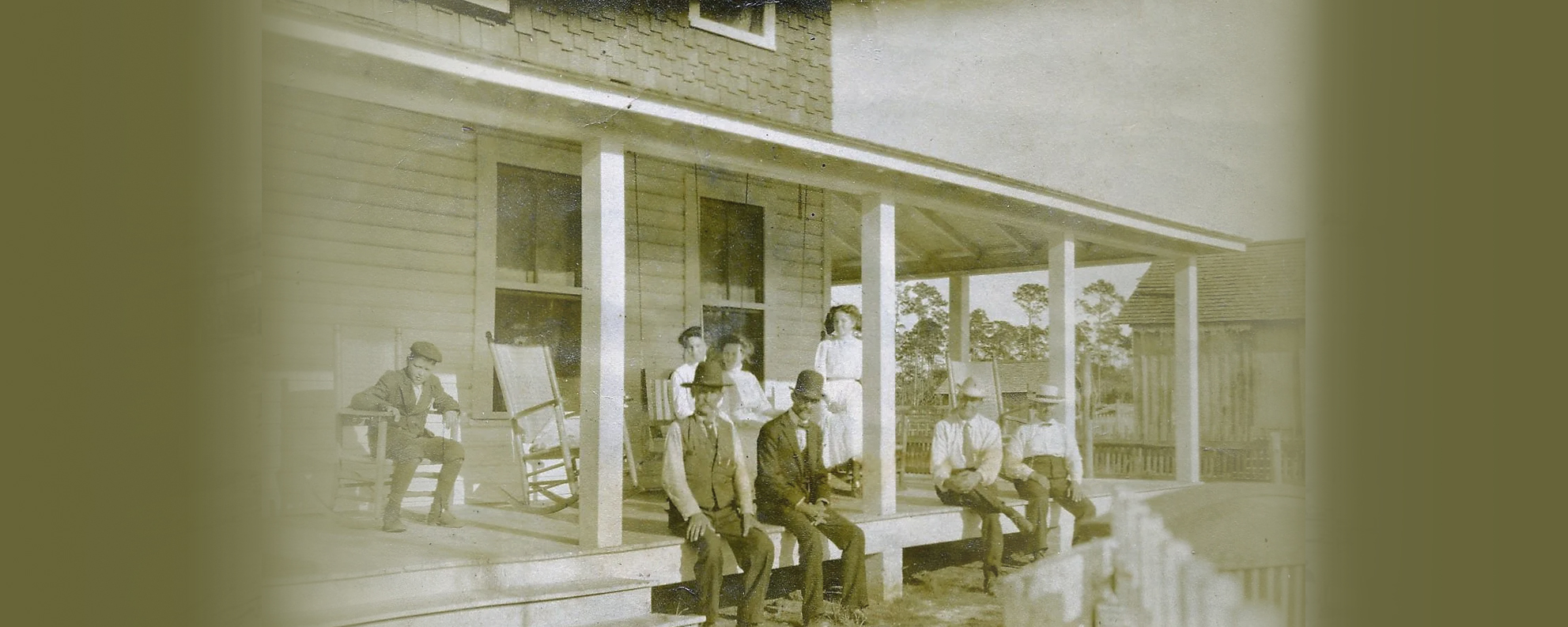
Drive west on Moody Boulevard from Flagler Beach, cross the Intracoastal Waterway, pass through Palm Coast, and keep going. Eventually you’ll reach the four-way intersection where State Road 100 meets U.S. 1 — a quiet crossroads marked by a few low-slung buildings, the historic Flagler County Courthouse, and the kind of unhurried small-town pace that’s increasingly rare in 21st-century Florida.
This is Bunnell. The county seat of Flagler County. The first city in the county to incorporate. The place that, in many ways, started everything.
Bunnell is older than Palm Coast. Older than Flagler Beach. Older than Flagler County itself. Its story stretches back to the late 1800s, when this stretch of Florida was empty pine forest and the only reason anyone passed through was a wood-burning train heading south. The story of how a cypress mill stop on Henry Flagler’s railroad became the political heart of one of America’s fastest-growing counties is one of the more overlooked tales in Florida history. Here’s how it happened.
Before Bunnell: A Land of Trains, Trees, and Turpentine
In the 1880s and 1890s, the area that would eventually become Flagler County was a working landscape. The Florida East Coast Railway, Henry Flagler’s then-expanding rail empire, was pushing south along Florida’s Atlantic spine, connecting St. Augustine to Daytona, then eventually to Palm Beach, Miami, and finally Key West. The trains were powered by wood-burning steam locomotives, which meant the railway needed an enormous, steady supply of cypress and pine to keep moving.
The land between St. Augustine and Daytona was rich in exactly that — vast pine flatwoods, cypress swamps, and unbroken stands of longleaf pine. It was also home to a thriving turpentine industry. Workers tapped pine trees with metal cups (some of which can still be found in the woods today) and collected the resin to be distilled into turpentine, rosin, and other naval stores essential to industries up and down the East Coast.
This was the world Alvah Alonzo Bunnell stepped into in late 1897.
1897: Alvah Bunnell Builds a Sawmill
Alvah Bunnell was 43 years old when he established a cypress sawmill — and shortly thereafter a small store — next to the Florida East Coast Railway tracks in what would eventually carry his name. There was no town. There were no streets. There was just a mill, a store, and a stop on Henry Flagler’s railroad.
Bunnell had an arrangement with the FEC: his mill would supply cypress wood for the steam locomotives that ran north and south through the area. To identify the location for mail delivery, freight, and passenger drop-offs, the railroad called the spot Bunnell Stop. That name appeared on the earliest railroad maps of Florida.
Around 1898, two young men arrived in the area to work in the burgeoning turpentine industry: 24-year-old Isaac I. Moody Jr., from Appling County, Georgia, and 36-year-old Major James Frank Lambert, from South Carolina. Both came to work for George W. Deen, who ran a large turpentine operation in St. Johns Park, just west of Bunnell Stop. Deen had previously worked for Isaac Moody’s father in Georgia and was also president of the St. John’s Park Development Company, which was speculating heavily on local land.
After several years working for Deen — who would later become a Georgia state senator — Moody and Lambert pooled their resources and bought a 30,000-acre tract from him, setting up their own turpentine camp and operation. The names Moody and Lambert would shape Bunnell, Flagler Beach, and the surrounding region for the next century.
1903: A Post Office
By 1903, Bunnell Stop had grown enough to warrant its own United States Post Office. This was the moment the settlement became something more than a railroad waypoint — it became a recognized community, with mail delivery, a name on the federal map, and a small but growing population of mill workers, turpentine laborers, farmers, and merchants.
The local economy was diverse for such a small place. Records from a periodical called the Bunnell Home Builder describe the surrounding farms as small but successful, raising sugar cane, corn, sweet potatoes, cucumbers, and hay. Cattle ranching and citrus were also growing industries. The land that had once been considered worthless swamp was proving productive — particularly once drainage and clearing turned the wettest acreage into farmable ground.
1909: The Bunnell Development Company
The pivotal year was 1909.
That year, Isaac I. Moody, J.R. Sloan, and J.F. “Major” Lambert — by then experienced businessmen with land holdings, capital, and connections — formed The Bunnell Development Company. It would become the foundation of modern Bunnell.
The company began aggressively platting the town, laying out streets, subdividing lots, and selling parcels to incoming residents and out-of-state buyers. They built the first permanent home in town that same year, constructed by the company for J.F. “Major” Lambert. The Lambert House still stands today as the oldest existing building in Bunnell.
1909 also saw construction of the first church in what would become Flagler County. The community was no longer just a railroad stop — it was becoming a town.
By 1910, the Bunnell First State Bank had opened its doors. The bank’s masonry building, constructed that same year, was added to the U.S. National Register of Historic Places in 1992 and remains one of Bunnell’s signature historical structures.
The Bunnell Development Company also built and operated The Bunnell Hotel, later renamed The Halcyon, which could accommodate 75 guests at $3 per day — competitive lodging for prospective land buyers arriving by train from the north. Less affluent visitors could stay at the Pine Grove Inn on the corner of Church Street and Moody Boulevard for $2 per day. The original Halcyon Hotel building, now boarded and fenced, still stands at the corner of Railroad and Lambert Streets — a quiet relic of the era when Bunnell was a destination, not a drive-through.
1913: The Town of Bunnell Is Born
In 1913, the Town of Bunnell was officially incorporated. The community had grown substantially in the decade since the post office opened — enough to warrant municipal government, formal services, and elected officials.
The same family names that had built the town in the 1900s now ran it. The Moody family. The Lambert family. The Deen family. The Knight family. The Holden family. Their descendants still live in Bunnell today, and many of the city’s parks, streets, and public buildings carry their names.
1917: Flagler County Is Created — and Bunnell Becomes the Seat
On June 12, 1917, the Florida Legislature created Flagler County by combining portions of St. Johns County to the north and Volusia County to the south. The new county was named in honor of Henry Morrison Flagler, the railroad and oil tycoon whose Florida East Coast Railway had made the development of this entire stretch of coast possible. (Flagler himself had died four years earlier in 1913.)
The next question was where to put the county seat. Several small communities competed for the designation — Espanola, Dupont, Haw Creek, Bulow, Korona, Favoretta, and the still-unincorporated coastal settlement of Ocean City Beach (later renamed Flagler Beach) all had claims to make. But Bunnell had clear advantages: it was geographically central, it had the strongest commercial base, it sat at the junction of major roadways and the FEC railroad, and it had the existing infrastructure to support government operations.
Bunnell was chosen as the county seat in 1917 — a designation it has held continuously ever since.
1924-1927: A City, a Courthouse, and a Boom
The Florida land boom of the 1920s reached even small inland towns like Bunnell. Prospective buyers poured in from the north, drawn by aggressive marketing campaigns, easy train access, and the promise of cheap Florida land. Speculation ran wild. Plats were drawn. Lots were sold.
In 1924, Bunnell was officially upgraded from a town to a City by the Florida Legislature. The following year, neighboring Flagler Beach was incorporated as well — its residents having just discovered that “Ocean City Beach” was already taken by communities in New Jersey and Maryland.
The biggest physical legacy of the boom era was the construction of the Old Flagler County Courthouse in 1926. Designed by architect Wilbur Talley in the Neoclassical style, the courthouse was officially dedicated on July 28, 1927. Its columns, brick facade, and proud bearing made it the unmistakable centerpiece of downtown Bunnell — and it remains so today, preserved as a historic structure even as a newer courthouse handles modern county functions.
Other buildings from this era still standing in Bunnell include:
- The George Moody House (1917), built in Craftsman style
- The William Henry “Doc” Deen House (1918), a classic frame structure
- The Holden House (1918), a Craftsman bungalow now owned by the Flagler County Historical Society and operated as a museum
- The Little Red School House (1938), constructed by Bunnell High School Future Farmers of America students
Together, these buildings form one of the most intact early-20th-century downtown districts in northeast Florida.
The Quiet Decades: Moonshine, Cattle, and Slow Growth
The Florida land boom collapsed in the late 1920s, and the Great Depression hit Bunnell hard. The town settled into a long, quiet stretch as the regional economy returned to its agricultural roots — cattle, potato farming (Flagler County’s seal still features a potato), citrus, and timber.
The 1920s and 1930s also brought the moonshine era. Flagler County’s rural backwoods, palmetto scrub, and isolated farms made it an ideal location for illegal stills. Bootleggers hid their operations in the dense low-bush palmetto, producing what locals called “low-bush lightning” — and the corridor running from Kissimmee through Flagler County up to St. Augustine earned the unofficial nickname “Bootleggers Paradise.” Local sheriffs spent decades chasing moonshiners, with Sheriff Homer Brooks famously making it his mission in the 1950s and 1960s to stamp out illegal distilling. Stills are still occasionally found in the woods today.
Bunnell’s population in 1920 was just 2,442 — and the entire county wasn’t much larger. The Ku Klux Klan paraded through town in those years warning about “loose women, gamblers, crooks, and bootleggers,” reflecting the social tensions of the era. It was a small, tight-knit, agricultural place where everyone knew everyone — and where the same families had been intermarrying and doing business with each other for two or three generations.
That stayed true for most of the 20th century.
1969: Everything Changes
In 1969, when International Telephone and Telegraph (ITT) and Levitt and Sons began quietly buying up tens of thousands of acres of land east of Bunnell to build the master-planned community of Palm Coast, almost no one in Bunnell could have predicted what was coming. Flagler County’s total population at the time was still under 5,000. Bunnell remained the unchallenged center of county life — its government, its commerce, its largest population center.
That changed quickly. By 1980, Palm Coast had begun to overtake Bunnell as the economic driver of Flagler County, with new housing developments, golf courses, traffic lights, and shopping centers appearing east of I-95. By 1990, Palm Coast’s population had reached 18,556 — already several times larger than Bunnell.
Bunnell didn’t disappear. It remained the county seat. It kept its government functions, its courthouse, its agricultural identity. But the center of gravity in Flagler County had shifted east.
Two natural disasters in the late 1990s underscored Bunnell’s continuing role as the county’s emergency and government hub. In 1985, wildfires burned 24,000 acres in Flagler County and damaged or destroyed 331 homes. In 1998, a far worse fire season led Governor Lawton Chiles to order the mandatory evacuation of all 45,000 Flagler County residents — the first and only time in Florida history that an entire county was evacuated. The 1998 fires burned 82,000 acres and destroyed 263 homes. Through all of it, Bunnell’s government, sheriff’s office, and emergency management infrastructure coordinated the response.
Bunnell Today
The 2020 Census counted 3,276 residents in Bunnell. By comparison, neighboring Palm Coast had crossed 89,000 — and is now well over 110,000. The disparity has become so pronounced that many residents of greater Flagler County rarely have reason to visit the county seat at all.
But Bunnell endures. The historic courthouse still anchors downtown. The Holden House Museum, operated by the Flagler County Historical Society, preserves the city’s past. The Bunnell Railroad Depot Museum tells the story of the Florida East Coast Railway and the cypress mill that started everything. The Old Bunnell State Bank Building still stands at the corner of Moody Boulevard and Bay Street. Family names from 1909 — Moody, Lambert, Deen, Holden — still appear on local mailboxes, business signs, and political ballots.
In 2025, the city hosted its inaugural Bunnell History Day, an event organized by the Flagler County Historical Society and the Palm Coast Historical Society to celebrate the city’s 116-year history. Vendors, historians, musicians, and Native American storytellers gathered at Edward Johnson City Park. A genuine Prohibition-era moonshine still was on display. Residents shared stories. The mayor — Catherine Robinson — spoke about Bunnell’s identity as the “Crossroads of Flagler County,” a nickname adopted in the early 2000s.
Bunnell is the kind of place that’s easy to drive past on the way to somewhere else. But for anyone who stops, talks to the people, walks the historic district, and reads the plaques on the old buildings, the city tells a story that no other community in Flagler County can claim: it was here first. It built the institutions everyone else inherited. It gave Flagler County its government, its courthouse, and its first newspaper. And more than 125 years after Alvah Bunnell first set up his cypress sawmill next to a wood-burning railroad, it’s still here.
A cypress mill, a turpentine partnership, a 30,000-acre land deal, a 1909 development company, a 1926 courthouse, a moonshine era, and a quiet refusal to vanish even as the rest of the county transformed around it — that’s the history of Bunnell. The city that started Flagler County, and the city that, against all odds, is still going.












Wonderful article on the history of Marineland that is posted on May 6/26. However, it states that Georgia Aquarium is the current operator and that is not true. Why not any history of the current owners/operators and how that all happened?
Hey there! We updated the piece with recent developments. We will reach out to do a new article on current operators also!