
The Atlantic Ocean is the world’s longest-running delivery service, and Flagler County’s 19 miles of coastline are one of its more unusual drop-off points. Over the years, the ocean has delivered all kinds of things to local beaches, ranging from the merely interesting (sea pork, mermaid’s purses, the occasional shark tooth) to the genuinely jaw-dropping. The combination of the county’s exposed Atlantic geography, its frequent hurricane impacts, and its location along major maritime routes between South Florida and the East Coast has made Flagler Beach, the Hammock, Painters Hill, and Jungle Hut Park unusually rich hunting grounds for beach mysteries.
Some of these stories are funny. Some are sad. One involves history rising literally out of the sand. One involves cocaine. And one involves the first ever orca stranding in the entire Southeast region of the United States. Here are the strangest things to ever wash up on Flagler County beaches.
1. A 21-Foot Killer Whale at Jungle Hut Park (January 2023)
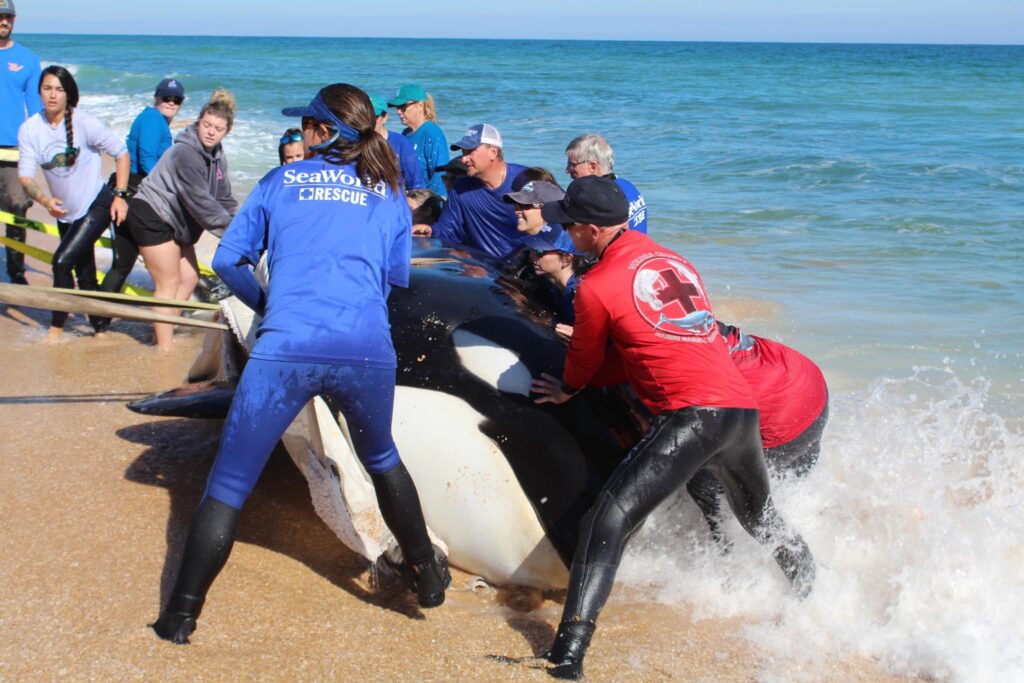
The strangest beach discovery in the modern history of Flagler County happened on the morning of January 11, 2023, when local resident Derek Pence was taking his usual morning walk on the beach near Jungle Hut Park in Palm Coast.
“We saw something large in the water,” Pence later told reporters. “It was about 25-feet offshore, stuck on the sandbar and it was larger than anything I’d ever seen stuck on the sandbar before.”
What he was looking at was a fully grown female orca, also known as a killer whale, approximately 21 feet long and weighing between 5,000 and 6,000 pounds. The whale was estimated to be over six years old and was, according to NOAA officials who arrived on the scene, in “decent body condition.” There were no visible injuries, no rudder marks, no signs of shark attack or boat collision.
The Flagler County Sheriff’s Office, the Florida Fish and Wildlife Conservation Commission, NOAA, and SeaWorld biologists all converged on the beach. Crowds of onlookers gathered to witness what was, by every measure, an absolutely unprecedented event.
“What’s so interesting about this case is that there has never been a reported killer whale stranding in the Southeast region of the U.S. So, this was a first,” said Dr. Erin Fougeres, marine mammal stranding program administrator at the National Oceanic and Atmospheric Administration.
This is worth pausing on. Killer whales are primarily a Pacific Ocean species. They do exist in the Atlantic, but they are vanishingly rare in the southeastern United States. The waters off Flagler County are, by orca standards, the equivalent of a desert. For one to not just appear here, but to actually beach itself in the surf, was, in NOAA’s official assessment, “extremely rare” and the first known event of its kind in the recorded history of the entire region.
Despite hours of effort by biologists to save the animal, the orca did not survive. The Flagler County Sheriff’s Office, with help from SeaWorld and FWC, eventually loaded the 6,000-pound whale onto a truck and transported it to SeaWorld for a necropsy.
The cause of death has never been definitively determined. Marine biologists noted that “we’re starting to see unusual species, species we don’t typically see, here in the South East appearing more and more in sightings and in strandings,” suggesting that broader changes in ocean conditions may be drawing rare species into unexpected waters.
For Flagler County residents who happened to be on the beach that morning, it was the kind of experience that doesn’t repeat. A scene from a documentary, playing out in real life, on the sand at Jungle Hut Park.
2. The Resurrected 1928 Pier (Hurricane Nicole, November 2022)
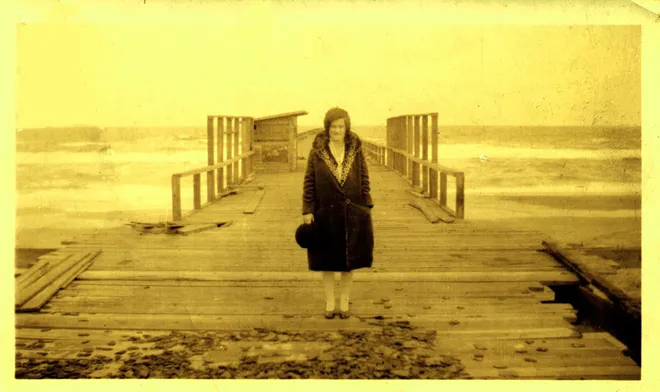
When Hurricane Nicole hit Flagler Beach in November 2022, it stripped the dunes, undermined A1A, and severely damaged the beloved 1928 Flagler Beach Pier. It also did something nobody expected: it raised the dead.
Specifically, it raised six wooden pillars that had been buried in the sand on the north end of Flagler Beach for nearly 80 years.
The pillars turned out to be the remains of what is believed to be the first pier ever built in Flagler Beach, constructed in the 1920s by a local businessman named George Bruner. Bruner’s pier was a private structure, approximately 600 feet long, located on his beachfront property on the north end of town. He charged $10 a year for membership, allowing paying customers to walk out over the Atlantic on what was, at the time, one of the longest fishing piers in northeast Florida.
Bruner’s pier was destroyed by a hurricane in the 1940s. Most of the wooden structure was either washed away or buried in the sand. For decades, the pier existed only in the memories of the oldest Flagler Beach residents and in the historical records of the city.
When Hurricane Nicole stripped the sand from the north end of Flagler Beach in November 2022, the pier rose again.
“I believe it was 600-feet long, and he was a private property owner on the north end,” Flagler Beach Ocean Rescue Director Tom Gillan told FOX 35 Orlando. “He decided to build a pier, and I believe he charged $10 a year for membership for people to walk out on the pier.”
Six wooden pillars, blackened and weathered by 80+ years of saltwater, stood briefly visible above the sand line before being reclaimed by subsequent tides and beach renourishment efforts. Officials urged caution, noting that hurricane-exposed buried structures can pose hazards to beachgoers.
The Bruner pier pillars are likely still there, buried under the sand, waiting for the next major hurricane to strip them visible again. They are, in their quiet way, one of the most haunting beach finds in Flagler County history. A lost piece of the city’s pre-modern era, briefly resurrected by a storm, then buried again by the same forces that built it.
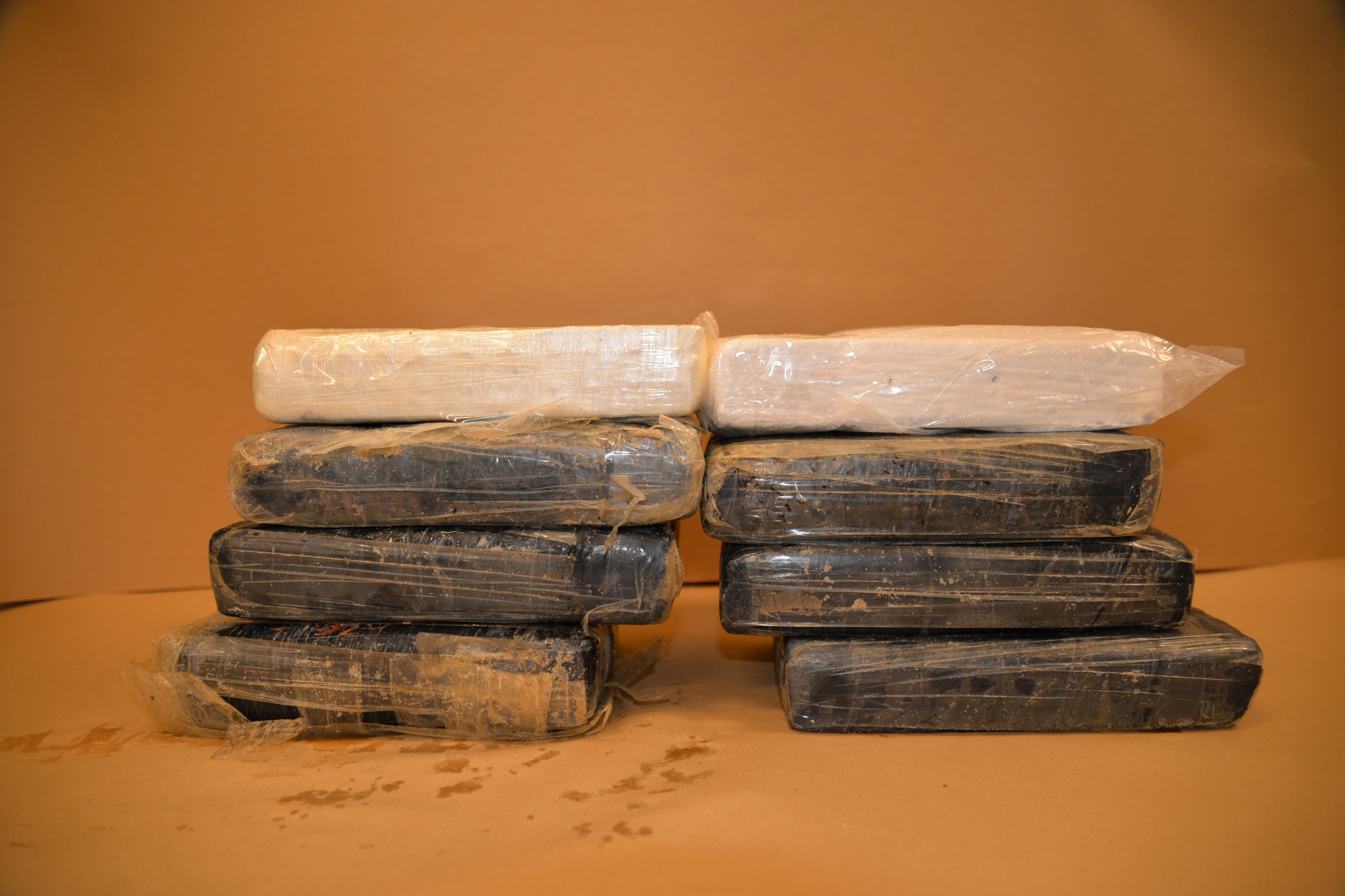
3. The 20 Pounds of Cocaine on Hammock Beach (October 2025)
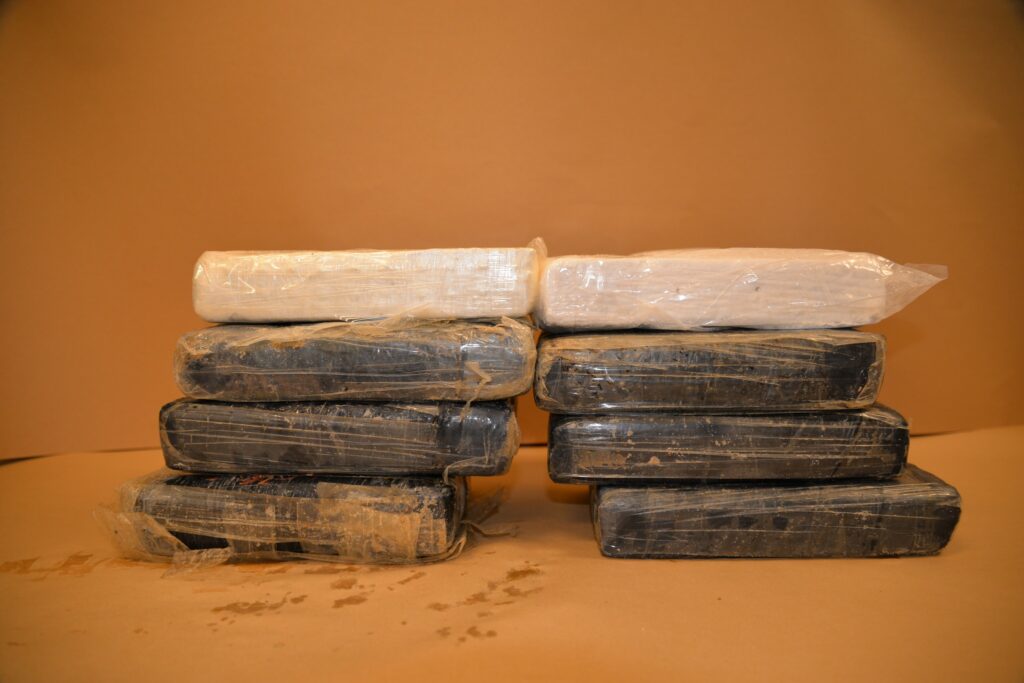
In October 2025, a Flagler County dog walker on Hammock Beach spotted what he initially thought might be a bag of snow.
It was not snow.
The Flagler County Sheriff’s Office responded to the call and confirmed that the suspicious package was actually a bag containing more than 20 pounds of cocaine. The bag had washed ashore on Hammock Beach, the stretch of barrier island shoreline north of Palm Coast and south of Marineland.
The discovery was substantial enough to be classified as a multi-million dollar drug seizure. Twenty pounds of cocaine, depending on purity and street pricing, can be valued anywhere from several hundred thousand to over a million dollars.
Flagler County Sheriff Rick Staly, never one to miss a chance for a memorable quote, addressed the discovery directly:
“We are working with the DEA to determine the source of the cocaine. I commend and thank the resident that called us so we could get this poison off the beach. If you see any suspicious packages on the beach call 386-313-4911. Do not touch it or take it. You could be arrested or worse, like a Cartel coming after you.”
The origin of the cocaine has not been determined. Bales and packages of narcotics washing up on Florida beaches is, unfortunately, not uncommon, particularly along the east coast where Caribbean trafficking routes converge with Atlantic currents. Most discoveries are linked to either smuggling operations that lost their cargo to weather or to deliberate jettisoning by traffickers fleeing law enforcement.
What made the Hammock Beach discovery notable was both the size of the package (20+ pounds is a significant quantity) and the location. Hammock Beach is generally considered one of the more affluent and quieter stretches of Flagler County coastline, home to Hammock Beach Resort, the Hammock Dunes community, and a series of high-end residential developments. Cocaine washing ashore there was a jarring reminder that the same Atlantic currents that bring tourists, pelicans, and shells also bring whatever else happens to be drifting in international waters.
4. The Cage With a Man Inside (July 2021)
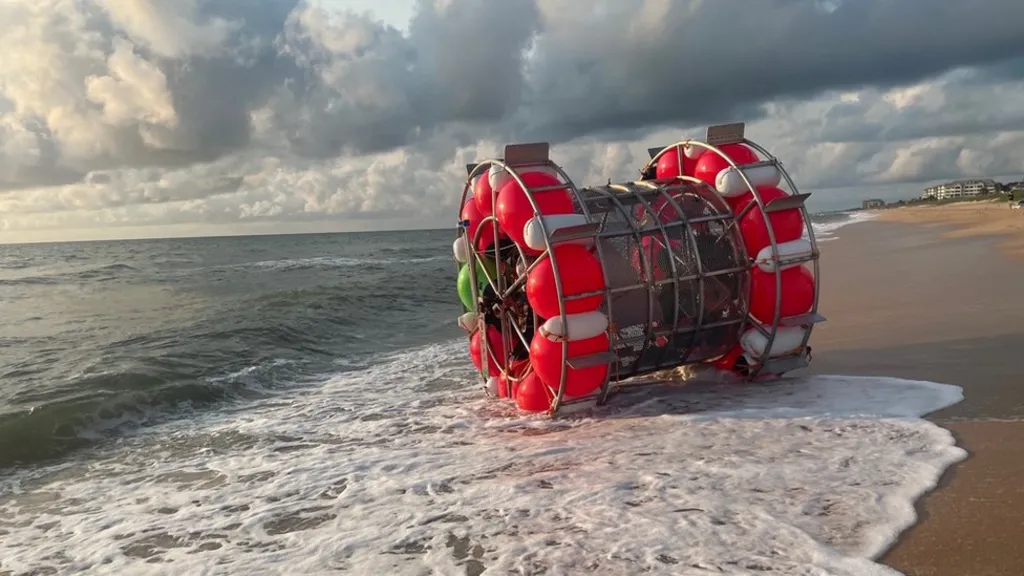
On the morning of July 24, 2021, the Flagler County Sheriff’s Office received a call about an unusual vessel washing ashore in the Hammock area.
When deputies arrived, they found something they had to look at twice.
Floating in the surf was a large cylindrical object with flotation devices on the outside. The structure resembled, as one observer on Facebook put it, a giant lobster trap. It was made of what appeared to be a cage-like metal frame.
Inside the cage was a person.
The Flagler County Sheriff’s Office reported that the person inside the cylindrical vessel was safe and uninjured. The official statement did not identify what, exactly, the person was doing inside the cage-like structure that had floated up onto a Flagler County beach on a Saturday morning in July.
The lack of follow-up explanation has, in the years since, only added to the strangeness of the discovery. Was it a homemade boat? A self-propelled artistic project? Some kind of personal flotation device experiment? An attempt to drift up the East Coast in a homemade pod? The Sheriff’s Office Facebook post simply thanked the responders, confirmed everyone was safe, and moved on.
For locals who saw the photos, the image stuck. A cylindrical metal cage with floats on the outside, a human visible inside, lying in the wet sand at the surf line of one of Florida’s quieter beaches. No explanation. No backstory. Just a strange Saturday morning in the Hammock that nobody has ever fully explained.
5. The Message in a Bottle to a Deceased Son (February 2023)
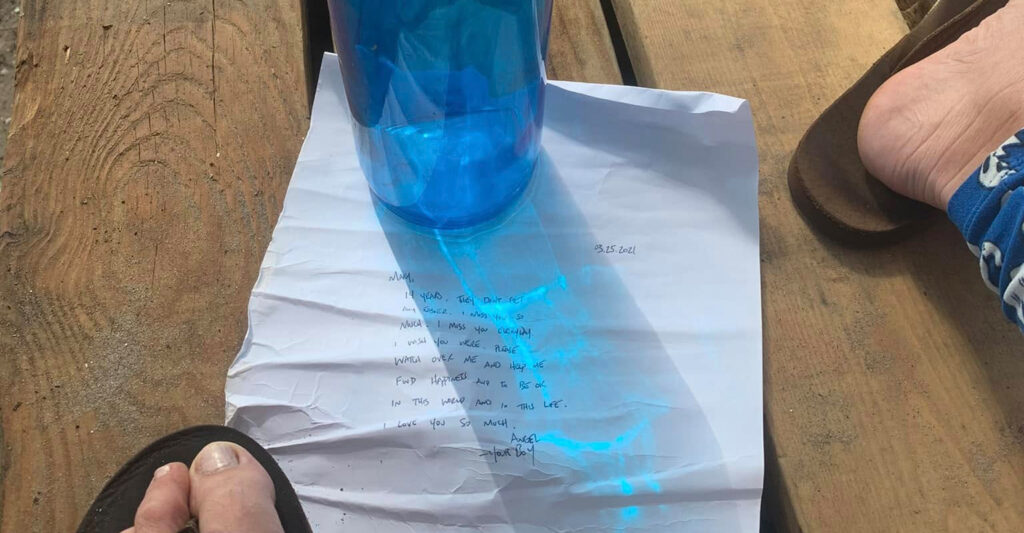
In early 2023, a Flagler Beach resident named Ted Horton was walking his golden retriever along the beach when he spotted a glass bottle sitting in the wet sand.
Inside the bottle were multiple sheets of paper.
Horton, intrigued, retrieved the bottle and opened it. The papers turned out to be handwritten notes from a father, a mother, and two daughters, all addressed to a deceased son. The notes were undated. They were written on stationery from a Ritz-Carlton notepad. The bottle itself didn’t appear to have been in the water very long.
“The bottle didn’t look like it had been in the water very long as no buildup of any kind was on the outside,” Horton wrote in a Facebook post that quickly went viral.
The family had clearly written the messages as a way of communicating with a loved one who had passed away, then sealed them in a bottle and released them into the ocean. The Atlantic, in its way, had carried the family’s grief to a stretch of Flagler Beach where a man walking his dog happened to find it.
What Horton did next is part of what made the story spread. Rather than keep the notes or post them publicly, he respected the family’s intent. He added his own note to the bottle, explaining where and when it had been found, and enlisted the help of a friend to take the bottle back offshore and release it into the water again.
The bottle, presumably, is still out there. Or it has washed up somewhere else. Or it has sunk. Whatever its current location, the family who wrote those notes will probably never know that, for a brief moment in early 2023, their messages reached the shore at Flagler Beach and were honored by a stranger with a golden retriever.
It is the kind of story that the ocean, very occasionally, leaves on the sand.
Bonus: The Beaked Whale (March 2023)
It would be incomplete to write this article without mentioning that just two months after the orca stranding at Jungle Hut Park, in March 2023, a second extraordinarily rare whale washed ashore in Flagler Beach.
This time, it was a beaked whale, identified by a SeaWorld researcher on the scene as either a Gervais’s beaked whale or a True’s beaked whale, both of which are deep-water species that almost never come close to shore. Beaked whales primarily inhabit deep waters far offshore, only coming in when sick. They are, in many cases, more rarely encountered than orcas in the Southeast.
The animal was spotted tumbling in from the surf break around 2 p.m. on a Friday afternoon. Locals quickly assembled to render aid, placing wet towels over the animal to prevent overheating and turning it away from the waves to keep water from flooding its blowhole. The whale remained alive for hours after beaching but was eventually euthanized to prevent further suffering. It was loaded onto a truck and transported to Orlando for a necropsy.
Two extraordinarily rare whale strandings in the same county in the same three-month window is a coincidence that biologists are still puzzling over. Both events were, at the time, called near-unprecedented by NOAA officials and marine mammal experts. Flagler Beach in early 2023 was, briefly, one of the most unusual whale-research locations in the entire country.
What Flagler County’s Beach Mysteries Tell Us
Five (or six) extraordinary beach finds across just a handful of years tell us a few things about Flagler County’s coastline.
The Atlantic delivers more than tourists. From the 1920s pier pillars to the 2025 cocaine bale, the ocean is constantly bringing things ashore here. Most of it is mundane (driftwood, sea pork, plastic bottles, jellyfish, the occasional buoy). But the unusual stuff finds its way to Flagler County more often than residents realize.
Hurricanes change what’s visible. The Bruner pier pillars existed for 80+ years before Hurricane Nicole revealed them. Many other historical structures, from old shipwrecks to colonial-era artifacts to lost coastal infrastructure, are likely buried in Flagler County’s beaches and dunes. Each major storm has the potential to expose something nobody knew was there. The Daytona Beach Shores shipwreck that was revealed by Hurricane Nicole in 2022 (now confirmed by St. Augustine Lighthouse archaeologists as an 80-foot-long mid-to-late 1800s merchant ship) is the regional example most cited by experts, but Flagler County itself has produced multiple smaller versions of the same phenomenon.
The orca and beaked whale strandings of 2023 are part of a broader pattern. Marine biologists have noted that “unusual species” are appearing in the Southeast U.S. more frequently in recent years. Whether this is related to changing ocean conditions, shifting migration patterns, or simply better observation and reporting is still being studied. But Flagler County, with its exposed Atlantic geography, is increasingly likely to be a witness to whatever is changing in the sea.
Always call the authorities. Several of the discoveries on this list, particularly the cocaine and the cage-with-a-person, would have been mishandled without proper response from the Flagler County Sheriff’s Office. As Sheriff Staly noted in the cocaine case: do not touch suspicious packages on the beach. Do not take them. Call 386-313-4911 and let the professionals respond.
Pay attention when you walk the beach. The Flagler County coastline rewards observation. The orca was first spotted by a local on his morning walk. The pier pillars were noticed by anyone walking the north end of Flagler Beach in the days after Hurricane Nicole. The message in a bottle was found by a man walking his dog. The cocaine was spotted by another dog walker. The cage was reported by a beachgoer. None of these stories would exist if ordinary people hadn’t been paying attention to what the ocean was depositing on the sand.
The Atlantic is always delivering something to Flagler County. Most of it is forgettable. Some of it is unforgettable. And occasionally, very occasionally, what washes up is the kind of story that gets told for years.