
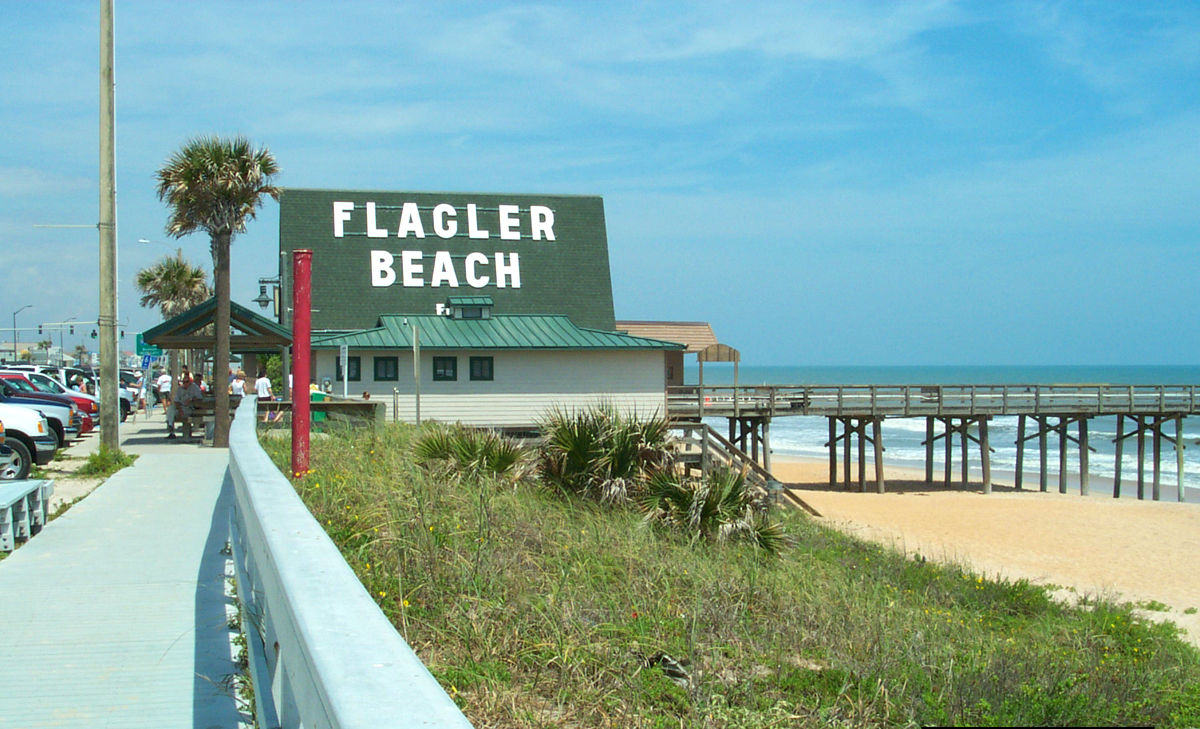
Almost a century ago, a small fishing pier was built into the surf at the foot of South 6th Street in a little Florida coastal town that had just been incorporated. The town was Flagler Beach. The pier was 800 feet long, made entirely of wood, and the tallest structure in the entire community.
Almost everything about Flagler Beach has changed in the 98 years since. The Atlantic has eaten away at the dunes more times than anyone can count. Hurricanes have rebuilt the shoreline in ways the original residents would not recognize. State Road A1A has been paved, repaved, washed out, and rebuilt with engineered seawalls. The town’s population has grown from a few hundred to over 5,000. Generations of families have come and gone.
But the pier remained. Through 1944, when half of it was torn off in a storm. Through 1964, when 400 feet were lost. Through the 1984 nor’easter that took another 400-plus feet. Through Hurricanes Matthew, Irma, Ian, and Nicole. Through six known major reconstructions over the decades. The pier kept getting shorter, then it would be repaired, then it would be hit again, then it would be repaired again. Until finally, in 2022, the pier was closed for the last time in its original form.
Right now, in early 2026, what remains of the historic 1928 wooden pier is being carefully dismantled. In its place, a new concrete pier is rising that is meant to last another century. The first 100 feet from shore, the section that has anchored the original structure since 1928, will be preserved.
This is the complete story of the Flagler Beach Pier. Every storm. Every rebuild. Every chapter. And what comes next.
Before the Pier: Flagler Beach in the 1920s
The story of the Flagler Beach Pier begins with a man named George Moody, the older brother of Flagler Beach founder Isaac Moody.
In September 1913, George Moody applied to homestead 169 acres of land that included one mile of ocean frontage, extending from the dunes inland to the marshland on the western side of what was then a barrier island accessible only by boat. He built the first house on the beach in 1914 and the first community gathering place, the Casino, in 1916. The settlement, then known as Ocean City Beach, grew slowly through the late 1910s and early 1920s.
In 1925, Ocean City Beach was officially incorporated. The community had been planning to use that name, but the U.S. Post Office Department informed them that it was already taken by Ocean City, New Jersey and Ocean City, Maryland. The residents settled instead on Flagler Beach, a name borrowing the prestige of Henry Flagler, the railroad and oil tycoon whose Florida East Coast Railway had made the broader region’s development possible.
George Moody became the city’s first mayor.
The newly incorporated Flagler Beach had ambitions. Tourism was beginning to find Florida’s east coast in earnest. The Dixie Highway brought Tin Can Tourists in their Model T Fords down from Chicago and the Midwest. A1A was a sand-and-shell road in those days, but it was passable. The first automobile bridges across the Intracoastal Waterway were being built. Beachgoers were arriving.
What Flagler Beach lacked was a fishing pier.
1928: The Pier Opens
Construction of the Flagler Beach Pier began in 1927 and was completed in 1928, just three years after the city’s incorporation. The pier extended 800 feet into the Atlantic, supported entirely by wooden pilings, with a wooden deck and railings.
For the small town, the pier was transformative. It was the largest single structure in Flagler Beach. It was visible from miles up and down the coast. It became the town’s most photographed landmark almost immediately and would remain so for the next 96 years.
The pier served multiple purposes. It was a fishing pier, providing local anglers and visiting tourists access to deeper water than they could reach from the shoreline. It was a community gathering place where families walked at sunrise and couples watched the moonrise at night. It was an economic engine for the small businesses that grew up around it: bait shops, restaurants, motels, and tourist services. It was a backdrop for almost every postcard, painting, and photograph the community would produce for the next century.
The 1928 pier was also, almost from the beginning, locked in an ongoing battle with the Atlantic Ocean.
The 1944 Storm: First Major Loss
According to engineering research conducted decades later by the firm Atkins, the Flagler Beach Pier has been damaged in major storm events at least seven times since its 1928 construction.
The first major loss came in 1944, when half of the pier was torn off during a storm that has not been definitively identified in surviving records but appears to have been a significant nor’easter rather than a tropical system. Roughly 400 feet of the pier disappeared into the Atlantic.
The community rebuilt. The pier was restored to something close to its original 800-foot length over the following years, though some accounts suggest it never quite reached its full original size.
The pattern, however, was now established. The pier would be damaged. The community would rebuild. The Atlantic would damage it again.
1964 and 1984: The Lost Lengths
In 1964, another major storm took approximately 400 feet off the pier. Reconstruction followed.
In 1984, the most consequential single storm in the pier’s pre-modern history hit. A powerful nor’easter, not a tropical system, struck the Flagler Beach coast in conditions that proved especially destructive to the wooden pier. Approximately 432 feet of the pier was lost to the Atlantic. The pier, originally 800 feet long, was now reduced to roughly 600 feet.
The 1984 nor’easter’s damage was severe enough that the city seriously considered whether to fully restore the pier or accept a permanently shorter structure. Ultimately, the decision was made to repair, but not to extend the pier back to its original 800-foot length. From this point forward, the Flagler Beach Pier would be a roughly 600-foot structure.
Memorial planks engraved with the names of local residents began to accumulate along the pier’s deck during this era, a community tradition that would continue for the next several decades.
2005: A Punishing Hurricane Season
The 2005 Atlantic hurricane season was the most active on record. While most of the season’s most famous storms (Katrina, Rita, Wilma) struck other parts of the Gulf and Caribbean, Flagler Beach was affected by the broader environmental impact of the prolonged season.
Approximately 180 feet of pier was lost during the 2005 hurricane season, primarily through the cumulative wave action of multiple storms passing offshore rather than from a single direct hit. The pier was repaired again, this time to a length of roughly 600 feet that would remain its working configuration for the next decade.
2016: Hurricane Matthew
The first really catastrophic storm to hit the Flagler Beach Pier in the modern era was Hurricane Matthew.
Matthew was a Category 5 hurricane in the Caribbean before tracking north along Florida’s east coast in early October 2016. The storm passed roughly 30 miles offshore of Flagler County as a Category 3 on October 7, 2016. The eye never made landfall in Florida, but the western edge of Matthew’s eyewall delivered hurricane-force winds, a 7-foot storm surge, and 36 hours of pounding wave action to the entire Flagler County coastline.
160 feet of the Flagler Beach Pier was torn off by Hurricane Matthew. Beyond the pier itself, A1A collapsed along a 1.3-mile stretch in south Flagler Beach, the entire dune system was destroyed, and 161 homes were damaged or destroyed countywide.
The recovery from Matthew took years. Flagler County launched a $18 million dune reconstruction project that brought roughly 1 million tons of sand back to the shoreline between 2018 and 2019. The pier itself underwent emergency repairs by Orlando-based Construction Co. Inc. for just under $1 million, with the goal of making it walkable, fishable, and danceable again by May 2017. Those repairs succeeded. The pier reopened, shortened but operational.
2017: Hurricane Irma
Less than a year after Matthew, Hurricane Irma threatened the entire state of Florida in September 2017. The Category 5 storm devastated the Caribbean, made landfall in the Florida Keys, then tracked up the western side of the Florida peninsula. Flagler County was on the eastern, less severe side of the storm but still experienced sustained tropical-storm-force winds and significant flooding.
The recovering Flagler Beach Pier took additional damage from Irma. About 400 homes flooded in Flagler Beach. The dune system, still being rebuilt from Matthew, was set back. Approximately $5 million in storm-related damage occurred countywide.
The pier was repaired again, but the cumulative effect of Matthew and Irma had clearly weakened the structure. City officials began seriously discussing whether the wooden pier could survive another major storm.
2021: The Decision to Replace
In 2021, Flagler Beach city leaders made a strategic decision that would shape everything that came next. After years of patching and emergency repair, the city voted to replace the wooden pier entirely with a new concrete structure designed to better withstand powerful storms and rising seas.
The decision was both engineering-driven and economic. By 2021, only three insurance companies in the entire world would insure a wooden pier of any significant size, according to then-mayor Suzie Johnston. The cost of insuring, repairing, and maintaining the wooden structure had become unsustainable. A modern concrete pier, while expensive to build, would dramatically reduce ongoing operational costs and would have a meaningful chance of lasting decades rather than years between major repairs.
Planning for the new pier began. Federal Emergency Management Administration funds and state grant funds would cover the bulk of the construction. Initial estimates put completion sometime in the 2024-2025 timeframe.
Then 2022 happened.
2022: Hurricane Ian
Hurricane Ian made landfall as a catastrophic Category 4 hurricane near Cayo Costa on Florida’s southwest coast on September 28, 2022, with winds of 150 mph. The storm crossed the state and exited near Cape Canaveral as a tropical storm. For Flagler County, Ian was primarily an offshore impact storm, but its massive size and slow forward speed delivered more than 36 hours of wave action and heavy rain to the entire northeast Florida coast.
The Flagler Beach Pier took severe damage. Its front section was lopped off. The structure was deemed unsafe. The pier was closed to the public in September 2022 and would never reopen in its original wooden form.
The closure was the end of an era. Generations of locals had walked the pier, fished from it, danced on its boards. Now, after 94 years, it was gated off and quiet.
2022: Hurricane Nicole
Just six weeks after Ian, before any meaningful recovery work could begin, Hurricane Nicole hit Florida’s east coast as a Category 1 hurricane on November 10, 2022. Nicole’s winds were comparatively modest, but its storm surge, wave action, and 48 hours of pounding broke a coastline that was already on the brink.
The remaining structure of the Flagler Beach Pier was damaged beyond any reasonable hope of repair. Hurricane Nicole was the storm that finally retired the historic 1928 pier as a usable structure. What had survived Ian could not survive a second major storm just six weeks later.
The decision to replace, made in 2021, became urgent. Plans accelerated. FEMA negotiations intensified. Engineering studies were commissioned. Architectural and design firms were brought in.
2024 to 2025: Designing the New Pier
The reconstruction project was entrusted to a team of engineering and design firms. Moffatt & Nichol, a global infrastructure firm specializing in coastal engineering, was hired as the project’s primary designer. England-Thims & Miller was contracted as project administrator. Chris Novak served as project manager on the city’s side, with Jason Cronk filling the role of clerk of the works to ensure construction met city specifications.
The design that emerged honored the history while modernizing for the future:
The new pier will stretch 800 feet into the Atlantic, restoring the original 1928 length. (The total length is sometimes cited as 828 feet to include the preserved historic 113-foot landward section.)
The deck elevation will rise to 28 feet above sea level, more than 10 feet higher than the original pier’s 17.8-foot elevation. This single design change is intended to take the pier “out of the 500-year storm and the wave action associated with those storms,” in the words of City Manager Dale Martin. Wave action striking the underside of the pier is what historically destroyed wooden Florida piers, and the elevated deck is engineered to clear all but the most extreme storm surge events.
The pier will be built primarily of concrete, with a reinforced concrete frame engineered to withstand 135 mile per hour wind loads. The deck will incorporate timber breakaway panels designed to detach in extreme storm conditions, minimizing damage to the underlying concrete structure. Timber railings will preserve the wooden aesthetic of the original pier.
The deck width will be expanded to 25 feet, five feet wider than the old pier, providing more space for fishing, walking, and gathering.
A T-shaped head at the east end will provide expanded space for fishing and viewing. The T-head will be approximately 20 feet by 35 feet in size.
The first 100 feet of the original pier, closest to shore, will be preserved. This historic section, the part of the structure that has anchored the pier since 1928, will be reinforced and integrated into the new design. The original wooden boards in this section, including many of the engraved memorial planks honoring local residents, will be preserved where possible. City officials have committed to making salvaged historic boards available to community members and family members of those memorialized on the planks.
The total project cost is approximately $14.1 million to $16 million, depending on the final scope of contracted work. Approximately two-thirds is funded by FEMA, with another third coming from a $5 million Florida state grant. Flagler Beach property taxpayers are not directly funding the bulk of construction.
2025: Construction Begins
Construction officially launched in 2025. The early phase focused on building a temporary trestle, essentially a parallel pier, alongside the existing damaged structure. The trestle was necessary to provide working access and support for the demolition and rebuild operations. Without it, crews would have had no safe way to dismantle the old pier or begin the new construction.
Building a temporary structure to demolish and replace another structure in the open Atlantic surf is, as one might imagine, technically demanding work. The trestle took most of 2025 to complete. Sea turtle nesting season caused additional delays through summer 2025, requiring the contractor to pause certain types of work to comply with Florida environmental protection regulations.
City Manager Dale Martin summarized the approach simply: “Basically, they build a pier to then use that pier to dismantle the existing pier and build the new one.”
Early 2026: Demolition Begins
The first week of January 2026 marked a milestone. After years of planning and months of trestle construction, active demolition of the historic 1928 pier began. Crews started removing spans near the A-frame entrance on the landward side and began working seaward.
Photos and drone video released by the project team in early 2026 show the temporary trestle running parallel to the existing pier, with sections of the original pier already removed. The visible progress was, as one Flagler Beach city commissioner put it, “eye opening.”
Demolition is expected to continue through the first half of 2026. Construction of the new concrete pier will progress in parallel, with the initial concrete pile installation expected to begin within weeks of the demolition start.
Late 2026: Target Completion
The current target completion date is December 2026, though the project administrator has requested a 40-day extension that would push final completion to mid-January 2027. The contractor has cited weather, environmental delays, and a $145,000 change order request related to the extension.
If the December 2026 target holds, the new pier would be ready in time to serve as the centerpiece of Flagler Beach’s centennial year. The original pier opened in 1928, so 2028 marks 100 years of continuous (if frequently interrupted) service.
The grand reopening is expected to be a significant community event. Flagler Beach residents and longtime visitors have been waiting since September 2022 for the pier to return.
What Will Be Lost (And What Will Survive)
The reconstruction project is a balance of preservation and modernization. The new pier will not be the old pier, and Flagler Beach has been honest about that.
What is being lost includes:
- The wooden deck that generations have walked across
- Most of the original 1928 wooden pilings and structure
- The rough, weathered character of a hand-built early 20th-century fishing pier
- The visual silhouette of the old pier (the new structure will be 10 feet taller and 5 feet wider, creating a different profile against the horizon)
What is being preserved includes:
- The first 100 feet of the original pier closest to shore
- As much of the original wooden boards as can be salvaged from that section
- The memorial planks engraved with names of local residents (where physically recoverable)
- The pier’s location, role, and community identity
- The wooden aesthetic of the railings and breakaway deck panels
- The 800-foot total length, restoring the original 1928 dimension
The aim, as City Manager Martin has said, is “preserving history while bracing for the future.”
Why the Pier Matters
Flagler Beach is a small town. Its population is about 5,200. It does not have the historical weight of St. Augustine to the north or the commercial scale of Daytona Beach to the south. What it has is the pier.
For 96 years, the Flagler Beach Pier has been the most recognizable single feature of the town. It has anchored the city’s identity in a way few small-town landmarks anywhere in Florida can match. It has appeared in nearly every postcard, painting, and tourism photograph of Flagler Beach since 1928. It has been the backdrop for first kisses, family vacations, fishing trips, and weddings. It has been the subject of countless local news stories, the gathering point for First Friday festivals, and the structure that visitors stop their cars on A1A to photograph.
It has also been a remarkable example of community resilience. Seven major storm-damage events. Seven major rebuilds. Through every era of Florida coastal change, Flagler Beach has decided, again and again, that the pier was worth saving.
The 2026 reconstruction is the most ambitious decision yet. Not just to repair the pier, but to fundamentally rebuild it for the next century. To trade wood for concrete. To accept some loss of the old in exchange for genuine durability against what’s coming.
If the new pier holds for 100 years, it will outlast almost every Flagler Beach resident alive today. It will see the city through climate changes, storm patterns, and demographic shifts that nobody can fully predict. And the first 100 feet, the section closest to shore, will still be the same wooden bones that George Moody, Isaac Moody, and the founding generation of Flagler Beach helped raise out of the surf in 1928.
A pier built three years after a town’s incorporation. Seven major storms. Six full reconstructions. A 1944 storm that took half of it. A 1984 nor’easter that took 432 feet. Hurricane Matthew that took 160 feet. Hurricanes Ian and Nicole that finally closed it. A 2022 closure that became a 2025 demolition that became a 2026 reconstruction with FEMA funding and 28-foot deck elevation and breakaway panels and concrete pilings and a preserved 100-foot historic section.
That’s the Flagler Beach Pier. 1928 to 2026. Almost a century of standing in the ocean, and another century, the city hopes, just beginning.