
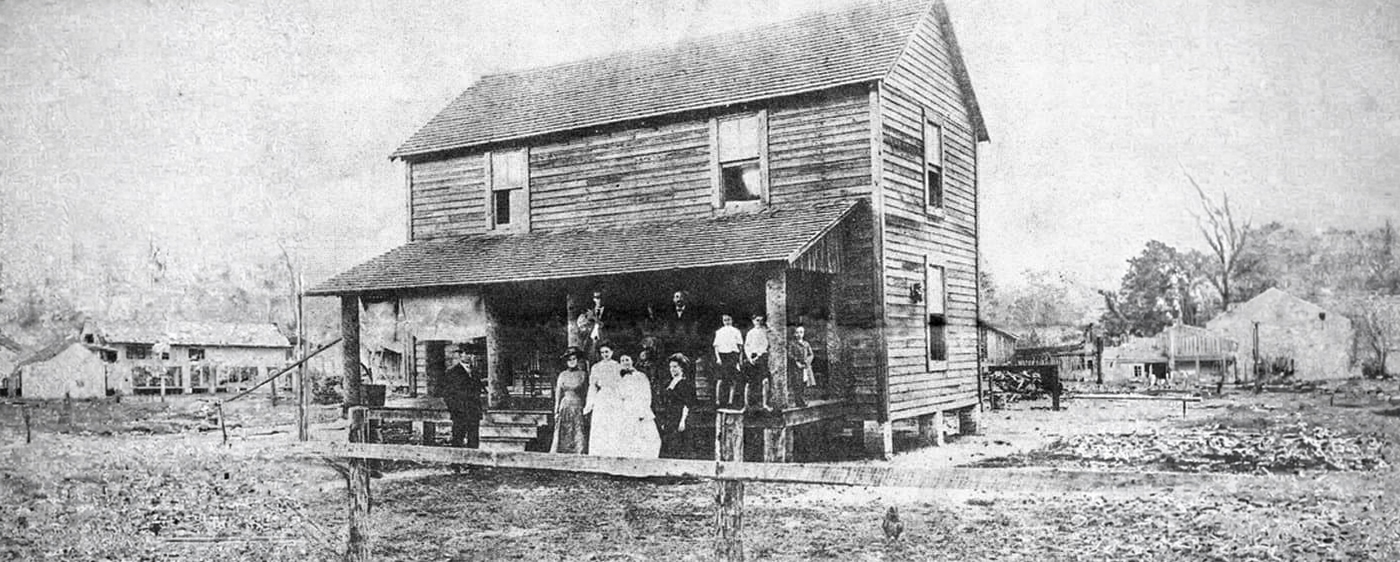
Drive the back roads of Flagler County today and you’ll mostly see the same things. Subdivisions. Strip centers. Pine forest. Cattle pasture. The occasional historic marker reminding you that something used to be there.
What “used to be there” was, in many cases, an entire town.
Before Palm Coast, before modern Flagler Beach, before Bunnell became the county seat, this stretch of northeast Florida was dotted with small communities. Lumber camps. Turpentine settlements. Polish immigrant villages. Farming hamlets. Plantation towns. Some had hundreds of residents, post offices, hotels, schools, and churches. Most are gone now. A few survive as unincorporated communities with a handful of homes and a road sign. One or two have been completely erased.
These are the lost towns of Flagler County, the forgotten settlements that helped build the place but didn’t survive into the modern era. Their stories are worth telling.
A Quick Note on What “Lost” Means
Florida’s lost towns generally fall into three categories. Some vanished entirely, leaving little or no physical trace. Some shrank from real towns into tiny unincorporated communities, with a handful of residents still living among the ruins of what used to be. And some live on as place names attached to roads, parks, or landmarks, but the actual community is long gone.
Flagler County has examples of all three. What follows isn’t an exhaustive list, but it covers the most historically significant lost towns in the county, organized roughly by what’s left of them today.
Bulow: The Plantation Town
Of all the lost towns in Flagler County, Bulow is the oldest and most famous.
In 1821, Major Charles Wilhelm Bulow, a wealthy merchant from Charleston, South Carolina, acquired 4,675 acres of land along a tidal creek that would eventually carry his name. Using the labor of nearly 200 enslaved people, he cleared 2,200 acres and planted sugar cane, cotton, rice, and indigo. The plantation became one of the largest sugar operations on Florida’s east coast.
Major Bulow died in 1823, just two years after acquiring the land. His seventeen-year-old son, John Joachim Bulow, inherited the operation and ran it for the next thirteen years. The plantation thrived. The Bulow sugar mill, built of locally quarried coquina rock, was the largest in East Florida. Naturalist John James Audubon was a guest at the plantation during the 1831 Christmas season. He used the visit to study Florida wildlife, including the Greater Yellowlegs species he later painted.
Bulow Plantation, and the small surrounding settlement that supported it, was destroyed in 1836 during the Second Seminole War. The Seminoles burned the sugar mill, the mansion, the slave quarters, and the outbuildings. John Joachim Bulow left for Paris that same year. He died in France shortly after.
The Florida Park Service acquired the ruins in 1945. The site was listed on the National Register of Historic Places in 1970 and is preserved today as Bulow Plantation Ruins Historic State Park. Visitors can walk among the coquina sugar mill ruins, see the foundations of the mansion and slave quarters, and explore the spring house and wells. There’s also a short hiking trail and a kayak launch on Bulow Creek. It’s one of the best-preserved plantation ruins in Florida.
The town of Bulow itself, however, is gone. What remains is the park, the creek, and the ruins.
Espanola: The Town the Highway Saved, Then Killed
Espanola is one of Flagler County’s most fascinating lost towns, in part because it almost made it. It just got bypassed at the worst possible moment.
The settlement began in the 1880s as a tiny crossroads in the dense scrub forest northwest of Bunnell. The first three families recorded there were the Hunters, the Helms, and the Raulersons. There was no waterway, no paved road, no railroad, and no obvious reason for anyone else to come. Descendants of those original three families still live in the area today.
Things changed in the early 1890s when news spread that a railroad would be built through Espanola from East Palatka. New families arrived seeking work. George Durrance came from San Mateo. George Burnsed came from Matanzas. George W. Deen of Baxley, Georgia bought several large tracts of land and established turpentine stills, which he leased to operators. Lawrence Sidney Cody and Joseph Barrett Boaz operated a stave mill. The narrow-gauge railway, originally built by Utley James White, was eventually purchased by Henry Flagler and converted to standard gauge as the Florida East Coast Railway.
By the early 1900s, Espanola was a thriving community of about 100 people. It had a hotel, a post office, a garage, a cafe, a rooming house, a barber shop, a dry goods store, a grocery store, a school, and even a mail route operated by Elzie Hunter using a horse-drawn cart. Florida Farms Development Company began selling tracts to settlers from the north.
Then in 1915, Espanola got a second boom. The new Dixie Highway, the massive private-public road project led by Indianapolis Motor Speedway founder Carl Fisher, was routed through the town. The Flagler County section was completed in 1916 as a 9-foot-wide brick road that connected Jacksonville south through to Flagler Beach and Bunnell. Tin Can Tourists in Model T Fords drove down from Chicago and the Midwest to the exotic tropics. Espanola was the welcome rest stop with a hotel, restaurant, barber shop, and post office.
The boom lasted about a decade. When U.S. Highway 1 was completed from St. Augustine to Bunnell in 1926, traffic shifted to the wider, faster, more direct route. Espanola was bypassed. The hotel closed. The restaurant closed. The post office eventually closed. The Florida East Coast Railway later abandoned the inland route through Espanola in favor of the Moultrie Cutoff in 1925.
Today, fewer than 100 people live in Espanola. The original 9-foot brick Dixie Highway still exists for about 9 to 10 miles north of the town, much of it in St. Johns County. It is one of the most intact stretches of the original Dixie Highway anywhere in Florida and is itself a destination for road trippers, historians, and Old Florida enthusiasts. The bricks are stamped with the words GRAVES B’HAMALA, identifying the original brick manufacturer. The road is just wide enough for one car. Most who drive it report not encountering another vehicle the entire way.
Espanola is the rare Flagler County lost town where you can still drive the road that built it.
Korona: The Polish Town
In 1914, a group of Polish immigrant families left Chicago, Detroit, and other northern cities for a tiny settlement in northern Volusia County. Three years later, when Flagler County was formed in 1917, that settlement became part of the new county. They named the town Korona, the Polish word for “crown,” in honor of the Blessed Virgin Mary, patron saint of Poland.
The families had been recruited through advertisements in The Bunnell Home Builder, a monthly newsletter published by the Bunnell Development Company. The promotional materials, some printed in Polish, promised inexpensive farmland at $35 per acre, three growing seasons per year, and a climate “free from ice and snow.” The development company even chartered a train called the Dixie Flyer to bring prospective buyers from Chicago to Bunnell for $41.89 round trip.
Thirty-five Polish families made up the first wave. Names like Stupecki, Waszewski, Strach, Trojanowski, Mazurewicz, and Cyzycki. Before they left, they raised $1,000 to build a Catholic church in their new home.
The result is one of the most remarkable historic structures in Flagler County. St. Mary Catholic Church, originally St. Mary Queen of Poland, was completed in 1914 in the Carpenter Gothic architectural style. The original sanctuary held 65 worshippers. The first Mass was celebrated on May 3, 1914. The church served as the spiritual, social, and community center for Korona’s Polish settlers for decades.
Korona at its peak had a post office (established 1918, closed 1950), the church, a duplex residence built for the priest, and a number of small farms growing potatoes, vegetables, and chickens. In 1926, a settler named Barney Trojanowski built the White Eagle Hotel, with a grocery store, feed store, and real estate office on the first floor. The Dixie Highway reached Korona in 1922, and U.S. Highway 1 ran through the town by the 1930s, providing improved access.
The original Polish settlement faded over the 20th century as families moved elsewhere or assimilated into the broader community. But St. Mary Catholic Church survived. A larger modern St. Mary Church was built on the property in 1994 to accommodate up to 500 worshippers, and the original 1914 building is still used for occasional weddings, baptisms, funerals, and silent prayer services. It is the oldest standing church in Flagler County and was officially listed on the National Register of Historic Places on January 25, 2024.
A Polish-language Mass is still offered weekly. The town of Korona is officially gone (it’s an unincorporated community using a Bunnell mailing address), but St. Mary Catholic Church and its adjacent Shrine of Saint Christopher keep the Polish heritage of the lost town alive.
Dupont: The Lumber Town That Was
Of all the lost towns of Flagler County, Dupont may be the one that left the smallest physical trace despite once being one of the busiest places in the county.
Around the turn of the 20th century, Utley James White moved from Hastings, Florida to Dupont. White was originally from Illinois, had built the White Towers Plantation in Hastings, and was the first man to commercially raise Irish potatoes in that area. At Dupont, he turned his attention to logging and lumber.
White built a large sawmill, a planing mill, and a stave mill at Dupont. To move timber and finished lumber, he constructed a tram road to Green’s Island near Flagler Beach, and then built a narrow-gauge railroad to Haw Creek that extended as far as the small settlement of Tipperary, just across Little Haw Creek on the Seville road. This railroad was eventually purchased by Henry Flagler and converted to standard gauge as part of the Florida East Coast Railway.
Dupont became a beehive of activity. White built homes for his white employees. The “quarters” housed more than 250 Black workers. White’s own residence, called The Mansion House, was considered a regional showplace. Other notable families lived at Dupont in this era, including the Lawrence S. Codys, the Austin V. Wicklines, and Dr. David Benton Brown.
In 1912, the Dupont Land Company of Scranton, Pennsylvania bought out White’s interests. The lumber boom continued for another decade or so before the timber was depleted. As the mills closed and workers moved on, Dupont faded.
Today, Dupont is essentially a place name on a map between Bunnell and Espanola. There’s no town center, no commercial district, and almost no physical evidence of what once stood there. A handful of homes and farms remain. The railroad is gone. The Mansion House is gone. The mills are gone.
Of all the towns on this list, Dupont may be the most genuinely lost.
Favoretta: The Spanish Lumber Camp
Favoretta is one of the older lost towns in Flagler County, dating back to the era when the Spanish controlled Florida. The original name was Favorita, given by Spanish settlers, which evolved into Favoretta over time.
The settlement was a lumber and turpentine center, similar to Dupont and Espanola. Many thousands of dollars worth of turpentine were extracted from the surrounding pine forests. George Moody, the older brother of Isaac I. Moody (the founder of Flagler Beach), was the first postmaster of Favoretta and its most prominent developer for many years. He owned a sawmill in the vicinity and worked actively on the town’s growth.
The Florida East Coast Railway runs through what was once Favoretta. So does U.S. Highway 1. The town is located just south of Korona. Today, a state road sign still identifies the location of Favoretta, but the sign is essentially all that’s there.
Favoretta is the kind of lost town that exists primarily as a name on maps, a place you drive through without realizing it.
Haw Creek: The Settlement That Stayed Small
Haw Creek is one of the older settlements in Flagler County, located on the western edge of the county along the creek of the same name. Unlike most of the other towns on this list, Haw Creek didn’t experience a real boom-and-bust cycle. It was always small and largely agricultural, and it has stayed small.
The community served as a regional center for cattle ranching, potato farming, and small-scale logging. Utley James White’s narrow-gauge railroad reached Haw Creek from Dupont. A small school operated for many years. When the school in nearby Codyville burned, students were transported to Haw Creek by what locals called the “dummy train.”
Haw Creek is still on the map today as an unincorporated community in western Flagler County. There are still residents, still a few small farms, still a recognizable sense of place. But it never grew into a real town, and it’s largely outside the modern Flagler County experience for most residents of Palm Coast and Flagler Beach.
Codyville: The Cody Brothers’ Settlement
Around 1910, the Cody brothers, Walter and Larry, homesteaded land in what became known as Codyville. They operated a shingle mill on their property. A one-room school house was built. Minnie Burnett was the first teacher; Ruth Trissell Cody was the second.
When the school building burned, the children were transported by the small narrow-gauge “dummy” train to the school in Haw Creek. The settlement never grew large.
Today, Codyville survives as a place name. The intersection where the settlement once stood is now known as Cody’s Corner, a name that occasionally appears on maps and in directions. Almost everything else is gone.
Other Lost Settlements
A handful of other small lost settlements dotted the Flagler County map at various points in the late 1800s and early 1900s. Most are now little more than footnotes:
- Andalusia was a small early village in the area
- Bimini (west of Espanola) became a major potato farming area in the early 1900s
- Black Point was an early village
- Dinner Island was a small settlement
- Mound Grove, located along Bulow Creek, was an Old Florida community now visible primarily from the water along the Bulow Creek Paddling Trail
- Roy appears in old county records as one of the early small settlements
- Shell Bluff was an early village
- Tipperary was a small place across Little Haw Creek that marked the end of Utley White’s narrow-gauge railroad
- Tomasello was an early village
These names appear on old maps, in genealogy records, and in occasional historical society articles, but most have left almost no physical trace. They were lumber camps, turpentine stills, family settlements, or rail-line stops that existed for a generation or two and then quietly disappeared.
Why So Many Towns Vanished
The lost towns of Flagler County share a few common patterns.
Most were built around a single industry. Lumber, turpentine, sugar, potatoes, or railroad work. When the industry collapsed, when the timber was cut, the turpentine pines exhausted, the sugar mill burned, or the railroad rerouted, the town’s reason for existing collapsed with it.
Most relied on a railroad for connection to the broader economy. Flagler County’s settlements were typically inland, away from natural waterways. The Florida East Coast Railway and the various spur lines built by lumber operators like Utley James White provided their lifeline. When those lines were rerouted (the Moultrie Cutoff in 1925 effectively ended the inland FEC route through several towns) or abandoned entirely, the towns were stranded.
Most were bypassed by major highways. The arrival of U.S. Highway 1 in 1926 and later Interstate 95 funneled traffic and commerce into a narrow corridor along the eastern side of the county. Inland communities that had once been on the main routes suddenly weren’t. The Dixie Highway era of the 1910s and 1920s was a brief moment when these inland places were viable.
And most existed before Flagler County was even a county. When Flagler County was created in 1917 from parts of Volusia and St. Johns counties, the new boundaries grouped these scattered settlements together. But many were already in decline by then. Bunnell quickly became the county seat. Flagler Beach grew into a destination. The smaller towns slowly faded into the background.
What’s Left to See
For history-minded visitors and residents, several of the lost towns are still worth visiting today.
Bulow Plantation Ruins Historic State Park is the most accessible and the most rewarding. The coquina sugar mill ruins, the foundation walls, the spring house, the kayak launch on Bulow Creek, and the hiking trail to the Fairchild Oak in adjacent Bulow Creek State Park give you a real sense of what the early 19th-century Florida frontier was like.
The Old Brick Road, the original Dixie Highway, runs about 9 to 10 miles north from Espanola through pine flatwoods. The road is one of the most authentic surviving stretches of the original 1916 Dixie Highway anywhere in Florida. It’s narrow, bumpy, and lightly trafficked, perfect for a slow drive in a sturdy vehicle.
St. Mary Catholic Church in Korona is open for visitors and active for worship. The original 1914 Carpenter Gothic building, now on the National Register of Historic Places, sits next to the larger 1994 modern church. The Shrine of Saint Christopher is also worth seeing.
The Flagler County Historical Society at the Holden House in Bunnell is the central archive for documents, photographs, maps, and oral histories from all of these lost towns. Anyone interested in deeper research will find more there than anywhere else in the county.
The lost towns of Flagler County are mostly silent now. The lumber camps are gone. The turpentine stills are gone. The rail lines that carried potatoes, oranges, and timber to market are gone. The hotels and restaurants and post offices that served the Tin Can Tourists are gone.
But the bones are still there if you know where to look. Bulow’s sugar mill. The Old Brick Road. St. Mary’s Polish church. A few family names that have hung on for five generations in a place that everyone else forgot. A place name on a map that you wouldn’t notice unless someone told you what used to be there.
These were real towns. Real people lived in them, raised families in them, built churches in them, and worked themselves to exhaustion in their mills and turpentine camps and cane fields. They didn’t last. But they were here. And in a county that has been transformed almost beyond recognition over the last fifty years, the lost towns of Flagler County remain one of the most authentic links to what this place used to be.