
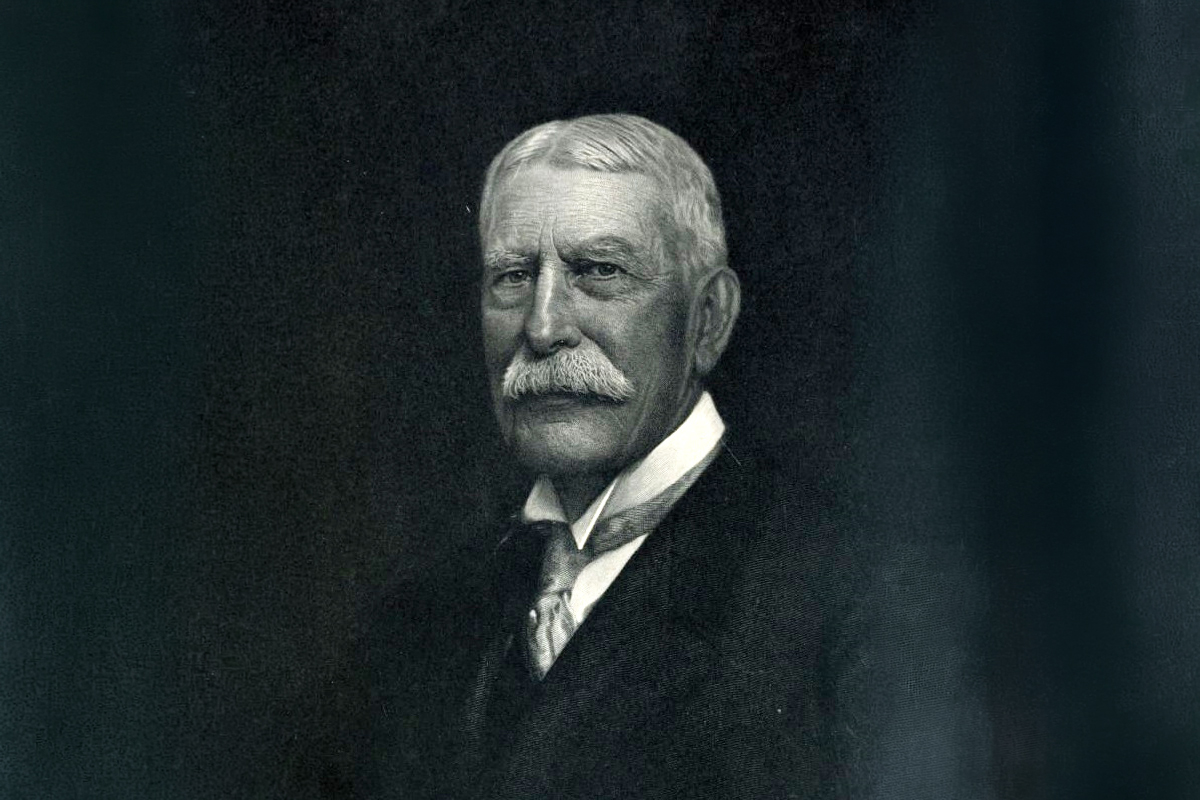
It’s the question almost every newcomer to the area eventually asks: Who was Henry Flagler, and what did he actually have to do with Henry Flagler and Flagler County, Flagler Beach, or any of this?
The short answer is that Henry Morrison Flagler was one of the most consequential people in Florida’s history, a Standard Oil tycoon turned railroad and hotel magnate whose Florida East Coast Railway essentially invented the modern state. The longer answer, and the more interesting one, is that his actual personal connection to Flagler County is far thinner than most people assume. He never built a hotel here. He likely never owned a single home in what is now Flagler County. The county wasn’t even named for him until four years after he died.
Understanding the connection between Henry Flagler and Flagler County helps to illuminate the broader impact he had on the development of this region.
And yet his fingerprints are everywhere, on the railroad that runs through Bunnell, on the name above the courthouse, on the city of Flagler Beach, on the very existence of this stretch of Florida as anything more than empty pine forest. To understand how that’s possible, you have to understand the man, the empire he built, and the particular way his legacy outlived him.
Here’s the real story.
Who Was Henry Flagler?
Henry Morrison Flagler was born on January 2, 1830, in Hopewell, New York, the son of a Presbyterian minister. He left school at 14 to work in his half-brother’s grain store in Bellevue, Ohio, where his salary jumped from five dollars a month to four hundred in just a few years. By his early twenties, he was a partner in a grain and commission business. By his thirties, he had survived a disastrous foray into salt mining in Michigan and rebuilt his fortune.
But the decision that would change his life — and Florida’s, came in the late 1860s, when Flagler partnered with a young Cleveland-based businessman named John D. Rockefeller. The two men, along with Samuel Andrews, founded the firm that would eventually become Standard Oil. By 1870, Standard Oil was incorporated. Within two years, it was the largest oil refiner in the United States. Within a decade, it was one of the most powerful corporations in American history.
Flagler became fabulously wealthy. By the early 1880s, he was earning several million dollars a year in dividends from Standard Oil alone — the equivalent of more than $100 million in today’s money, every year. He was 52 years old, financially secure for life, and looking for something new to do.
Florida found him.
How Florida Found Henry Flagler
In 1878, Flagler made his first trip to Florida with his first wife, Mary, who had been suffering from chronic illness. Her doctor had recommended a milder climate, and the Flaglers spent a winter in Jacksonville. Mary died in 1881. Two years later, Flagler remarried, his second wife, Ida Alice, and took her to St. Augustine.
He was charmed by St. Augustine’s old Spanish architecture, mild winters, and Atlantic breezes. But he was also frustrated. The hotels were inadequate. The transportation was unreliable. There simply wasn’t enough infrastructure in Florida to support the kind of wealthy northern tourism that the climate seemed to invite. Flagler saw an opportunity to build something nobody had built before: a true “American Riviera,” a chain of grand hotels connected by a reliable railroad, stretching the entire length of Florida’s east coast.
Over the next three decades, from 1885 until his death in 1913, Flagler poured an estimated $50 million of his personal fortune into making that vision real. He built the Hotel Ponce de Leon in St. Augustine (now Flagler College). He built the Alcazar (now the Lightner Museum). He built the Hotel Ormond near Daytona, the Royal Poinciana and The Breakers in Palm Beach, the Royal Palm in Miami, and the Casa Marina in Key West. He built his personal residence, Whitehall, in Palm Beach, a 75-room, 100,000-square-foot mansion that’s now the Henry Morrison Flagler Museum.
And to connect them all, he built a railroad.
The Florida East Coast Railway
The Florida East Coast Railway didn’t start as a single grand project. It started as a series of acquisitions. In 1885, after deciding to build the Ponce de Leon, Flagler realized his hotel would fail without reliable rail access. So he bought the existing Jacksonville, St. Augustine and Halifax Railroad. Then he bought the St. Johns Railway. Then the St. Augustine and Palatka Railway. Then he upgraded everything to standard gauge, replaced the rails, and connected the lines into a continuous route from Jacksonville to St. Augustine.
By spring of 1889, his network reached Daytona. By 1894, it reached West Palm Beach. By 1896, after a devastating freeze that wiped out citrus crops as far south as Palm Beach — Flagler pushed his rails an additional 60 miles to a then-unincorporated settlement on Biscayne Bay. When the residents tried to name their new town “Flagler” in his honor, he refused, suggesting they use the old indigenous name for the river running through it instead. The town became Miami.
By 1912, after seven years of construction, hundreds of worker deaths from hurricanes, and an investment of tens of millions of dollars, Flagler completed his most audacious project: the Overseas Railroad, an extension of the FEC that crossed 128 miles of open ocean to reach Key West. He rode the first train into Key West on January 22, 1912, just weeks after his 82nd birthday. He died sixteen months later, on May 20, 1913, from injuries sustained in a fall at Whitehall. Every locomotive on the Florida East Coast Railway stopped wherever it was for ten minutes at the time of his funeral as a final tribute.
Where Was Flagler County in All of This?
This is where the story gets interesting, and where most articles about Henry Flagler’s connection to the local area get sloppy.
When Flagler built his railroad south from St. Augustine in the late 1880s, the original main line did not run through what is today coastal Flagler County. Instead, it took a circuitous inland route: south from St. Augustine to Hastings, then west to East Palatka (where it crossed the St. Johns River), then south through San Mateo, then back east to Bunnell, before continuing south to Daytona. Bunnell sat at the junction where the inland route rejoined what became the FEC’s southbound mainline. That’s why the railroad mattered to the future of Flagler County, Bunnell was a stop on Flagler’s original route.
It’s also why Bunnell exists at all. The town was founded around 1897 by Alvah Alonzo Bunnell, who built a cypress sawmill next to the FEC tracks specifically to supply wood for Flagler’s wood-burning steam locomotives. Without the railroad, there would have been no mill. Without the mill, there would have been no town. The Florida East Coast Railway made Bunnell, and by extension, eventually made Flagler County — possible.
But Flagler himself? There is no credible historical record indicating Henry Flagler ever spent meaningful time in what is now Flagler County. He didn’t build a hotel here. He didn’t develop a town here. He didn’t own a residence here. The land that would become Flagler Beach was, during his lifetime, almost entirely undeveloped barrier island. The land that would become Palm Coast was pine forest, swamp, and turpentine camps. The county itself, split off from St. Johns and Volusia counties, didn’t exist until 1917, four years after Flagler’s death.
The Moultrie Cutoff, a 29-mile direct line from St. Augustine to Bunnell that finally let FEC trains skip the inland detour through East Palatka, wasn’t completed until 1925. By then, Flagler had been dead for twelve years, and the rail line through what is today’s Flagler County was being run by his successors.
So Why Is It Called Flagler County?
On June 12, 1917, the Florida Legislature created Florida’s 53rd county by combining sections of St. Johns County to the north and Volusia County to the south. The new county needed a name.
Naming the county after Henry Flagler was a recognition of historical and economic reality, not personal residency. By 1917, four years after his death, Flagler was already widely understood as the single most consequential figure in modern Florida history. He had:
- Built the railroad that made the entire east coast economically viable
- Founded or substantially developed the cities of St. Augustine (modernized), Daytona (linked), Palm Beach, West Palm Beach, Miami, and Key West
- Donated extensively to schools, churches, and hospitals across the state
- Provided the infrastructure (the railroad) that made it possible for places like Bunnell, Espanola, Dupont, Korona, and Bulow to exist as functioning communities at all
- Encouraged settlement and agriculture along his rail line through programs like the Model Land Company
For a new county whose entire economic existence, the cypress mills, the turpentine industry, the potato farms, the cattle ranches, depended on the FEC Railway running through Bunnell to ship goods north and south, naming it after Flagler was less a tribute to a personal connection than an acknowledgment that he had, in a very real sense, made the whole place possible.
The same logic explains the name of Flagler Beach. When the small coastal community of Ocean City Beach tried to incorporate in 1925 and discovered that the postal name was already taken by Ocean City, New Jersey and Ocean City, Maryland, the residents had to come up with something new. They settled on Flagler Beach, borrowing the prestige and name recognition of the railroad tycoon whose company had made the broader region possible, even though Flagler himself had no personal involvement with the town.
The Things in Florida Actually Named for Henry Flagler
Henry Flagler is one of the most-named people in the entire state of Florida. The list of places, institutions, and landmarks bearing his name is long:
- Flagler County (1917)
- Flagler Beach (incorporated 1925)
- Flagler College in St. Augustine (housed in his original Hotel Ponce de Leon)
- Flagler Hospital in St. Augustine
- Flagler Street in downtown Miami (the city’s main east-west commercial street)
- Flagler Avenue in Key West
- Flagler Drive along the West Palm Beach waterfront
- Flagler Memorial Bridge in Palm Beach
- Flagler Monument Island in Biscayne Bay (built specifically as a tribute after Miami declined to take his name)
- Flagler, Colorado (yes, even outside of Florida)
- The Henry Morrison Flagler Museum at Whitehall in Palm Beach
- Flagler Live, the local Flagler County news outlet
- And the countless schools, parks, and streets across Florida bearing some variation of his name
The Real Connection
So what is Henry Flagler’s real connection to Flagler County? It’s not personal. It’s not residential. It’s structural.
Without Henry Flagler, there would have been no Florida East Coast Railway. Without the FEC, there would have been no train stop at Bunnell. Without Bunnell, there would have been no commercial center to draw the cypress mills, the turpentine operations, the land developers, the post office, the bank, the courthouse. Without that commercial center, there would have been no rationale for splitting a new county off from St. Johns and Volusia in 1917, and certainly no name worth bestowing on it.
Flagler Beach exists because mainland residents needed somewhere to swim, and the railroad made it possible to ship lumber and supplies to build a beach community on the previously empty barrier island. Palm Coast exists because, fifty-six years after Flagler’s death, ITT and Levitt and Sons looked at a vast tract of cheap, undeveloped Flagler County land sitting near the existing rail and highway corridors that Flagler’s empire had made possible, and saw a master-planned city.
In a very real sense, every person who lives in Flagler County today lives downstream of decisions Henry Flagler made in the 1880s and 1890s. He never met them. He almost certainly never set foot on the dunes at Flagler Beach, never walked the streets of Bunnell, never imagined Palm Coast. But his railroad ran through here. His vision of Florida as a destination, not a frontier, created the conditions under which everything that came after became possible.
The county wasn’t named Flagler because he lived here. It was named Flagler because, in 1917, no one could imagine the place existing without him.
A railroad tycoon who likely never visited the county that bears his name, whose company built the cypress-fueled tracks that gave rise to Bunnell, whose reputation was enough to rename a beach town nearly a century ago, and whose legacy still touches almost every corner of modern Flagler County, that’s the real story of Henry Flagler and Flagler County. The man wasn’t from here. But the place wouldn’t be here without him.