



Most people who live in or visit Flagler County have no idea that this quiet stretch of Florida coastline has a Hollywood story. The beaches look like beaches. The dunes look like dunes. There are no studio backlots, no walk-of-fame stars, no celebrity restaurants advertising their celebrity chefs. If you drive A1A from Marineland to Flagler Beach to Bunnell, nothing about the landscape suggests that filmmakers have been pointing cameras at it for nearly 90 years.
But they have. From the original Universal Studios monster era of the 1950s, through the cult B-movie boom of the 1970s, to the modern era of independent productions and television commercials, Flagler County has quietly racked up an unusual filmography. Some of the productions are genuinely famous. Some are infamous. Some are so obscure that even dedicated film buffs don’t know they exist.
What ties them all together is a single facility: Marineland, the world’s first oceanarium, which opened in 1938 with the original mission of being an underwater film studio. Marineland’s role in cinema history is the foundation of Flagler County’s connection to Hollywood, and it explains nearly every major production filmed in the area before 1990.
Here are the movies and television shows you probably didn’t know had a Flagler County connection.
A Quick Note on Geography
Before getting into the films, one piece of context worth understanding: the line between Flagler County, St. Johns County, and Volusia County has shifted somewhat over the decades, and the small Town of Marineland straddles the Flagler/St. Johns border. Most of the actual Marineland park property sits in Flagler County, but the official mailing address uses a St. Augustine, Florida ZIP code. Some film historians attribute Marineland productions to St. Augustine or “Northeast Florida” rather than Flagler County specifically.
For purposes of this article, anything filmed at Marineland or anywhere else in modern Flagler County (Palm Coast, Flagler Beach, Bunnell, the Hammock, the Intracoastal corridor, A1A, and the broader county) counts as “filmed in Flagler County,” regardless of mailing address conventions.
Marineland: Built to Be a Film Studio

The story of Hollywood in Flagler County begins with Marineland’s founding mission. When W. Douglas Burden, Cornelius Vanderbilt “Sonny” Whitney, Sherman Pratt, and Count Ilya Tolstoy (grandson of Leo Tolstoy) conceived the project in 1937, their original purpose was specifically to build an underwater film studio. The era before SCUBA gear (Cousteau wouldn’t co-invent the Aqua-Lung until 1943) and before reliable waterproof cameras meant that Hollywood had no good way to capture authentic underwater footage. The Marineland founders proposed bringing the underwater world up to the cameras: enormous saltwater tanks stocked with live marine animals, fitted with portholes, ready to be filmed from outside the glass.
When Marine Studios opened to the public on June 23, 1938, the original tanks (a 400,000-gallon Circular Oceanarium and a 450,000-gallon Rectangular Oceanarium) were equipped with more than 200 porthole windows specifically designed for film cameras. The slogan was “bring the sea ashore.”
What the founders didn’t fully anticipate was that tourism would dwarf filmmaking as the actual business. Within months of opening, Marine Studios had become Florida’s most popular tourist attraction, drawing as many as 900,000 visitors annually at its peak. Filmmaking continued, but it was always secondary to the carnival of dolphin shows, sea lion performances, and oceanarium tours that the public actually came for.
Still, over the decades, the original mission was fulfilled in surprising ways. Hollywood did come to Marineland. And when it did, it brought some of the most distinctive productions in mid-century horror and adventure film history.
Revenge of the Creature (1955)

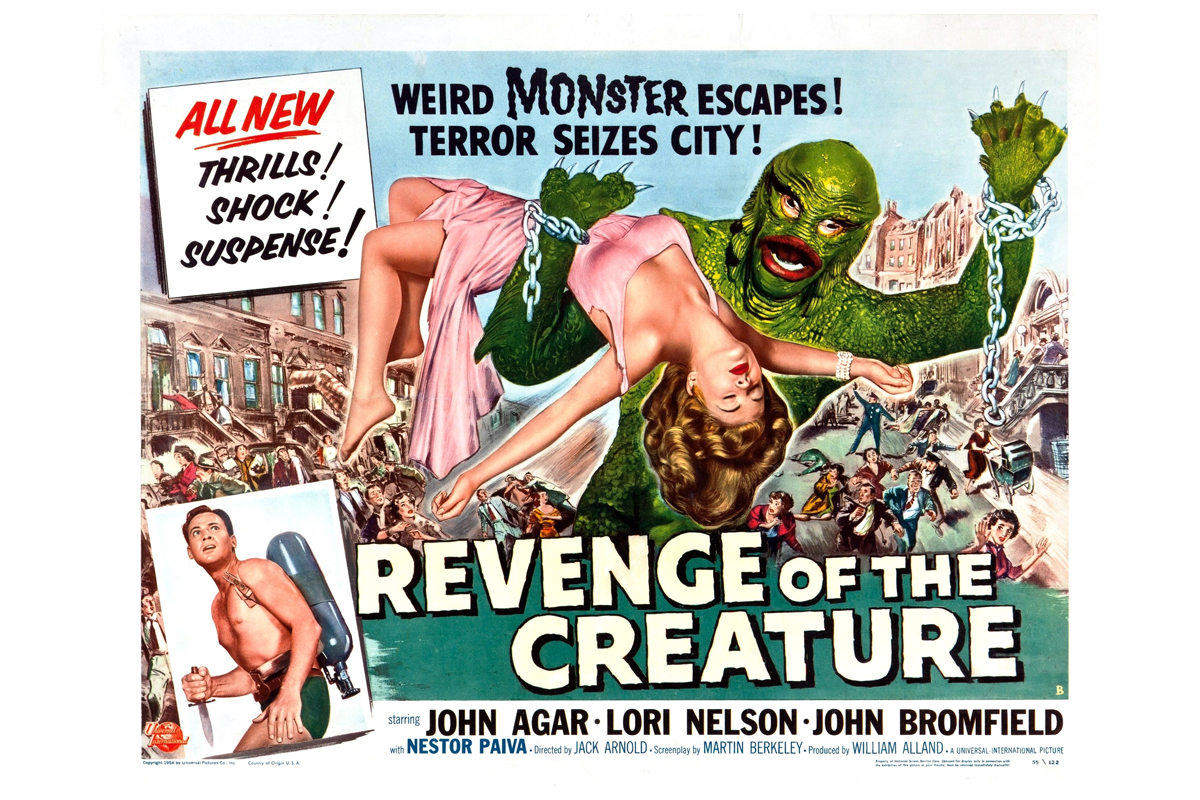
The most famous Hollywood film with a Flagler County connection is Revenge of the Creature, the 1955 sequel to Universal Pictures’ classic Creature from the Black Lagoon.
Important historical correction worth flagging: Creature from the Black Lagoon itself was not filmed at Marineland. The 1954 original was shot primarily at Wakulla Springs near Tallahassee (for the famous underwater sequences) and at Universal Studios in California (for the above-water scenes). Many tourism articles and local histories conflate the original and the sequel, but the Marineland connection is exclusively to the 1955 follow-up.
The plot of Revenge of the Creature is exactly what its title suggests. The Gill-man, the half-human, half-amphibian creature from the original film, is captured in the Amazon and shipped to Florida, where he is put on display and trained at an oceanarium. That fictional oceanarium is, transparently and unmistakably, Marineland of Florida, with the actual park serving as the location for the film’s central scenes. In the movie, scientists at Marineland attempt to train the creature using a cattle prod. The creature, predictably, does not respond well.
Several aspects of Revenge of the Creature make it historically significant:
The Marineland connection was not subtle. The film essentially serves as a feature-length advertisement for the park, with Marineland’s actual tanks, dolphins, sea lions, and signage all visible on screen.
The Lobster House scenes were filmed in Jacksonville. The film’s climax involves the Gill-man going on a rampage through Jacksonville, including a memorable scene at the Lobster House restaurant on the Southbank. Jacksonville residents were used as extras for those scenes, while St. Augustine and Flagler County locals were used for the Marineland scenes. The Lobster House restaurant burned down in the 1960s and is no longer standing.
It was Clint Eastwood’s first on-screen role. A 24-year-old Eastwood, completely uncredited, plays a lab assistant in a small scene. His character has perhaps a minute of screen time. Most viewers don’t notice him. Revenge of the Creature is, technically, the film that started Clint Eastwood’s career.
Ricou Browning played the Gill-man underwater. Browning, the Florida State University student and Wakulla Springs lifeguard who had played the underwater creature in the 1954 original, returned for the sequel. His underwater scenes at Marineland required him to perform inside the actual oceanarium tanks alongside the real dolphins and other marine animals.
The film was originally released in 3-D, like its predecessor, though most modern audiences see only the standard 2-D version.
Revenge of the Creature received mixed reviews at the time. It was less successful critically than the original, but it earned enough at the box office to justify a third entry in the series (The Creature Walks Among Us in 1956, which was filmed elsewhere and has no Flagler County connection). Today, the film is mostly remembered as Clint Eastwood’s debut, as a curiosity of 1950s monster cinema, and as the production that put Marineland on Hollywood’s map.
Sea Hunt (1958-1961)

Beyond feature films, the most successful television production with a Marineland connection was Sea Hunt, the syndicated adventure series starring Lloyd Bridges as ex-Navy frogman Mike Nelson. The show ran from 1958 to 1961 across 155 episodes, becoming one of the most popular syndicated television shows of the era.
Sea Hunt established many of the conventions of underwater adventure television. Bridges’ character used SCUBA gear, fought villains underwater, recovered sunken treasures, and rescued stranded divers. The show pioneered the kind of underwater action storytelling that would later inform films like the James Bond underwater sequences and modern SCUBA-themed thrillers.
Episodes of Sea Hunt were filmed at multiple Florida locations, including Marineland. The Marineland tanks provided the controlled environment necessary for the kind of choreographed underwater action sequences the show specialized in. Wide shots that needed open water were typically filmed at Silver Springs or in the Gulf of Mexico, but the technically difficult underwater stunt work and the close-up dramatic underwater sequences were often filmed at Marineland.
Ricou Browning, who had played the Gill-man in the Creature films, was deeply involved in the underwater filmmaking on Sea Hunt and went on to become a major underwater film director and producer for Ivan Tors Studios. His career, which started with a chance encounter at Wakulla Springs in 1953, was substantially built on work performed at Marineland and other Florida underwater filming locations throughout the 1950s and 1960s.
Zaat (1971): Florida’s Strangest Cult Film
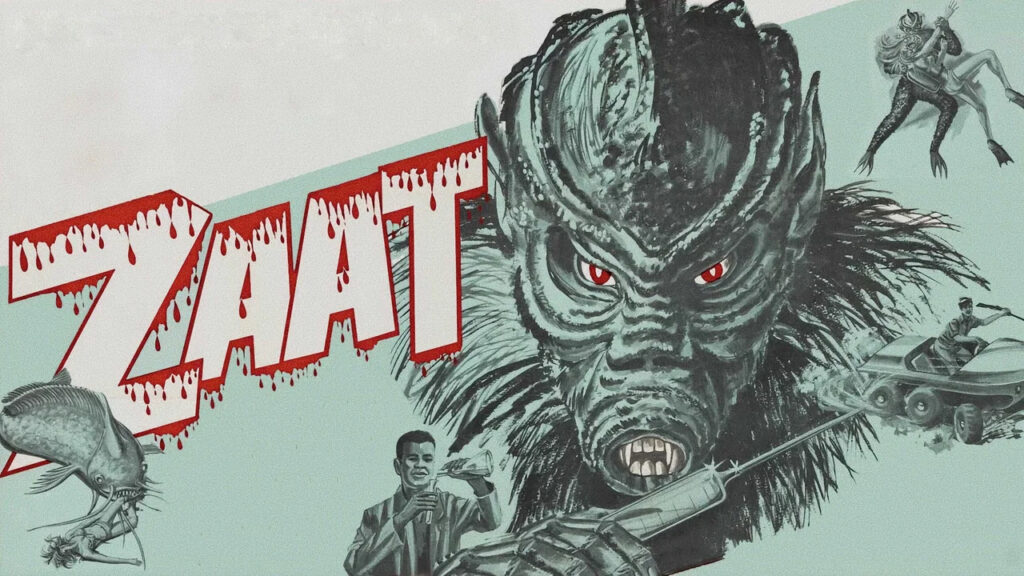
If Revenge of the Creature is Flagler County’s most famous Hollywood production, Zaat (1971) is by far its most strange.
Zaat is a low-budget Florida-produced horror film about a mad scientist named Dr. Kurt Leopold who turns himself into a giant walking catfish using a combination of electronic equipment, flashing lights, a giant syringe, and Marineland water tanks. As a giant walking catfish, he proceeds to kidnap “babelicious” victims for unspeakable experiments and to pollute Florida lakes so the fish living in them will grow and rise up against humanity. He is opposed by a beleaguered Southern sheriff, a solemn Black biologist, and agents from the Inter-Nations Phenomenon Input Team, who wear matching groovy jumpsuits.
That is, more or less, the actual plot of the actual film.
Zaat (also released under the alternative titles The Blood Waters of Dr. Z and Hydra) was directed by Don Barton and produced on a shoestring budget. Filming took place in 1970 and 1971 at multiple Northeast Florida locations, with major sequences shot at Marineland (where the catfish transformation scenes use the actual Marineland water tanks) and Green Cove Springs.
The film was not exactly successful. Reviews at the time and since have been almost uniformly negative, focusing on the shoddy creature suit, the plodding pace, the bizarre voiceover that opens the film for nearly twenty minutes before any character speaks, and the genuinely strange tonal choices throughout. One review summarized it as “the creature design was fairly shoddy, and it was blatantly obvious that it was just a guy in a rubber suit walking and swimming about.”
Hopes that Zaat would launch a Florida film industry quickly faded. Gordon Kipp wrote optimistically in The Daytona Beach News-Journal in 1972 that “Zaat may be the start of something big.” It was not the start of something big. It was, instead, the start of a long, eccentric afterlife.
In 1999, Zaat was featured on Mystery Science Theater 3000, the cult comedy series that lovingly mocked bad films. The MST3K treatment introduced Zaat to an entirely new generation of viewers, most of whom watched it specifically because it was bad.
In 2012, Zaat was released on DVD with a director’s commentary by Don Barton. Cinematique of Daytona, a movie-lovers organization in downtown Daytona Beach, hosted special screenings of the film with Barton in attendance, drawing significant local interest.
Today, Zaat enjoys a healthy cult following. It is freely available on the Internet Archive. It has been the subject of multiple academic articles on Florida cult cinema. It is genuinely beloved by a small but passionate community of bad-movie enthusiasts. And it remains, for better or for worse, one of the most distinctively Flagler County films ever made. The actor who played the catfish, Wade Popwell, has been celebrated at horror film conventions. Director Don Barton remained active in Florida film promotion for decades.
The film’s tagline, delivered earnestly in the trailer: “Beneath the calm, polluted waters… lurks the most terrifying monster of all!”
It is a perfect Florida B-movie. It has a perfect Flagler County connection. And it is, against all reasonable expectations, still being watched more than fifty years later.
Days of Thunder (1990)
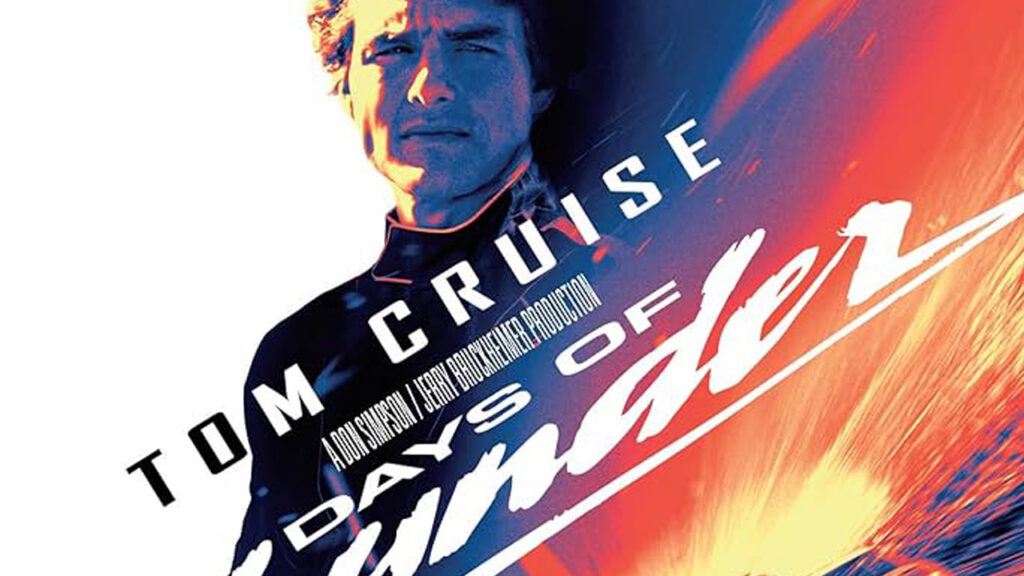
Credit to reader Robert Kornacki for the call out. The biggest Hollywood production with a confirmed Flagler County connection is Days of Thunder, the 1990 NASCAR drama starring Tom Cruise, Nicole Kidman, Robert Duvall, Randy Quaid, Cary Elwes, Michael Rooker, and a cameo-heavy roster of real NASCAR legends including Richard Petty, Rusty Wallace, Neil Bonnett, and Harry Gant. Directed by Tony Scott (Top Gun, Crimson Tide) and produced by Jerry Bruckheimer and Don Simpson, the film grossed nearly $158 million worldwide and was Cruise and Kidman’s first time on screen together.
Most of Days of Thunder was filmed at the major NASCAR tracks the story revolves around: Daytona International Speedway, Charlotte Motor Speedway, Darlington Raceway, Bristol Motor Speedway, North Wilkesboro, and Phoenix Raceway. But Flagler County was on the production map too. Flagler Executive Airport in Bunnell (then known as Flagler County Airport) served as a filming location for the production, which makes sense given the airport’s proximity to Daytona International Speedway, just 30-some miles to the south.
The exact scenes filmed at Flagler Executive Airport are not well documented in the surviving production records. The most likely use was as a base for the aerial filming work that was central to Days of Thunder‘s racing sequences, including helicopter staging, location scouting flights, and possibly some of the aerial b-roll establishing shots that appear throughout the film. The airport’s two paved runways, both over 5,000 feet long, would have been more than sufficient for the production aircraft used by the Bruckheimer/Simpson production team. The airport itself was originally constructed during World War II as Naval Outlying Field Bunnell, an auxiliary airfield supporting flight training operations from nearby Naval Air Stations in Jacksonville, Daytona Beach, and DeLand. By 1989-1990, when Days of Thunder was filming, it was a quieter general aviation airport, well-suited to hosting a film production without the kind of commercial traffic congestion that would have complicated work at Daytona Beach International.
For Flagler County, the Days of Thunder connection represents the highest-profile mainstream Hollywood production ever to have used a local filming location. Where Revenge of the Creature and Zaat are cult and B-movie credits, Days of Thunder is genuine A-list Hollywood: a $60 million Bruckheimer production starring the biggest movie star of the era, scored by Hans Zimmer, with a Whitesnake song on the soundtrack and a real Daytona 500 backdrop. Tom Cruise was, briefly, working in Flagler County. Most local residents have no idea.
Other Productions at Marineland
Beyond the major productions above, Marineland has hosted a steady stream of smaller film and television projects throughout its history. Most of these were:
- Nature documentaries focused on dolphins, sharks, and other marine life. Some appeared on networks like National Geographic, Discovery Channel, and Animal Planet over the decades.
- Educational films for schools, scientific institutions, and conservation organizations.
- Television commercials using the oceanarium tanks for product shots involving water, marine life, or “tropical” backgrounds.
- Local news coverage and travel features that, while not strictly “Hollywood,” documented Marineland for regional and national audiences.
The full filmography of Marineland productions is genuinely extensive but mostly anonymous. The original 1938 mission of “bringing the sea ashore” for film cameras has been quietly fulfilled, in fragmented form, for nearly nine decades.
Beyond Marineland: Other Flagler County Filming
While Marineland dominates the Flagler County film story before 1990, the rest of the county has occasionally hosted productions as well, particularly in the modern era.
The Atlantic beaches along Flagler Beach, Painters Hill, MalaCompra Park, and Jungle Hut Park have appeared in various commercials, music videos, and independent films over the decades. The combination of cinnamon-colored coquina sand, low development, and dramatic dunes makes the Flagler coastline visually distinctive. Production crews have historically used this stretch when they needed “Florida beach” footage that didn’t include high-rises in the background.
Princess Place Preserve and Bulow Plantation Ruins, with their natural Old Florida settings and historical structures, have been used for period film and television projects, particularly historical documentaries about Spanish colonial Florida and the Seminole Wars.
Palm Coast’s canals and waterways have been used for boating commercials and lifestyle photography, particularly for Florida tourism marketing aimed at out-of-state retirees.
The Hammock and Hammock Beach Resort have appeared in luxury lifestyle and golf-themed productions, including some televised PGA-related content from the Conservatory and Ocean Courses.
The Modern Film Commission Era
In recent years, the City of Palm Coast has been listed as the official film commission for Flagler County by Film Florida (the state’s film and entertainment industry trade association). This means independent producers, advertising agencies, and other film projects have a formal channel for permits, location scouting, and production support in the area.
The Palm Coast film commission has been promoting the county’s filming assets including:
- 125 miles of trails through diverse Florida landscapes
- More than 70 miles of saltwater and freshwater canals
- 19 miles of Atlantic beaches with minimal development
- Multiple state parks with preserved historical structures
- The Hammock Dunes Bridge and Intracoastal vistas
- Town Center for modern, urban production needs
The Palm Coast and the Flagler Beaches tourism organization is also a designated film support partner. Productions interested in filming in the area can contact either organization for information on permits, location access, and lodging.
While Flagler County has not become a major production center comparable to Miami-Dade, Palm Beach, or Atlanta (each of which is dominant in the Southeast film market), the area has seen steady small-scale production interest throughout the 2010s and 2020s. Most modern productions are independent films, commercials, music videos, and travel/lifestyle content rather than major studio features.
The Cultural Legacy
Flagler County’s film history is, in some ways, perfectly representative of Florida’s broader cinema story. The dominant Florida productions are not Florida-set blockbusters. They are quirky, regional, often weird films that capture something specific about the state’s relationship to nature, water, and the strange edges of American culture.
Revenge of the Creature, with its captured swamp monster on display at a Flagler County tourist attraction. Zaat, with its mad-scientist-turned-walking-catfish polluting Florida lakes from his Marineland-based laboratory. Sea Hunt, with its idealized Atlantic adventures filmed in carefully controlled oceanarium tanks. These productions all share something distinctive: they treat Florida as a place where nature is mysterious, strangely powerful, and not quite under human control. They use Florida as the natural setting for stories about creatures, transformations, and the uneasy relationship between man and water.
That instinct continues today. When Florida shows up in modern film and television, it’s often in the same role: the place where weird things happen, the place where the natural world bites back, the place where ordinary American expectations break down at the edge of the swamp or the surf.
Flagler County’s small but distinctive Hollywood history is a real part of that broader Florida film story. The Gill-man came here. The walking catfish was made here. Lloyd Bridges dove here. Clint Eastwood made his first appearance on a Marineland soundstage here. Ricou Browning learned his craft here. Don Barton made the most weird-Florida film ever made here, and a Mystery Science Theater 3000 audience laughed at it 28 years later.
Most Flagler County residents have no idea any of this happened. The locations are still here, mostly. Marineland still operates. The beaches, dunes, and preserves still look much like they did when Zaat was lurching across them in 1971. The dolphins swimming behind the porthole windows are descendants of the same dolphins who watched Ricou Browning play the Gill-man underwater seventy years ago.
It’s not Hollywood. But for nearly 90 years, in a quiet, eccentric, mostly unknown way, Flagler County has been making movies. And the movies continue to find their way back to anyone willing to look for them.







You forgot about “Days of Thunder.” Many of the racing scenes were filmed at the Flagler County Airport, where a re-creation of a straight away was built on the taxiways.
You are absolutely right, Robert. We’ll add it now with credit for the call out!