



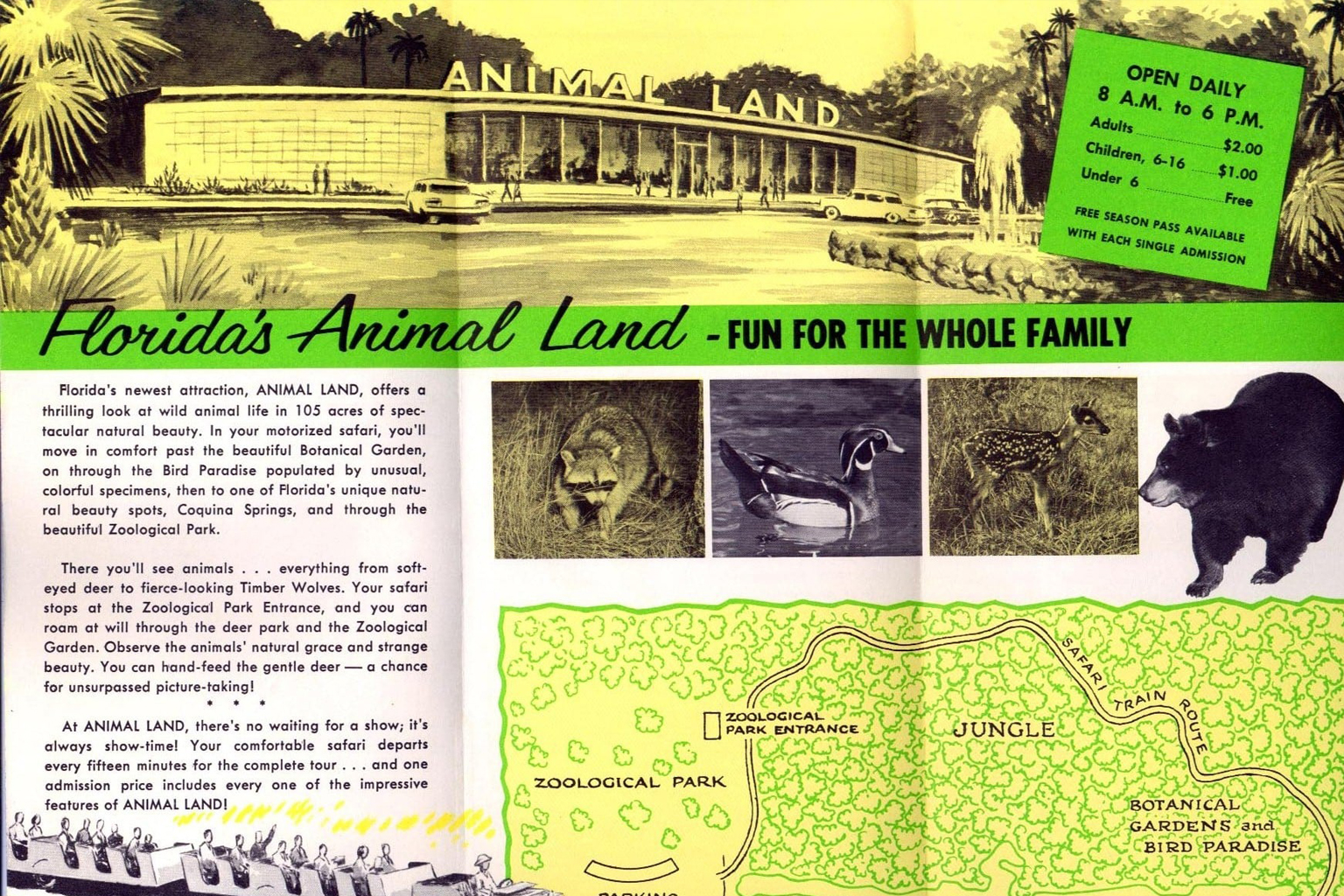
For a brief moment in the early 1960s, before Palm Coast existed and before Disney World transformed Florida tourism forever, a 105-acre roadside zoo and botanical garden sat on State Road A1A about three miles south of Marineland. It had a tram. It had animals. It had landscaped gardens. It had a name borrowed from a sister attraction in Michigan. And then, almost as quickly as it appeared, it was gone.
It was called Animal Land.
If you’ve lived in Palm Coast for years and you’ve never heard of it, that’s understandable. Animal Land operated for only two years. Most of the people who visited are now in their 70s or 80s. There are no roadside markers, no preserved buildings, no historical society plaques. The land it occupied is now part of the dense coastal corridor that includes Hammock Dunes, Beverly Beach, and the modern barrier island development that grew up around Marineland after the 1970s.
But Animal Land was real. And its story is a small but fascinating chapter in the long, strange history of Florida’s lost roadside attractions, that vanished American genre of mid-century family tourism that thrived along U.S. 1 and A1A before the interstate highway system and Walt Disney World rendered nearly all of them obsolete.
What Was Animal Land?
Animal Land was a roadside zoological park and botanical garden that operated from approximately 1962 to 1964 on State Road A1A in Flagler County, Florida, about three miles south of the much more famous Marineland of Florida.
According to Florida tourism historians who track the state’s pre-1972 roadside attractions, Animal Land sat on a 105-acre property and used a tram to take visitors through its combined botanical gardens and zoo exhibits. The Florida operation was affiliated with Animal Land of Grayling, Michigan, a sister attraction in the lower peninsula of Michigan that featured live exhibits of Michigan-native wildlife along with souvenirs and snacks. Whether the Florida location featured Michigan animals adapted to a southern climate, exotic species more suited to Florida tourism, or some combination of the two is not well documented in surviving records.
What is clear is that Animal Land was part of a broader cluster of small attractions that grew up around Marineland during the 1950s and 1960s. Marineland itself, which opened in 1938 as the world’s first oceanarium, was at the height of its popularity in this era, drawing as many as 900,000 visitors per year. Tourists driving A1A between St. Augustine and Daytona Beach passed Marineland and were natural targets for additional attractions trying to capture their dollars.
Animal Land wasn’t the only one. Just two miles further south, Parrot Village operated from approximately 1955 to 1962, a roadside parrot attraction five miles south of Marineland. The general pattern was clear: where Marineland brought the crowds, smaller attractions tried to siphon off some of the traffic with their own animal-themed tourist experiences.
The Era of Florida’s Roadside Attractions
To understand Animal Land, it helps to understand the era it was born into.
In the 1950s and early 1960s, Florida tourism looked dramatically different than it does today. Walt Disney World was still a decade away, opening on October 1, 1971. SeaWorld in Orlando didn’t open until 1973. Universal Studios Florida opened in 1990. Before any of those, Florida tourism was a sprawling, decentralized network of small, independently owned attractions clustered along the major highways: U.S. 1, U.S. 41 (the Tamiami Trail), U.S. 19, and the Atlantic A1A.
These attractions were almost all family-owned operations. They were small (typically a few acres to a few dozen acres). They were heavy on novelty (alligator wrestling, exotic birds, “world’s largest” something, mystery houses, jungle gardens). They thrived on highway billboard advertising and on the genuine excitement of mid-century American families taking their first car-trip vacation to Florida. Most charged a few dollars per car. Most operated on shoestring budgets. Most are gone.
Florida tourism historians have catalogued more than 185 lost Florida roadside attractions from this era. The names are evocative and often hilarious: Atomic Tunnel in Daytona Beach. Bongoland in Port Orange. Six Gun Territory in Ocala. Tragedy In The US Museum in St. Augustine. Frog City on the Tamiami Trail. Snake-a-Torium. Tussaud’s London Wax Museum at St. Petersburg Beach. House of Mystery in Haines City. Tropical Wonderland in Titusville. Africa USA in Boca Raton. Cypress Gardens Water Skiers. Marco Polo Park near Bunnell.
Animal Land was one of these. It opened in 1962, hoping to capture some of the tourist traffic flowing past Marineland. It closed in 1964. And then it disappeared.
Why Animal Land Failed (And Why Most Roadside Attractions Did)
The roadside attraction business was harder than it looked. Most operations were undercapitalized, run by families with more enthusiasm than experience. The animals required care and food and veterinary attention. The grounds required landscaping. The gift shop and snack bar required staffing. Insurance was a constant problem. Hurricane damage was always a risk. And the marketing required ongoing investment in billboards, brochures, and promotional materials.
Animal Land’s two-year run is short even by the standards of the genre. There are several plausible reasons it didn’t last:
- Direct competition with Marineland. Marineland was the dominant local attraction by an enormous margin. Visitors who had already paid to see dolphins and sea creatures may not have wanted to pay again three miles down the road for a smaller zoo and garden.
- Limited tourist season. The Florida tourist economy of the early 1960s was concentrated in the winter months. A 105-acre operation with extensive grounds and live animals had to be maintained year-round but only generated significant revenue for part of the year.
- The remote location. A1A south of Marineland in 1962 was genuinely undeveloped. There was no Hammock Dunes. There was no Palm Coast. Visitors had to make a deliberate choice to drive there, and most were already focused on Marineland as their A1A destination.
- Capital and operational challenges. Most small Florida roadside attractions of this era operated at the margins financially. A run of bad weather, a lawsuit, an animal escape, a single major equipment failure could end the operation.
Whatever the specific reason, Animal Land closed in 1964. The animals presumably were sold or transferred to other facilities. The botanical gardens were left to fend for themselves against the Florida climate, which would have reclaimed most of the landscaped areas within a few years. The 105 acres returned to a quiet stretch of A1A frontage.
What’s There Today
The site of the former Animal Land sits in what is now an unassuming stretch of A1A in unincorporated Flagler County, in the general area between Marineland and Beverly Beach. The exact parcel boundaries are not publicly documented in any easily accessible historical record.
In the years after Animal Land closed, the land in this area went through significant changes. Marineland itself remained the dominant landmark on this stretch of coast, though it would experience its own boom (peaking with Disney World’s opening in 1971, which boosted Florida tourism overall) and bust (devastating decline after SeaWorld opened in 1973, then near-bankruptcy through the 1980s and 1990s). The property west of A1A in this area, which would eventually become the Hammock and Hammock Dunes developments, remained largely undeveloped pine forest and scrub through the 1970s.
By the late 1980s, the Hammock Dunes Bridge opened, connecting mainland Palm Coast to the barrier island and accelerating development of the previously remote coastal area. ITT and its successors built the original Hammock Dunes oceanfront community. Hammock Beach Resort would eventually open as a major luxury resort and golf community.
Today, the general area where Animal Land once stood is mostly residential and resort development, broken up by stretches of remaining natural Florida coastal habitat. There is no marker. There is no preserved structure. There is no commemorative anything. If you didn’t know to look for it, you would never guess that a 105-acre tropical zoo and botanical garden had once welcomed tourists from this exact stretch of A1A.
Why Animal Land Matters
Animal Land matters not because it was particularly important or particularly successful, but because of what it represents.
The era of small, independently owned Florida roadside attractions was a genuine American cultural moment. For two or three decades after World War II, families in Ohio and New York and Pennsylvania piled into station wagons, drove south, and stopped at every billboard-promoted alligator farm and parrot jungle and orchid garden along the way. The attractions themselves were uneven (some wonderful, some genuinely awful) but the experience of road-tripping Florida and stopping at quirky, family-run roadside places was genuinely magical for kids and reasonably affordable for parents.
That entire ecosystem was destroyed almost overnight by three things: the interstate highway system (which let drivers bypass the old U.S. routes where most attractions sat), the rise of major theme parks (Disney World, SeaWorld, Universal) that consolidated tourism into massive concentrated destinations, and the broader shift in American vacation patterns away from car-trip family tourism toward fly-and-stay resort vacations.
By the late 1970s, most of Florida’s small roadside attractions were either gone or struggling. By the 1990s, almost all of them were gone. Today, only a small handful of the original mid-century roadside attractions still operate in something resembling their original form: Gatorland in Orlando (which opened in 1949), Wonder Gardens in Bonita Springs (1936), the St. Augustine Alligator Farm (which goes back to the late 19th century), and a handful of others that found ways to evolve and survive.
Marineland itself is a survivor in this group, though in a much-changed form as Marineland Dolphin Adventure operated by the Georgia Aquarium since 2011.
Animal Land was not a survivor. It joined the long list of vanished places: Africa USA, Bongoland, the Atomic Tunnel, Tropical Wonderland, Six Gun Territory, Cypress Gardens (the original), Marine Wonders, Parrot Paradise, and dozens of others. None of these places ever had a chance against the post-Disney transformation of Florida tourism.
But all of them, including Animal Land, were once real. People worked at them. People visited them. People remember them. They’re part of the deeper history of Flagler County and the broader Florida coast, the layer beneath the modern era of master-planned communities and luxury resorts.
Looking for Animal Land Today
For history-minded Palm Coast residents and visitors who want to explore this kind of vanished Florida, a few resources are worth knowing about:
The Flagler County Historical Society at the Holden House in Bunnell maintains the county’s primary historical archive. While the society’s focus is broader than just Palm Coast roadside attractions, staff there are often able to help researchers track down information on specific local history questions, including pre-ITT-era operations on A1A.
The Palm Coast Historical Society at Holland Park focuses primarily on Palm Coast’s history from the ITT era (1969 onward) but is increasingly engaged with the broader history of the area, including pre-Palm Coast roadside attractions and the long story of A1A development.
Florida Attractions History (floridaattractionshistory.com) is one of the best online catalogues of pre-1972 Florida roadside attractions. Their listings are where the basic facts about Animal Land’s dates, location, and Michigan affiliation are best documented.
The “Lost Roadside Attractions of Florida” lecture series has occasionally been presented at the Palm Coast Community Center, including a January 2025 program by Zach Zacharias that covered Animal Land alongside Bongoland, Six Gun Territory, Marco Polo Park, and other vanished attractions of the pre-Disney era.
Marineland Dolphin Adventure is itself an interesting living connection to the era. Visitors there are essentially walking on the same stretch of coast that Animal Land tourists experienced 60 years ago. The original Marineland and Animal Land were neighbors, though only one survived.
Two years of operation, 105 acres of tropical zoo and botanical garden, a tram, an unknown number of animals, a sister attraction in northern Michigan, and a quietly vanished memory along the A1A corridor. That’s Animal Land. A small, half-forgotten piece of pre-Palm Coast Florida tourism history, hidden in plain sight on a stretch of road that thousands of modern Palm Coast residents drive past every week without realizing what once stood there.
The bones are gone. The records are thin. But the story is real, and it’s part of how this place came to be what it is today.
Reader Comment: While Animal Land closed in 1964 and the era of small roadside zoos has largely ended, readers interested in seeing big cats in Northeast Florida today have at least one excellent option. Catty Shack Ranch Wildlife Sanctuary in Jacksonville, founded in 1996, is an accredited 501(c)(3) sanctuary that rescues and rehabilitates lions, tigers, leopards, cougars, and other big cats. Located about 90 minutes north of Palm Coast and just minutes from Jacksonville International Airport, the sanctuary is open to the public for educational tours. Unlike the 1960s roadside attractions covered in this article, Catty Shack operates as a nonprofit conservation and rescue facility rather than a commercial tourism operation.







You forgot Northeast Florida’s oldest big cat rescue Catty Shack Ranch Wildlife Sanctuary and Educational Park in Jacksonville, just minutes from the JAX airport.
Hey Kristi, we added a snippet at the end of article to shout-out Catty Shack Ranch.