
Drive east on Moody Boulevard until the asphalt meets the Atlantic, and you’ll find yourself in one of the last truly old-Florida beach towns left on the east coast. Flagler Beach has somehow resisted nearly everything that has reshaped the rest of the Florida shoreline — the high-rise condos, the chain hotels, the carnival tourism. The buildings still stop short of the dunes. The sand still glows that distinctive cinnamon color. The locals still wave from porches.
Behind that quiet charm is a surprisingly rich history — one that spans a railroad tycoon who never set foot in town, a homesteader with a vision, a pier that has survived a century of hurricanes, and a series of remarkable near-misses that helped Flagler Beach become exactly what it is today rather than something else entirely.
Here’s the story of how Flagler Beach came to be.
Before the Town: A Wild Stretch of Atlantic Coast
For most of recorded history, the long, narrow barrier island between the Halifax River and the Atlantic Ocean was almost entirely empty. Timucua and later Seminole peoples used the coast seasonally for fishing and gathering. Spanish colonial maps from the 1500s and 1600s noted the area but rarely described it in detail; there was little reason to settle on a stretch of dune-and-scrub that flooded easily and offered no natural harbor.
In the early 1800s, large plantations began to dot the inland reaches of what is now Flagler County. Bulow Plantation, just to the southwest of modern Flagler Beach, was at one point the largest sugar plantation on Florida’s east coast before being burned during the Second Seminole War in 1836. But the actual oceanfront — the dunes, the beach, the wild coastline — remained largely untouched for another half-century after that.
The coast wouldn’t truly begin its transformation until the railroad arrived. And to understand the railroad, you have to understand the man whose name Flagler Beach would eventually borrow.
The Henry Flagler Connection (And Why It’s Confusing)
Henry Morrison Flagler is one of the most consequential figures in Florida’s history. Born in upstate New York in 1830, he became a co-founder of Standard Oil alongside John D. Rockefeller, amassing one of the great fortunes of the Gilded Age. After visiting St. Augustine in the 1880s and finding it charming but undersupplied with hotels and reliable transportation, Flagler made it his second act to single-handedly transform Florida’s east coast into what he envisioned as an “American Riviera.”
Between 1885 and 1912, Flagler built a chain of grand hotels — the Ponce de Leon in St. Augustine, the Hotel Ormond near Daytona, the Royal Poinciana and The Breakers in Palm Beach, the Royal Palm in Miami — and connected them all with the Florida East Coast Railway, eventually extending the rail line all the way to Key West. He effectively founded Palm Beach, West Palm Beach, and modern Miami. Florida’s 53rd county was named in his honor in 1917, four years after his death.
But here’s where it gets interesting: Henry Flagler himself had very little direct connection to the small beach town that would eventually carry his name. He never built a hotel there. His railroad ran inland, through what is now Bunnell, not along the coast. The naming of Flagler Beach was, in a sense, an act of regional honor and postal necessity — not a tribute to a place Flagler had personally developed.
1909: The Bunnell Development Company and the First Land Sales
The real story of Flagler Beach begins in 1909, when two men — Isaac I. Moody and J.F. Lambert — formed the Bunnell Development Company and began selling parcels of land along the coast east of the Halifax River, often through the mail to families across the country. It was a classic Florida land scheme of its era: subdivide the wilderness, mail out brochures, and sell lots to dreamers looking for a fresh start in the Sunshine State.
Among the early buyers — and visionaries — was George Moody, Isaac’s son. George applied to homestead 169 acres on the barrier island east of what is now the Intracoastal Waterway. He saw something more than empty dunes. He saw a beach resort.
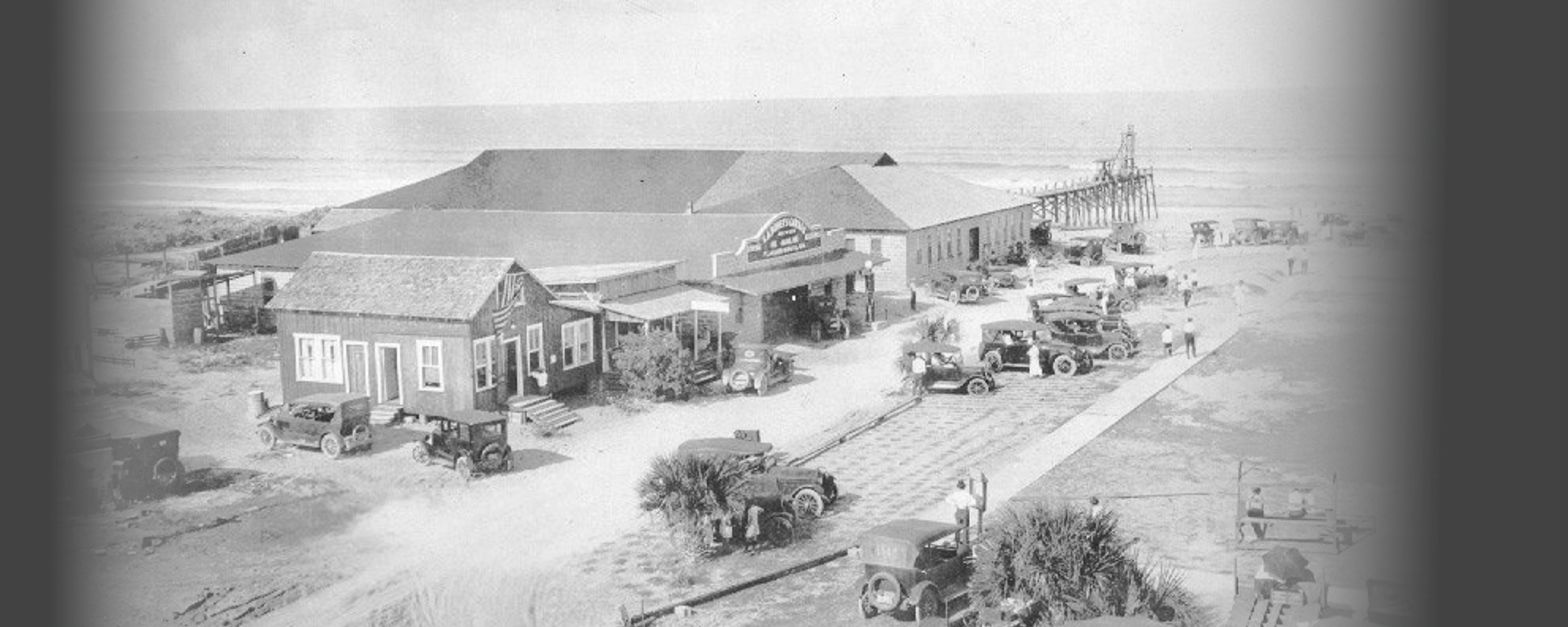
George Moody subdivided his property and named it Ocean City Beach, then began the slow work of turning a sand spit into a community. In 1914, he built the first house on the beach. In 1916, he built the Casino — a community gathering place that quickly became the social heart of the tiny settlement. Word spread. Mainland families began making the trek across the river to swim, picnic, and enjoy the cool Atlantic breeze.
Ocean City Beach was officially on the map.
1925: A Postal Problem and a New Name
By the early 1920s, Ocean City Beach was growing fast enough that residents wanted to formally incorporate as a town and establish their own post office. There was just one problem: when they applied for a postal permit, the U.S. Post Office Department informed them that the name was already taken. There was an Ocean City, New Jersey. There was an Ocean City, Maryland. A third would not be approved.
The community needed a new name — and quickly. They settled on Flagler Beach, a nod to Henry Flagler, the railroad and oil tycoon whose Florida East Coast Railway had made the development of this stretch of coastline possible (even though the rail line itself ran several miles inland through Bunnell). The county had been named for Flagler just eight years earlier in 1917, so the choice fit naturally.
In 1925, the city was officially incorporated as Flagler Beach. George Moody, the homesteader who had built the first house and the original Casino, became the city’s first mayor.
1928: The Pier That Defined a Town
If there is one structure that has come to symbolize Flagler Beach, it is the wooden fishing pier that stretches out from the foot of South 6th Street into the Atlantic. The pier was constructed in 1928, just three years after the town’s incorporation, originally extending an impressive 800 feet into the surf.
The pier transformed Flagler Beach. It became the town’s most recognizable feature — a destination for anglers, a draw for tourists, and a backdrop for nearly every postcard, painting, and photograph the community would produce for the next century. Generations of Flagler Beach kids learned to fish off the pier. Generations of visitors caught their first sunrise from its planks.
It was also, almost from the beginning, locked in a perpetual battle with the Atlantic Ocean.
A Century of Storms — and Survival
Flagler Beach sits exposed on Florida’s northeast coast, with no protective barrier islands to absorb hurricane energy and no significant inlet to disrupt longshore currents. The town has been hit, hard, repeatedly:
A 1984 nor’easter tore 432 feet from the pier, reducing its original 800-foot length by more than half. In October 2016, Hurricane Matthew ripped another 160 feet from what remained, while also undermining a 1.3-mile stretch of A1A on the south end of town and damaging dozens of public dune crossovers. Hurricane Irma in 2017 hit the recovering pier again. Hurricanes Ian and Nicole in 2022 finally did what nearly a century of storms had threatened — the pier was deemed unsafe and was closed to the public.
Each time, the town rebuilt. Each time, the pier came back. And each time, residents reaffirmed something that visitors often miss on their first trip to Flagler Beach: this is a place defined as much by its resilience as by its scenery.
The Pier Reborn
In early 2025, after years of FEMA negotiations, engineering studies, and design workshops, the City of Flagler Beach broke ground on a complete reconstruction of the iconic pier. The new pier, expected to be completed by the end of 2026, will stretch approximately 800 feet — restoring its original length — and stand more than 10 feet taller than the previous structure. It will be supported by reinforced concrete pilings and overlaid with wood planking to preserve the look and feel of the original wooden boardwalk.
The first 100 feet closest to shore — the section that has anchored the structure since 1928 — will be preserved and reinforced rather than demolished, retaining a tangible connection to the original. Some of the historic wooden boards salvaged from earlier reconstructions are also being preserved as part of the design.
Importantly, the project is being funded almost entirely through FEMA (75 percent) and Florida state disaster recovery funds (25 percent), meaning Flagler Beach property taxpayers are not directly footing the bill. As city officials have noted, the new design is engineered to withstand the wave action associated with a 500-year storm — though, as everyone in Flagler Beach knows, the Atlantic always gets the last word.
A1A, the Scenic Highway, and a Town That Refused to Change
One of the things that makes Flagler Beach genuinely unique among Florida coastal towns is its commitment to staying small. While neighboring stretches of A1A in Volusia County and St. Johns County have filled in with high-rises, condo developments, and chain hotels, Flagler Beach has kept its building heights low, its downtown walkable, and its commercial development modest by Florida standards.
State Road A1A, which runs the length of the town along the oceanfront, is designated as a Florida Scenic Highway — and the local commitment to preserving its character has been fierce. After Hurricane Matthew destroyed a 1.3-mile section of A1A in 2016, the road was rebuilt with engineered seawalls, beach renourishment, and dune restoration to protect against future storms while keeping the view intact.
The six-block downtown along Central Avenue still hosts the kind of independent boutiques, antique stores, art galleries, and family-run restaurants that have largely vanished from larger Florida beach towns. The First Friday festival, held the first Friday of every month at Veterans Park, draws live music, vintage cars, and pet-friendly events that feel like they could just as easily have happened in 1965.
Flagler Beach Today
Today, Flagler Beach is home to roughly 5,200 year-round residents, though that number swells significantly during the winter months and tourist season. The town spans about three square miles along the Atlantic, with six miles of beach, the Flagler Beach Historical Museum on South Central Avenue preserving the community’s past, and a growing reputation as one of Florida’s last great undiscovered coastal communities.
Surfers come for the consistent waves. Anglers come for the surf fishing and (eventually) the rebuilt pier. Birders come for the diverse coastal habitat. Foodies come for the independent oceanfront restaurants. Dog owners come because Flagler Beach is one of the few places on the Florida coast where dogs are genuinely welcome on the beach. Cyclists come for the A1A River to Sea Trail, which winds along the dunes for miles.
What they all leave with, almost invariably, is the same observation: Flagler Beach feels like the Florida that everyone else has either forgotten or paved over. The buildings stay low. The pace stays slow. The pier — even when it’s under construction — stays the symbol of a town that has weathered everything the Atlantic has thrown at it for a hundred years and has every intention of being here for another hundred more.
A homesteader’s vision, a postal department’s name change, a tycoon’s borrowed legacy, a wooden pier, and a stubborn refusal to be like everywhere else — that’s the history of Flagler Beach. And the story is still being written.