On June 23, 1938, more than 30,000 cars clogged Florida’s State Road A1A south of St. Augustine to attend the grand opening of an attraction unlike anything that had ever existed in the world. It was called Marine Studios. It was promoted as “the world’s first oceanarium,” a brand-new word coined to describe what Marine Studios actually was. And it had been built, at staggering expense, by an unlikely group of investors that included a great-great-grandson of Commodore Cornelius Vanderbilt, a chairman of Pan American Airways, a Standard Oil heir, and the grandson of Leo Tolstoy.
The original purpose of Marine Studios was not tourism. It was movie-making. In an era before SCUBA gear, before waterproof cameras, before any reliable technology for filming underwater, a group of wealthy adventurers decided to build the ocean indoors so that Hollywood could finally shoot it. The slogan was “bring the sea ashore.” The idea was that filmmakers would rent out the giant ocean-water tanks to capture footage of marine life that no one had ever been able to film before.
What happened instead is one of the strangest accidental success stories in the history of American tourism. The film studio became an aquarium attraction. The aquarium attraction became a phenomenon. The phenomenon spawned an entire town that incorporated itself just two years later. The town and the attraction became, for several decades, one of Florida’s most-visited destinations. Then Disney happened. Then hurricanes. Then a long quiet decline. Then, against most odds, a 21st-century rebirth as a focused conservation and education center now operated by the Georgia Aquarium.
This is the full story of Marineland, Florida, the world’s first oceanarium and one of the most remarkable cultural inventions in the long history of American tourism.
The Founders
The story of Marineland begins with four men who shared an interest in film, exploration, marine biology, and the kind of large-budget projects that were possible only for the heirs of Gilded Age fortunes.
W. Douglas Burden was the lead founder. A great-great-grandson of Commodore Cornelius Vanderbilt, the railroad and shipping magnate who built one of America’s largest 19th-century fortunes, Burden was a trustee of the American Museum of Natural History in New York and a serious naturalist in his own right. He had led an expedition to capture Komodo dragons for the museum in the 1920s, an experience that reportedly inspired the original concept for King Kong. He served as Marine Studios’ first president.
Cornelius Vanderbilt “Sonny” Whitney was Burden’s cousin and the project’s chairman. Whitney was the chairman of Pan American Airways, a producer involved in the making of Gone With the Wind, and another trustee of the American Museum of Natural History. He combined enormous family wealth with active business interests in aviation and entertainment. The Whitney family’s involvement would shape Marineland’s history for the next half-century.
Sherman Pratt was the third founder. His grandfather Charles Pratt had been one of John D. Rockefeller’s partners in Standard Oil, making the Pratt family one of America’s wealthiest petroleum dynasties. Sherman Pratt was connected with RKO Pictures and was an active member of the Explorers Club. He brought both Hollywood connections and serious capital to the project.
The fourth founder was the most romantic figure of the group. Count Ilya Andreyevich Tolstoy was the grandson of Leo Tolstoy, the legendary Russian author of War and Peace and Anna Karenina. Born in Russia, the younger Tolstoy was a noted naturalist and explorer who had led expeditions to Tibet and other remote parts of the world. He shared his fellow founders’ interest in natural history and filmmaking. The presence of a Tolstoy among the investors gave Marine Studios an instant cultural cachet that pure American wealth could not have provided alone.
Together, these four men set out to build something that had never existed.
The Concept: Bring the Sea Ashore
The original idea, conceived in 1937, was specific and surprisingly practical. Filmmakers in the 1930s had no good way to capture underwater footage. SCUBA gear was still being invented (Jacques Cousteau wouldn’t co-invent the Aqua-Lung until 1943). Waterproof cameras barely existed. Underwater scenes in movies of the era were mostly faked using miniature models or shot in tanks at the studio.
The Marineland founders proposed a different solution. Instead of bringing cameras underwater, they would bring the underwater up to the cameras. They would build huge tanks of seawater, stock them with live marine animals, and install windows so that filmmakers could shoot through the glass. The tanks would be large enough to recreate something resembling an actual ocean environment, and the animals inside would behave naturally enough to provide authentic-looking footage.
The location they chose was a stretch of barrier island on Florida’s Atlantic coast about 20 miles south of St. Augustine, on the border between what is now Flagler County and St. Johns County. The site had several advantages. It was relatively free of major hurricanes (a critical consideration for a project this expensive). It was close to Jacksonville, which had once been a hotbed of American filmmaking before the industry consolidated in California. The barrier island was narrow enough that they could build their oceanarium on the ocean side of A1A and dock filmmakers’ boats on the Intracoastal Waterway side. And the land was relatively cheap.
Construction was carried out by the Arthur Franklin Perry Co. of Jacksonville, the engineering firm that handled the enormous technical challenge of building tanks capable of holding hundreds of thousands of gallons of seawater while remaining structurally sound. The original Circular Oceanarium held approximately 400,000 U.S. gallons. The Rectangular Oceanarium held approximately 450,000 gallons. Together they constituted what the founders proudly called the world’s first oceanarium.
A new word was coined to describe what they had built. “Oceanarium” was distinguished from “aquarium” by a crucial design choice: marine species lived together in the tanks, mingled, as they would in the actual ocean. Traditional aquariums kept species segregated by tank, isolated from each other. Marine Studios was the first facility in the world that deliberately mixed dolphins, sharks, sea turtles, fish of dozens of species, eels, and other marine life in shared tanks designed to approximate natural ocean conditions.
The tanks were constructed with more than 200 porthole windows so that visitors and filmmakers could see directly into the underwater world. The windows were arranged at multiple heights, allowing viewers to observe marine life at every depth.
A complex system of seawater intake pipes ran 50 feet under the sand and out into the Atlantic Ocean. Pump stations called “galleries” pumped the water from those pipes to a filtration plant. The filtered seawater was then circulated through the oceanariums and discharged into the Intracoastal Waterway. A dedicated team of pump crews maintained the system 24 hours a day. Water was treated with copper sulfate to control algae growth, with on-site lab crews monitoring concentrations. This water-treatment method was itself one of Marineland’s earliest scientific contributions to the emerging field of marine animal husbandry.
The Grand Opening, June 23, 1938
When Marine Studios opened to the public on June 23, 1938, the founders expected modest tourist interest. They got a phenomenon.
Estimates of the opening day attendance vary in surviving accounts. Some sources cite over 20,000 visitors. Others cite 30,000. Either way, the result was the same: A1A was completely overwhelmed. Cars clogged the highway in both directions for miles. Photographers lined up to capture the event. The relatively quiet stretch of coast suddenly held the largest crowd it had ever experienced.
The main attraction on opening day was a bottlenose dolphin. To 1938 American audiences, the chance to actually see a live dolphin up close, swimming naturally in a giant tank, was genuinely revolutionary. Most Americans had never seen a marine mammal in person. Most knowledge of dolphins, whales, sharks, and other ocean creatures was confined to sailors, fishermen, and a handful of scientists. Marine Studios opened the underwater world to ordinary tourists for the first time.
The founders’ filmmaking concept was almost immediately overwhelmed by the tourism reality. Yes, films would be made at Marine Studios over the decades to come. But what they had really built, without quite intending to, was the first modern marine theme park.
The Discovery That Changed Everything
The pivotal moment in Marine Studios’ early history was an accident.
In the facility’s early years, divers regularly entered the oceanarium tanks to feed the animals by hand. The dolphins, being highly intelligent and quickly recognizing that divers carried food, learned to swarm the ladders the moment a diver descended. This was a problem. The other species in the tanks were getting outcompeted for food.
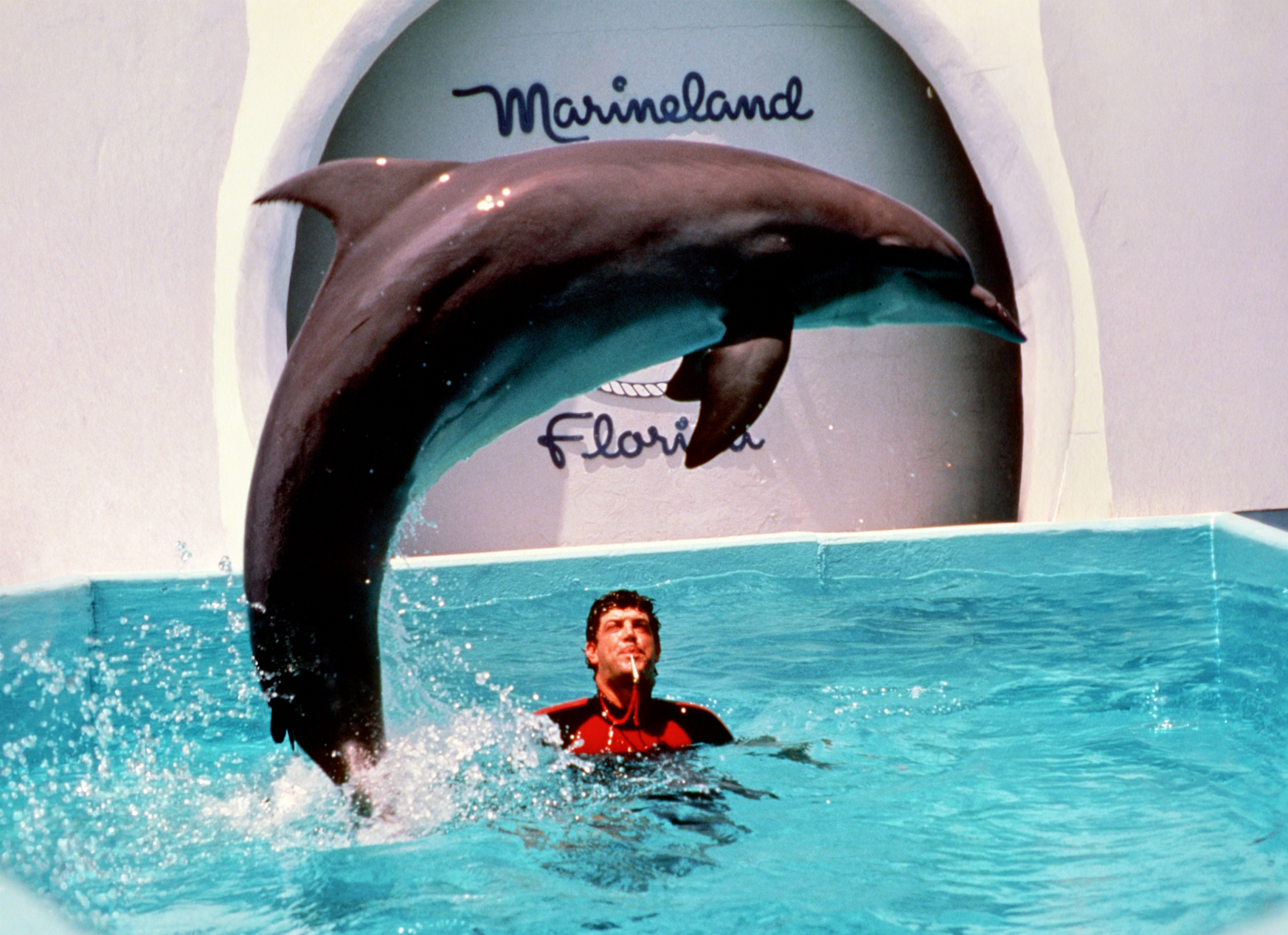
One day, in an attempt to distract the dolphins, a diver threw a fish out into the water away from the ladder. To everyone’s surprise, a dolphin leaped up out of the water and caught the fish in midair.
The watching audience cheered. The diver and the staff stared at each other. They had just discovered, completely by accident, that dolphins could be trained.
This realization changed everything. Within months, Marine Studios staff began deliberately training dolphins to perform behaviors on cue. Within a few years, dolphin shows became the primary attraction. Visitors who came to look through portholes at swimming sea creatures could now also watch live performances of dolphins jumping, retrieving objects, ringing bells, and (eventually) pulling small boats and surfboards.
The discovery that dolphins were intelligent and trainable was one of the most consequential moments in the history of human-marine mammal interaction. Every dolphin show ever performed at SeaWorld, every “swim with the dolphins” experience at every resort in the world, every research program studying dolphin cognition, traces its lineage back to that one accidental moment at Marine Studios in the late 1930s. It happened in Flagler County. Almost no one outside the area knows.
The Famous Visitors
Marine Studios’ combination of novelty, celebrity-investor pedigree, and oceanfront location made it an instant fashionable destination. Within a few years of opening, the attraction had become a regular stop for some of the most famous figures in mid-20th-century American culture.
First Lady Eleanor Roosevelt visited and wrote about Marine Studios in her syndicated newspaper column “My Day.” Her endorsement gave the attraction national legitimacy.
Ernie Pyle, the legendary war correspondent, visited and proclaimed it “something absolutely new in Florida.”
Ernest Hemingway was a regular visitor to Moby Dick’s Bar, the on-site lounge attached to the Dolphin Restaurant. Hemingway, who lived in Key West for much of the 1930s and was a passionate deep-sea fisherman, found Marine Studios a natural extension of his interests.
John Dos Passos, the modernist American novelist, was another regular at Moby Dick’s.
Thornton Wilder, the Pulitzer Prize-winning playwright (Our Town, The Skin of Our Teeth), visited.
Sigrid Undset, the exiled Norwegian Nobel Prize-winning novelist, visited during her time in the United States.
Robert Benchley, the legendary humorist and Algonquin Round Table member, visited so frequently that he was named honorary mayor of Marineland. (His grandson Peter Benchley would later write Jaws, giving the family a strange double connection to American marine wildlife pop culture.)
William Rose Benet, the Pulitzer Prize-winning poet whose family roots traced back to a prominent St. Augustine Minorcan lineage, was inspired by Marine Studios to write a children’s book about dolphins. He also mentioned Marineland in his autobiographical work The Dust Which Is God. His brother Stephen Vincent Benet (author of The Devil and Daniel Webster) visited as well.
Most famously, Marjorie Kinnan Rawlings, the Pulitzer Prize-winning Florida author of The Yearling and Cross Creek, was a regular presence at Marineland for personal reasons. Her husband, Norton Baskin, took over operation of the Dolphin Restaurant and Moby Dick’s Bar after World War II and managed the facility for many years. Rawlings had a beach house not far north of Marineland and spent significant time at the attraction.
For several decades, Marineland was a literary, cultural, and political crossroads. It was the kind of Florida destination where a war correspondent, a Nobel laureate, a Pulitzer winner, and a Tolstoy descendant might all be present in the same week.
The War Years and a Shark Repellent
When the United States entered World War II in December 1941, Marine Studios faced a crisis. Tourism collapsed. Many staff members enlisted. The facility temporarily closed to the public.
But the closure didn’t mean the marine biology research stopped. During the war years, scientists working at Marine Studios developed something genuinely consequential: a shark repellent designed to aid the survival of shipwrecked sailors and downed pilots in the Atlantic and Pacific. The repellent was tested in Marine Studios’ tanks using captive sharks, and the formula was eventually adopted by the U.S. Navy and Army Air Forces for inclusion in survival kits issued to flight crews.
The wartime contribution was a small but real piece of the World War II story, and it confirmed that Marine Studios had become much more than a tourist attraction. It was a working marine biology laboratory whose research had real-world applications.
When the facility reopened to the public in 1946, the post-war tourism boom was about to transform it.
The Town of Marineland
In 1940, just two years after the attraction opened, the surrounding settlement was incorporated as the Town of Marineland, Florida. (Some sources cite 1946 as the incorporation year, reflecting confusion in the historical record; the most reliable accounts place the incorporation at 1940.)
The town was tiny by any conventional measure. It existed primarily to support the attraction and the small group of staff, scientists, and family members who lived on the immediate property. Its government structure was simple: one mayor, one commissioner, and a handful of town staff. Its population has historically hovered between roughly 10 and 25 residents.
According to current Marineland Dolphin Adventure historian Terran McGinnis, “I don’t even know if this is true anymore, but for a long time, we always said we’re the only town where there are more dolphin residents than human residents.”
The Town of Marineland straddles the border between Flagler County and St. Johns County. Most of the actual park property is in Flagler County, but the town’s address technically uses a St. Augustine, Florida ZIP code. Streets bear names like Tolstoy Lane, the official address of the Marineland Marina.
The Postwar Boom
The 1950s and 1960s were Marineland’s golden age. The facility expanded steadily. New tanks were added. A larger gift shop opened in 1954. A proper laboratory was constructed in 1953. A new administration building replaced the original in 1962. The roof was added to the dolphin stadium in 1961, and that same year the marketing officially shifted from “Marine Studios” to “Marineland.” The town and the attraction became, in popular awareness, one and the same.
Annual attendance peaked at approximately 900,000 visitors per year during this era. By comparison, that’s roughly the same annual attendance Disney’s Animal Kingdom recorded in some of its slower years. For a single Florida coastal attraction in the pre-Disney era, 900,000 visitors annually was extraordinary.
The facility offered a wide range of amenities beyond the oceanariums:
- The Marineland Motel (also operating at various times as Marine Village Court and Quality Inn/Marineland)
- The Dolphin Restaurant managed by Norton Baskin
- Moby Dick’s Lounge, designed to rock like a ship at sea
- The Periwinkle Snack Bar and Sandpiper Snack Bar
- The Marineland Marina
- A Texaco service station adjacent to the Periwinkle
- A regular Greyhound Bus Lines stop
- A fruit shop and gift shop
- A pier at the north end of the facility
The whole complex covered approximately 125 acres at its peak.
Hollywood Comes Calling
The original purpose of Marine Studios as a film production facility was, eventually, fulfilled. The most famous productions filmed at Marineland include:
Revenge of the Creature (1955) is the direct sequel. In the film’s plot, the captured creature from the original is put on display at Marineland itself, where it’s trained with a cattle prod. The fictional Marineland in the movie is, of course, the actual Marineland providing the location.
Sea Hunt (1958-1961) was a popular television series starring Lloyd Bridges as scuba diver Mike Nelson. Episodes filmed at Marineland.
Zaat (1971), a low-budget locally produced cult horror film about a mad scientist who turns himself into a giant walking catfish, was partially filmed at Marineland and remains a beloved curiosity in the Florida cult film canon.
Various commercials, nature documentaries, and television specials over the decades also used Marineland’s tanks for footage that would have been impossible or prohibitively expensive to capture in the open ocean.
Nellie the Dolphin: A 61-Year Resident
One of the most beloved residents of Marineland was Nellie, a bottlenose dolphin born at the facility on February 27, 1953. Nellie lived her entire 61-year life at Marineland, an extraordinary lifespan for a captive dolphin and a testament to the quality of care she received.
When Nellie was born in 1953, Eisenhower was president, Marineland was at the height of its postwar boom, and Disney World didn’t exist. When she died in 2014, six different presidents had served, Disney World had been open for 43 years, SeaWorld had risen and faced major public controversy, and Marineland itself had been through bankruptcy, closure, demolition, reconstruction, and acquisition by the Georgia Aquarium.
Nellie’s son and grandson continue to live at Marineland today, providing a multigenerational dolphin family connection that almost no other facility in the world can match.
The Decline
The first sign of trouble was Walt Disney World, which opened on October 1, 1971. Counterintuitively, the immediate impact on Marineland was positive. Disney World drew millions of new tourists to Florida overall, and many of them took side trips to the existing attractions, including Marineland. Annual attendance surged in the early 1970s.
Then SeaWorld Orlando opened in 1973.
SeaWorld was the first major theme park specifically designed to compete with Marineland’s marine mammal niche. With Disney-level marketing budgets, central Florida location, much larger tanks, more elaborate shows, and the kind of integrated tourism infrastructure that Disney was pioneering, SeaWorld immediately captured a huge share of the marine mammal tourism market.
Marineland’s decline began almost immediately. By the late 1970s, attendance had fallen sharply. By the early 1980s, the original founders were aging or gone. In the mid-1980s, Cornelius Vanderbilt Whitney sold Marineland to a group of investors, beginning a long series of resales and ownership changes that would ultimately destabilize the facility.
The University of Florida established the Whitney Marine Laboratory adjacent to Marineland in 1974, providing some institutional continuity to the broader Marineland identity. But the tourist attraction itself entered a long, painful decline.
Throughout the 1980s and 1990s, the park struggled. Maintenance was deferred. Hurricanes did damage that wasn’t fully repaired. The original 1938 oceanariums, despite their historic significance, were aging structures that hadn’t been built to last forever. Multiple ownership changes left no consistent management. A nonprofit corporation was eventually established to keep Marineland operating, but operations were marginal at best.
The 1999 Hurricanes and the Aftermath
In 1999, Hurricanes Floyd and Irene caused extensive damage to Marineland and forced a two-month closure. The famous boardwalk was destroyed. The walkways to Whitney Park collapsed due to erosion. The filtration plant was threatened with falling into the ocean. The iconic Marineland sign was damaged.
In 2003, all of the park buildings west of A1A were demolished, leaving only the original structures along the Atlantic Ocean and the original administration building.
In 2004, after being battered by three more hurricanes, Marineland closed completely for major renovations as part of a development scheme by the Atlanta-based developer Jim Jacoby, who had purchased the property in 2001. During the renovation, the heart-wrenching decision was made to demolish the original 1938 Circular Oceanarium and Rectangular Oceanarium, along with the 1952 stadium and tanks, all of which had deteriorated beyond repair.
The demolition of the 1938 oceanariums was the end of an era. The world’s first oceanariums, the literal physical structures that had given the word “oceanarium” its meaning, no longer existed.
The Rebirth
On March 4, 2006, Marineland reopened to the public as the Marineland Dolphin Conservation Center. In a gesture of historical respect, the new operation offered admission at the original 1938 price of one dollar for the reopening.
The new Marineland was fundamentally different from the old. The mission shifted from entertainment-driven tourism to conservation, education, and research. The dolphin shows of the postwar era gave way to small-group educational encounters. The emphasis was on understanding marine mammals rather than performing them.
In 2008, three bottlenose dolphin calves were born at the facility, the first generation of dolphins born into the new conservation-focused era. Two males and one female, they were named in November 2008 and continue to be part of the Marineland family.
In January 2011, the Atlanta-based Georgia Aquarium, the largest aquarium in the United States, purchased Marineland’s Dolphin Conservation Center for a reported $9.1 million. The facility was renamed Marineland Dolphin Adventure, the name it operates under today.
On May 31, 2018, Marineland reopened its iconic historic arch entrance at a special ceremony, celebrating the facility’s 80-year history. The arch had been a recognizable visual landmark of the original Marineland for decades, and its restoration was a deliberate effort to honor the historical legacy while operating in the modern era.
Marineland is officially designated a Florida Heritage Site, with its own state historical landmark sign acknowledging its role as the world’s first oceanarium and one of Florida’s most historically significant tourist attractions.
Marineland Today
The current Marineland Dolphin Adventure offers a much smaller, more focused experience than the postwar Marineland of dolphin shows and 900,000-visitor years. Most operations focus on:
- Dolphin encounters of various levels, from simple touch-and-feed programs to in-water swim experiences
- Educational programs for schools, summer camps, and visiting groups
- Research and conservation activities operated in coordination with the Georgia Aquarium
- Sea turtle, shark, and other marine life exhibits in habitats designed for animal welfare and education rather than spectacle
- The original arch entrance, restored as a historical landmark
- The adjacent University of Florida’s Whitney Laboratory for Marine Bioscience, which continues serious marine research and operates a sea turtle hospital open for public tours
The Town of Marineland still exists, with a population of approximately 15 to 20 human residents. The Marineland Marina continues to provide protected docking for cruising yachts on the Intracoastal Waterway.
What’s gone is the carnival atmosphere of the postwar peak. The Dolphin Restaurant is closed. Moby Dick’s Bar is closed. The motel, the Texaco station, the Greyhound stop, and most of the support amenities are gone. The 1938 oceanariums themselves are gone, replaced by smaller, modern habitats designed to current marine mammal welfare standards.
What remains is the soul of the place: the world’s first oceanarium, in a small Flagler/St. Johns County town that still bears its name, still operating, still teaching, still working with the descendants of dolphins whose ancestors were the first ever bred in captivity.
Recent Developments (Spring 2026)
In the months following the December 2025 ownership transfer, Marineland under Apex Associates has begun signaling its direction. In March 2026, the oceanarium announced two notable developments.
In a St. Patrick’s Day fundraising drive between March 14 and 21, Marineland raised $20,000, doubled from an initial $10,000 goal after an anonymous donor offered to match individual contributions. According to a report by the Palm Coast Observer, the funds will be used to enhance Marineland’s water quality and treatment systems.
“It’s an amazing community,” Marineland Director Jack Kassewitz told the Observer. “I’ve lived in not a lot of places, but this is the most sensitive, caring community I’ve ever been [in].”
Marineland also announced the appointment of Jason Bruck, a marine mammal scientist and associate professor of biology at Stephen F. Austin State University in Texas, as the facility’s new Director of Research and Education. Bruck has spent two decades researching dolphin communication and cognition, and his lab has developed drone technology for collecting blow samples from dolphins and porpoises in wild health assessments.
According to the Observer report, Bruck will lead Marineland’s 2026 summer camps for students ages 7 to 17, providing access to working researchers as they learn how scientists study marine life. His academic appointments are also expected to open new university collaboration opportunities for Marineland, both in Florida and at Stephen F. Austin in Texas.
Kassewitz characterized the focus on education and research as a return to Marineland’s original mission. “We’re taking it back, and yet still going forward in terms of the importance of good research, good scientific research,” he told the Observer.
Marineland is also reinstating its immersion program for visitors.
Marineland’s Legacy
The historical significance of Marineland is hard to overstate.
It coined the word “oceanarium” and invented the concept of mixed-species marine display.
It accidentally discovered that dolphins could be trained, launching the entire global dolphin show industry.
It pioneered marine animal husbandry techniques (water filtration, copper sulfate treatment, captive breeding) that became industry standards.
It contributed war-effort research that saved an unknown number of shipwrecked sailors and downed pilots in WWII.
It served as a filming location for cultural artifacts including Creature from the Black Lagoon and Revenge of the Creature.
It hosted Eleanor Roosevelt, Ernest Hemingway, Marjorie Kinnan Rawlings, Robert Benchley, and a who’s who of mid-20th-century American literary culture.
It anchored Florida tourism on the northeast coast for more than three decades.
It survived the Disney/SeaWorld revolution that destroyed dozens of comparable mid-century attractions.
It rebuilt itself in the 21st century as a focused conservation and education center under the Georgia Aquarium’s stewardship.
A great-great-grandson of Cornelius Vanderbilt. A Tolstoy. A Pratt heir from Standard Oil. A trustee of the American Museum of Natural History who maybe inspired King Kong. Four men in 1937 who decided to bring the sea ashore for film cameras, accidentally invented the modern marine theme park, and built something that has now operated, in one form or another, for nearly 90 years on the same stretch of Florida barrier island.
The slogan was always “the world’s first oceanarium.” After almost nine decades, it’s still true. And every modern aquarium, every dolphin encounter, every captive marine mammal habitat anywhere in the world is, in some real sense, descended from what those four men built between St. Augustine and Daytona Beach in 1937 and 1938.
Marineland is still there. The arch is still there. The dolphins are still there, including the descendants of Nellie. The world’s first oceanarium continues to bring the sea ashore.