
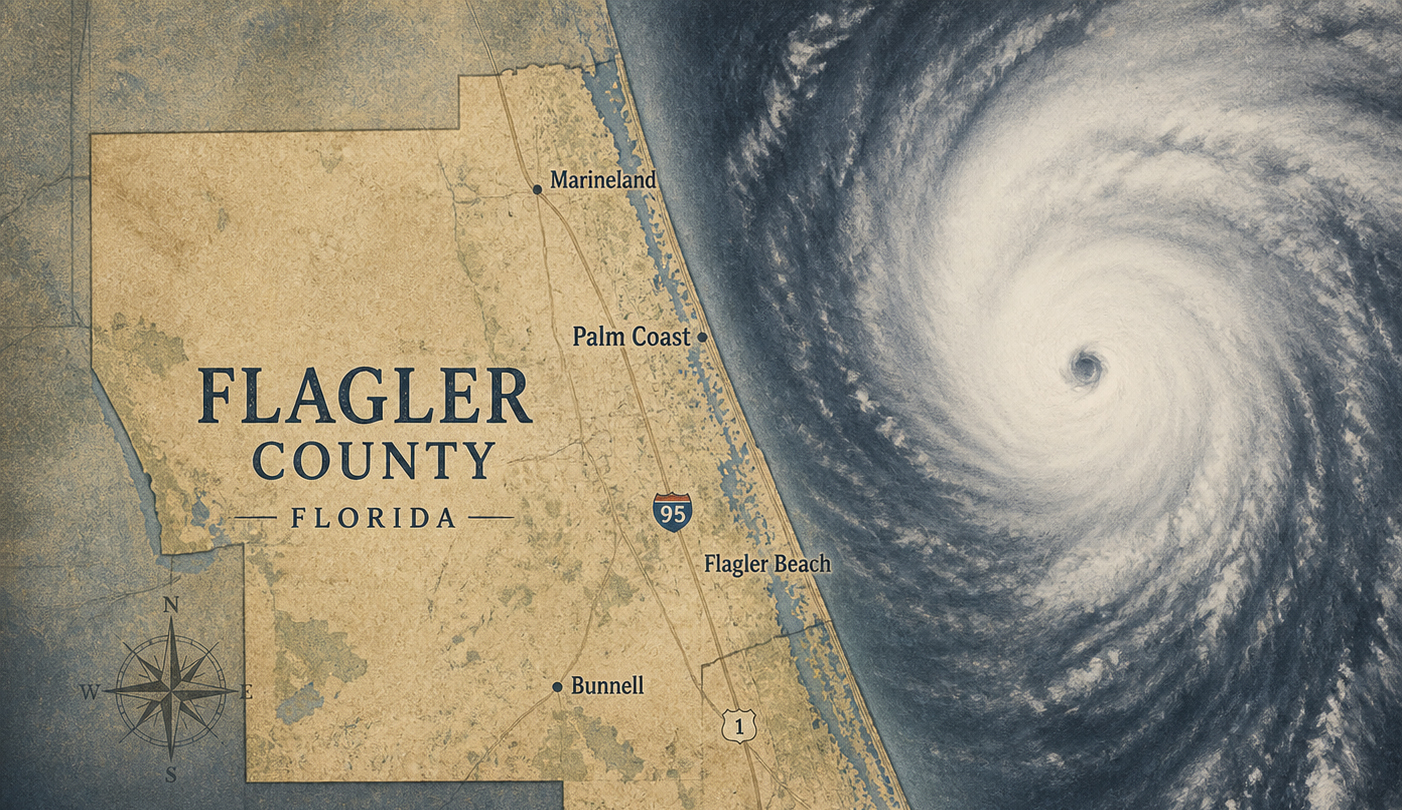
Talk to anyone who has lived in Flagler County for a few decades and you’ll eventually hear some version of the same idea. The land curves the wrong way. Cape Canaveral pushes storms back out to sea. The Atlantic’s worst always seems to slide just offshore.
There’s some truth to the pattern. Flagler County has been fortunate compared to other parts of Florida. The last direct hurricane hit was in 2004 with Hurricane Charley. The last truly catastrophic Florida hurricane that touched this coast was the 1928 storm. In between, there have been dozens of named storms, several near misses, and a handful of offshore passes that still managed to do real damage.
This is the full history of how hurricanes have shaped Flagler County, from the early days of Bunnell and Flagler Beach to the modern era of Matthew, Irma, Ian, and Nicole.
Why Flagler County’s Coast Is Exposed
Flagler County sits on roughly 19 miles of Atlantic coastline between St. Augustine and Daytona Beach. Unlike South Florida, where barrier islands and reefs absorb some hurricane energy before it reaches the mainland, Flagler’s barrier island is narrow and low. State Road A1A runs the length of it, often within yards of the high-tide line. There is no significant inlet nearby. The closest are St. Augustine to the north and Ponce de Leon to the south, which means wave energy and longshore currents that hit Flagler’s shoreline are essentially unbroken.
The county’s topography also matters. Most of Flagler is flat, low-lying, and crisscrossed by canals. Palm Coast alone has more than 70 miles of saltwater and freshwater canals. Heavy rainfall has nowhere to go quickly, and storm surge can push miles inland before encountering enough elevation to slow it down.
What that means in practice is that even storms passing safely offshore can still affect the coast through wave action and dune erosion. Storms that make landfall elsewhere in Florida often deliver tropical-storm-force impacts here.
The 1928 Hurricane (San Felipe-Okeechobee)
The deadliest hurricane in Florida history struck the state on September 16, 1928. The Category 5 storm made landfall near West Palm Beach with winds estimated at 150 mph, then moved inland and pushed Lake Okeechobee over its earthen dike. Nearly 3,000 people died, mostly Black migrant farmworkers in the agricultural communities south of the lake. It remains the second-deadliest hurricane in U.S. history after the 1900 Galveston storm.
Flagler County in 1928 was a small rural county of fewer than 3,000 residents. Bunnell had just been upgraded from a town to a city in 1924, and Flagler Beach had been incorporated only three years earlier in 1925. The county was overwhelmingly agricultural, with cattle, potato farms, citrus, and turpentine making up most of the local economy. The infrastructure to record local storm impacts in detail did not really exist yet.
What is known is that the 1928 hurricane caused widespread damage across the entire Florida east coast as it moved north, and Flagler County’s small communities of Bunnell, Flagler Beach, Espanola, Bulow, and Korona were not spared. The newly built Flagler Beach Pier, then just months old, took its first beating from a major Atlantic storm. It survived.
The Quiet Decades: 1930s Through 1990s
For most of the 20th century, Flagler County avoided direct hurricane hits. Storms passed offshore. Tropical systems made landfall in South Florida, the Panhandle, or up the coast in the Carolinas. Flagler residents experienced wind, rain, and occasional flooding, but nothing catastrophic.
A few notable near-misses during this stretch:
Hurricane Donna (1960) tracked up the Florida peninsula in September 1960 as a Category 4, eventually exiting near Daytona Beach. Flagler County experienced significant tropical-storm-force winds and rain but no major structural damage.
Hurricane David (1979) made landfall near West Palm Beach as a weakened Category 2 and tracked up the Florida east coast, delivering gusts and heavy rain to Flagler.
Hurricane Erin (1995) made landfall near Vero Beach as a Category 1 in August 1995, then tracked across central Florida. Flagler experienced tropical-storm conditions.
Hurricane Floyd (1999) is one of the most consequential near-misses in Flagler County history. The massive Category 4 storm threatened the entire Florida east coast in September 1999, prompting one of the largest evacuations in U.S. history before turning north and largely sparing the state. For Flagler County, the timing was historic for a different reason. Hurricane Floyd was the storm that forced the city of Palm Coast to postpone its incorporation referendum from September 14 to September 21, 1999. The vote passed a week later. Without Hurricane Floyd, Palm Coast’s official incorporation date might have looked very different.
Hurricane Irene (1999) hit Florida just weeks after Floyd, causing widespread flooding statewide. Flagler experienced heavy rain.
Hurricane Charley (2004): The Last Direct Hit
For modern Flagler County residents, the storm that ended any complacency about hurricane risk was Hurricane Charley.
Charley made landfall as a Category 4 hurricane near Punta Gorda on Florida’s southwest coast on August 13, 2004, with maximum winds near 150 mph. The storm then moved diagonally across the state on a northeast track, passing near Kissimmee and Orlando before exiting the Florida coast near Daytona Beach around midnight. It was still of hurricane intensity when its center cleared the coast.
Flagler County, just north of where Charley exited, took a direct hit from the still-powerful hurricane. It is the most recent storm in modern memory to deliver sustained hurricane-force winds to the county. Trees were down across Palm Coast, Flagler Beach, and Bunnell. Power was out for days in many areas. Roof damage was widespread.
Charley was followed in 2004 by Hurricanes Frances, Ivan, and Jeanne, all in September. It was a punishing hurricane season that saw multiple named storms affect Flagler County either directly or through outer bands. The cumulative effect was significant, and the season is still cited locally as the modern benchmark for what an active hurricane year looks like.
The Quiet Stretch: 2005 to 2015
Following the brutal 2004 and 2005 seasons, Flagler County entered an unusually quiet decade. Tropical storms came and went. Tropical Storm Fay caused widespread flooding in 2008. Hurricane Sandy passed offshore in 2012, generating significant beach erosion as it tracked up to the Northeast.
For ten full years, Flagler County avoided any storm-related disaster declaration. Newer residents, and there were a lot of them as Palm Coast was named the fastest-growing metro in America during this period, moved in with little personal experience of what a hurricane could do here.
Then 2016 happened.
Hurricane Matthew (October 2016)
Hurricane Matthew was a Category 5 hurricane in the Caribbean before tracking north along Florida’s east coast in early October 2016. It made its closest approach to Flagler County as a Category 3 storm passing roughly 30 miles offshore on October 7. The eye never made landfall in Florida, but the western edge of Matthew’s eyewall delivered hurricane-force winds, a 7-foot storm surge, and 36 hours of pounding wave action to the entire Flagler County coastline.
The damage was severe. According to Flagler County emergency officials and post-storm assessments:
- 161 homes were destroyed or damaged countywide
- Nearly 1,000 homes were flooded by tidal surge
- Approximately $50 million in storm-related damage occurred along Flagler’s 17 miles of beaches
- State Road A1A collapsed along a 1.3-mile stretch in south Flagler Beach, with portions of the road washed into the Atlantic Ocean
- 160 feet of the Flagler Beach Pier was torn away, severely damaging the iconic 1928 structure
- The dune system was largely destroyed along the entire coastline
- Dozens of public dune crossovers were damaged or destroyed
- Power was out for days across most of the county
The recovery from Matthew took years. The Florida Department of Transportation rebuilt the destroyed sections of A1A with engineered seawalls and reinforced beach renourishment. Flagler County launched an $18 million dune reconstruction project that brought roughly 1 million tons of sand back to the shoreline between 2018 and 2019.
Hurricane Irma (September 2017)
Less than a year after Matthew, Hurricane Irma threatened the entire state of Florida. The Category 5 storm devastated the Caribbean and made landfall in the Florida Keys on September 10, 2017, then tracked up the western side of the Florida peninsula. Flagler County was on the eastern, less severe side of the storm but still experienced sustained tropical-storm-force winds and significant flooding.
The damage in Flagler County included:
- Approximately $5 million in storm-related damage
- Roughly 400 homes flooded in Flagler Beach alone
- Additional damage to the recovering Flagler Beach Pier
- Renewed erosion along stretches of A1A still recovering from Matthew
- Power outages affecting most of the county for days
Irma’s biggest contribution to Flagler County’s hurricane history was timing. Coming so soon after Matthew, before recovery was complete, it compounded the damage and set back the rebuilding effort by months. Many homeowners who had just finished repairs from Matthew had to start over.
Hurricane Ian (September 2022)
Hurricane Ian made landfall as a catastrophic Category 4 hurricane near Cayo Costa on Florida’s southwest coast on September 28, 2022, with winds of 150 mph. The storm then crossed the state and exited near Cape Canaveral as a tropical storm, weakening as it went.
For Flagler County, Ian was, like Matthew before it, primarily an offshore impact storm. The eye never came close to Flagler. But Ian’s massive size and slow forward speed delivered more than 36 hours of wave action and heavy rain to the entire northeast Florida coast. The damage included:
- 132 homes affected, 7 with major damage, 65 with minor damage (county tally)
- No homes fully destroyed
- Approximately $2 million in residential damage, plus over $1 million in local government recovery costs
- Severe damage to the Flagler Beach Pier, with its front section lopped off and the structure closed indefinitely
- The dune system was again severely degraded, and most of the $18 million in sand from the 2018 to 2019 reconstruction was washed away
- Beach erosion was catastrophic along the entire 19-mile coastline, exposing previously protected properties
Ian is often remembered statewide for its devastating impact on Fort Myers Beach, Sanibel, and Captiva Islands. Its long-distance effects on the Flagler County shoreline were among the most severe of any modern storm here.
Tropical Storm Nicole (November 2022)
Just six weeks after Ian, before the dune system could be rebuilt or even surveyed properly, Hurricane Nicole hit Florida’s east coast as a Category 1 hurricane on November 10, 2022. Nicole’s winds were comparatively modest, but its storm surge, wave action, and 48 hours of pounding broke a coastline that was already on the brink.
The damage in Flagler County was, in many ways, worse than Ian:
- Approximately $23.7 million in damage countywide
- 299 homes affected, 218 flooded, 20 with major damage, 125 with minor damage
- Two dozen rescues from flooded homes in Flagler Beach
- Sections of A1A again collapsed onto the beach below
- The remaining dune system was almost entirely eliminated
- The Flagler Beach Pier was deemed structurally unsafe and closed permanently to the public
- Roughly 166,800 cubic yards of structural debris was generated countywide
- Approximately 49,900 cubic yards of vegetative debris was also generated
Nicole was the storm that finally retired the historic 1928 Flagler Beach Pier as a usable structure. It was also the storm that made clear Flagler County’s shoreline could not survive without sustained, ongoing intervention. The county’s coastal management plans, dune reconstruction efforts, and beach renourishment projects have been continuous ever since.
The Pier Rebuild and the Coast Today
In early 2025, after years of FEMA negotiations, engineering studies, and design workshops, the City of Flagler Beach broke ground on a complete reconstruction of the iconic pier. The new structure, expected to be completed by the end of 2026, will stretch approximately 800 feet, restoring the original 1928 length, and stand more than 10 feet taller than its predecessor. It will be supported by reinforced concrete pilings and engineered to withstand the wave action associated with a 500-year storm. The first 100 feet closest to shore, the section that anchored the pier since 1928, will be preserved.
The pier reconstruction is funded almost entirely through FEMA (75 percent) and Florida state disaster recovery funds (25 percent), meaning Flagler Beach property taxpayers are not directly footing the bill.
Meanwhile, beach renourishment and dune reconstruction efforts continue across the entire 19-mile shoreline. The U.S. Army Corps of Engineers, the Florida Department of Environmental Protection, Flagler County, and the City of Flagler Beach are all involved in ongoing projects designed to rebuild and protect the county’s natural coastal defenses.
What Flagler County’s Hurricane History Teaches
A few things stand out across a century of hurricane experience here.
The pattern of being spared has been real, but not absolute. Flagler County has not had a direct major hurricane hit in living memory, and the geographic fortune that has helped this stretch of coast is genuine. At the same time, offshore storms can still cause significant damage. Matthew, Ian, and Nicole each delivered serious impacts without the eye ever coming ashore.
The coastline requires ongoing attention. Each major storm strips dunes, undermines A1A, and reduces the natural protection that the next storm has to work against. The county’s recurring beach renourishment projects are part of why the shoreline remains viable as a tourist economy and as protection for the homes and businesses along A1A.
Recovery time matters. When storms hit in close succession, like Matthew and Irma in 2016 and 2017, or Ian and Nicole in 2022, the cumulative damage can be more severe than either storm alone.
Inland flooding is part of the picture too. While much of the headline damage falls on the barrier island, Flagler County’s flat topography and extensive canal system mean that inland Palm Coast and Bunnell can experience freshwater flooding from heavy rainfall events. Tropical Storm Fay in 2008 caused severe inland flooding even without coastal surge.
For most years in most Flagler County neighborhoods, hurricane season passes without serious incident. But when storms do arrive, residents who are prepared tend to fare significantly better than those who aren’t. Hurricane season in Florida runs from June 1 to November 30 every year. Flagler County Emergency Management recommends maintaining a basic hurricane preparedness plan, having supplies for at least 7 to 10 days, knowing your evacuation zone, and staying informed through official channels.
Flagler County’s hurricane history is not a story of constant disaster. It’s a story of a coastline that has weathered a lot, recovered each time, and continues to find a balance between the natural forces that shape it and the community that has chosen to call it home.