
In December 1970, just ten months before Walt Disney World opened in Orlando, an ambitious group of investors broke ground on a 5,000-acre theme park near Bunnell. The plan was simple, audacious, and almost immediately doomed: build a Florida amusement park that would catch tourists driving down I-95 to Disney, give them a reason to stop in Flagler County, and capture a meaningful share of the booming Florida tourism market.
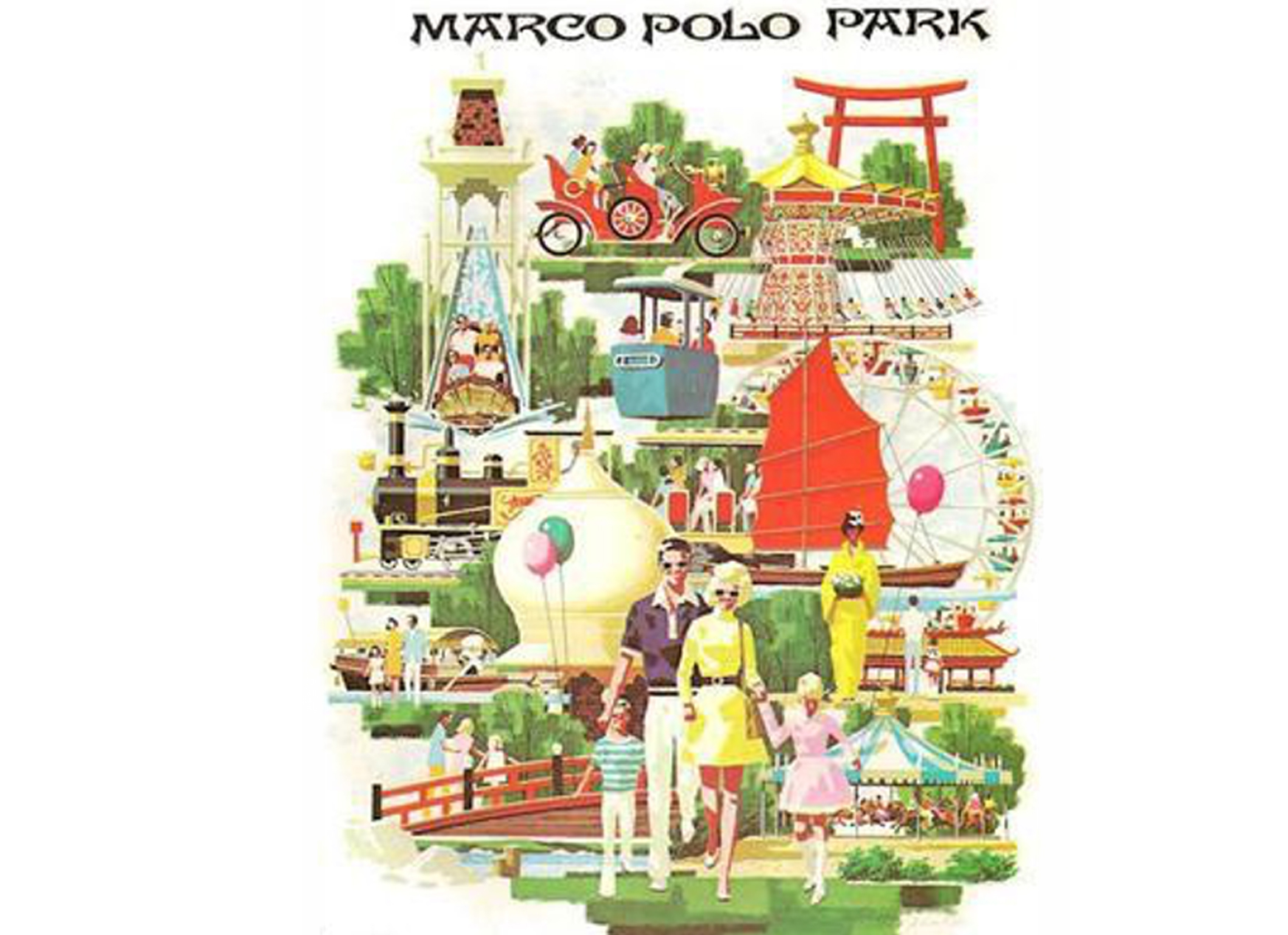
They called it Marco Polo Park. It was themed around the 13th-century travels of the Venetian merchant from Venice through Turkey, India, China, and Japan. It had five themed sections, a ferris wheel, a steam train that ran the perimeter, an overhead Sky Ride gondola system, sampans built from teak imported from Japan, restaurants serving tempura, puppet shows, dancing performances, a petting zoo, and a giant Marco Polo character who walked around greeting guests in a body puppet costume that, according to the man who wore it, was unbearably hot inside.
For about five and a half years, Marco Polo Park existed. It employed nearly 100 young people during its peak summers. It welcomed visitors with the slogan “the greatest adventure of your life.” It hoped to be a regional anchor of Florida tourism in the I-95 corridor. By 1976, it was gone. By 1978, the equipment was being auctioned off. By 1984, when a former employee slipped through a gap in the fence to walk the property one last time, there was almost nothing left but a couple of stacked train cars.
The site is now occupied by the Plantation Bay Golf and Country Club community, where most residents have no idea their gated subdivision sits on the buried bones of a 1970s theme park. This is the story of how Marco Polo Park happened, why it failed, and what it tells us about the Florida tourism revolution of the early 1970s.
The Bold Vision
The story of Marco Polo Park begins in the late 1960s, when American leisure travel was undergoing a transformation. Florida had been a major tourist destination for decades, anchored by Marineland, Cypress Gardens, Silver Springs, Weeki Wachee, and the long string of small roadside attractions that lined U.S. 1, U.S. 41, and A1A. But the announcement of Walt Disney World in 1965 changed everything. Disney’s planned 25,000-acre Orlando project was on a scale never before attempted in American tourism, and every entrepreneur in Florida (and in much of the country) was suddenly thinking about how to position themselves in the world Disney was about to create.
A group of investors led by Daytona Beach hotel and motel developer Oscar Leron “Jack” White saw an opportunity. White was an established figure in Daytona Beach business, responsible for some 40 motels and condominiums along the Volusia County coast, a former president of the Daytona Regional Chamber of Commerce, and a member of various civic boards. He understood the tourism business. He understood that millions of cars would soon be driving down I-95 toward Orlando. And he understood that a strategically located attraction between Jacksonville and Daytona Beach could intercept some of those cars.
A September 2, 1970 executive memo to the Marco Polo Park board of directors made the case explicitly: “Within the last two generations, leisure has ceased to be a problem of the affluent alone and has become more and more a problem of everyone… yet this very ambiguity creates a market for efficient supplies of entertainment such as never before been known.”
The investors believed that Disney World would be too crowded, too expensive, or too far for many travelers, and that Marco Polo Park would be a natural overflow destination. They also believed that the Marco Polo theme would distinguish them from Disney’s heavily branded American iconography. Where Disney was selling Mickey Mouse and Main Street USA, Marco Polo Park would sell exotic Asia and Mediterranean Europe.
The investors acquired 5,000 acres of land in southern Flagler County, just north of the Volusia County line, near what is now Exit 278 on I-95. The location was strategic: directly visible from the interstate, with easy access for travelers in either direction. They began construction.
There is also a fascinating side note about the planning era. According to surviving records, the original investors were told that Roy Rogers, the legendary Western movie star, was interested in building his own theme park nearby. The Roy Rogers project never materialized, but the thinking it represented (multiple major attractions clustering around a strategic interstate corridor) shows how serious the post-Disney Florida theme park speculation had become.
The Opening: December 28, 1970
The first phase of Marco Polo Park, the Japanese section, officially opened on December 28, 1970. It opened ten months before Walt Disney World, which would open on October 1, 1971. For that ten-month window, Marco Polo Park was one of the more ambitious new theme park projects in Florida.
The Japanese section alone covered approximately 500 of the park’s 5,000 acres. The centerpiece was a recreation of a Japanese fishing village set in elaborate Japanese botanical gardens, with a mile-long artificial waterway spanned by ornate “Oriental” themed bridges. Eighteen sampans made of teakwood imported directly from Japan carried visitors along the waterway. Two restaurants served tempura-style dishes. Souvenir shops sold Japanese-themed merchandise.
Annual admission was set at just $2 for adults and $1 for children when the park first opened. By April 1, 1971, adult admission had been raised to $2.50. By the standards of 1970s Florida tourism, these were extremely modest prices, well below what Disney would charge later that year.
The opening generated genuine public excitement. Television commercials ran across northern, northeastern, and central Florida, promising visitors “the greatest adventure of your life.” For the first year, the Japanese section operated essentially alone, with the rest of the park still under construction. Visitors with a “caravan club pass” could tour the in-progress sections to see what was coming.
What was coming was ambitious.
The Full Park: May 1972
In May 1972, Marco Polo Park completed its full planned expansion. Four additional themed sections opened, plus a petting zoo. The full park now featured five themed lands: Japan, China, India, Turkey, and Venice. The choice of sections roughly traced the actual route of Marco Polo’s 24-year journey from his native Venice through Turkey, the Middle East, India, China, and back, with the Polo family making their famous trek across Asia.
This put Marco Polo Park in interesting historical company. The park’s “five worlds” concept (multiple themed sections each representing a different country and culture) anticipated by 11 years what Disney would eventually do at Epcot when its World Showcase opened in 1982. Marco Polo Park was not the first or only theme park to use the multi-country format, but for a 1970s Florida operation, it was a genuinely creative concept.
The five sections were connected by an overhead passenger gondola system called the Sky Ride, which provided aerial views throughout the park. The Sky Ride was one of the more memorable features for visitors who experienced the park, especially children. From the gondola, you could see across all five sections, with their gardens, canals, lagoons, and themed architecture spread out across the Florida pine flatwoods.
Other attractions included:
- A perimeter steam train running around the entire park
- A drive-it-yourself cars track for children
- Internationally themed restaurants serving the food of each represented region
- Live music performances
- Movie screenings
- Puppet shows
- Dancing performances representing the different cultures
- A 40-horse carousel (added later)
- A ferris wheel
- The aforementioned petting zoo
Marco Polo himself, played by an employee in a full-body Marco Polo character costume, walked around the park greeting guests, posing for photos, and serving as a roaming brand ambassador. According to one former employee who occasionally wore the suit, “Man was that suit hot.”
The park provided nearly 100 jobs to young Florida workers during the two summers of its peak operation. Many were college students or recent graduates, drawn to the novelty of working at a brand-new Florida theme park. Some, like one Texas-based recent college graduate named Bruce Elliott, came specifically to work the 1974 expansion and stayed only a few months but kept fond memories of the experience for decades.
The Problems
The opening was successful. The early reviews were positive. The park generated genuine local enthusiasm and out-of-state curiosity. And yet, by almost every account that survives, Marco Polo Park was never actually profitable. The reasons are multiple, overlapping, and ultimately fatal.
Disney World was too big. Walt Disney World opened on October 1, 1971, ten months after Marco Polo Park’s first phase. The scale of Disney’s operation simply dwarfed every other Florida tourism business. Disney could afford national advertising, multi-day vacation packages, on-site hotels, character merchandising, and the kind of vertically integrated tourism experience that smaller parks could not match. Where Marco Polo Park hoped to capture overflow Disney visitors, the reality was that Disney visitors largely went straight to Disney, did Disney, and went home, with little appetite for a smaller side stop.
Years later, Jack White summarized the problem in a sentence that has become the standard epigraph for the Marco Polo Park story: “I learned one important lesson. You can’t compete with the mouse.”
The interstate exit was difficult. Marco Polo Park’s location was geographically prime but logistically awkward. Travelers heading south on I-95 toward Daytona Beach, Cocoa, the Kennedy Space Center, or Orlando had to either take an inconvenient detour to the next exit and double back, or leave the beach area entirely and come back. Many simply continued to their destinations. The “stop and visit” market that the park needed to capture turned out to be much smaller than the investors had projected.
The marketing oversold the experience. Television commercials promising “the greatest adventure of your life” set expectations that the actual park, while genuinely charming, could not match. Visitors arriving expecting a Disney-level production found a smaller, less polished operation. The gap between the marketing and the reality damaged word-of-mouth.
The park bled money. Operating a 5,000-acre property with extensive landscaping, a Sky Ride, a steam train, multiple restaurants, character performers, and full park staff required enormous overhead. Without the visitor numbers to support it, losses accumulated quickly.
The First Closure and the Fires
By 1974, the financial situation had become untenable. Marco Polo Park closed in October 1974. Whether the closure was originally intended to be permanent or temporary is debated in surviving accounts, but what happened next made the question moot.
In February 1975, two fires ravaged the closed park property just eight days apart. Arson was strongly suspected. The fire began in the Japanese Village, which had been the park’s centerpiece and most expensive section. At the same time the fire started, an unknown person fired two gunshots at a security guard before fleeing the property.
The fires were never definitively solved. The Japanese Village, including the imported teak sampans, the recreation fishing village, the elaborate gardens, and the restaurants, was completely destroyed.
Passport to Fun World: The Brief Reopening
Despite the fires, Marco Polo Park’s investors made one last attempt to save the operation. In May 1975, the park reopened under new management by the Ozarks Park, Dogpatch USA organization, which operated theme parks in other parts of the country. The new operators kept the world-travel theme but gave the park a new name: Passport to Fun World.
The destroyed Japanese Village was completely razed and replaced with a bandstand featuring an American theme. A 40-horse carousel was added. The other four sections (China, India, Turkey, Venice) were partially rehabilitated. The park advertised itself as “close to everything in central Florida” and “The Best Day Money Can Buy.”
It didn’t work. The fundamentals that had doomed Marco Polo Park were unchanged. Disney World was even more dominant than it had been in 1971. The interstate access was still awkward. The brand had been damaged by the closure and the fires. Passport to Fun World closed permanently in 1976, less than 18 months after reopening.
The remaining equipment was sold at auction on March 14, 1978. Florida theme park collectors and operators bought what they could. The land sat largely abandoned for the next several years.
The Long Erasure
By the early 1980s, Marco Polo Park had become a Florida ghost story. The structures that hadn’t burned were demolished. The gardens were reclaimed by Florida scrub and pine. The sampans, the Sky Ride, the carousel, the ferris wheel, the steam train, and Marco Polo’s body puppet were all scattered to other parks or scrap.
In 1984, Bruce Elliott, the Texas college graduate who had worked at the park during its 1974 final expansion, returned to the area and slipped through a gap in the fence to walk the property one last time. “There was not much left,” he later wrote, “but there were a couple of train cars, one stacked on top of the other, and I could see the track for the little drive-it-yourself cars that ran around. It all was kind of sad, but it also brought back some great memories of that summer ten years before.”
A few years later, even those traces were gone.
The road that had once been called Marco Polo Park Boulevard, the access road from the interstate to the park’s main entrance, reverted to its original name: Old Dixie Highway. The renaming was both bureaucratic and symbolic, the final acknowledgement that the theme park experiment had ended.
Today, the site of Marco Polo Park is occupied by Plantation Bay Golf and Country Club, a large gated residential community with two golf courses, a clubhouse, tennis courts, a fitness center, and several hundred homes. Most Plantation Bay residents have no idea what stood on their land before. The pine forest that the park’s investors first cleared in 1970 has been re-cleared and replaced with manicured fairways and residential landscaping.
There is no historical marker. There is no preserved structure. There are no ruins. If you didn’t know to look for it, you would never guess that Plantation Bay’s golf course occupies the bones of one of Florida’s most ambitious failed theme parks.
What Marco Polo Park’s Failure Tells Us
Marco Polo Park was not the only Florida theme park to fail in the 1970s. Several others vanished in the same era:
- Wonderland Park in Titusville, closed 1973
- Pirates World in Dania, closed 1975
- The Aquatarium (also known as Shark World) in St. Pete Beach, closed 1977
- Various smaller attractions across the state
The pattern was consistent. Each of these parks had been planned in the late 1960s, when Florida tourism was growing but still decentralized across hundreds of independent operations. Each had launched in the early-to-mid 1970s, just as Walt Disney World was establishing itself as the dominant force in the state’s tourism economy. Each had failed to achieve the scale necessary to compete with Disney’s marketing reach, brand power, and integrated vacation experience.
The Florida tourism industry that emerged from the 1970s was fundamentally different from the one that preceded it. Where the pre-Disney era had been characterized by hundreds of small, family-owned roadside attractions and a handful of mid-sized regional parks, the post-Disney era was dominated by a small number of corporate theme park giants (Disney, Universal, SeaWorld, Busch Gardens) with the resources to compete on Disney’s terms. The entire middle tier of Florida tourism, the regional theme parks like Marco Polo Park, was effectively wiped out.
For Flagler County and Bunnell, the loss of Marco Polo Park represented something specific. It was, briefly, one of the largest commercial enterprises in the county. It employed scores of local young people. It put Bunnell on the tourism map in a way that the small county seat had never been before. When it closed, Bunnell returned to its quieter agricultural and county-government identity, and the next major commercial transformation of the area would be Palm Coast, growing on the eastern side of I-95 throughout the 1970s and 1980s.
In a sense, Marco Polo Park’s failure was Palm Coast’s gain. The land that the theme park had occupied eventually became Plantation Bay, a residential community whose buyers were drawn to the same growing Flagler County that ITT was selling on the Palm Coast side. The dream of Marco Polo Park, that thousands of out-of-state visitors would discover Flagler County and decide to stay, ultimately came true. They just stopped buying admission tickets and started buying houses.
What’s Left to See
For those interested in exploring Marco Polo Park’s legacy today, very little physical evidence remains. But a few resources are worth knowing about:
The Flagler County Historical Society at the Holden House in Bunnell maintains the original 1970 executive memo report from the Marco Polo Park board of directors, along with photographs, postcards, and other documents from the park’s brief operation. For serious researchers, this is the primary archive.
The Halifax Historical Museum in Daytona Beach has photographs and memorabilia from Marco Polo Park, including images of the Marco Polo character costume.
Plantation Bay Golf and Country Club itself, while it preserves nothing of the theme park, sits on the original 5,000-acre site. The community is private, but the surrounding roads (including the renamed Old Dixie Highway) follow paths that once led to the theme park’s entrance.
Postcards, ticket stubs, and merchandise from Marco Polo Park occasionally appear on eBay and at Florida history collectors’ shows. They are increasingly valuable as the park fades further from living memory.
Online tribute communities including the Florida Backroads Travel website and the Orlando Memory archives preserve photographs, postcards, and personal recollections from former visitors and employees. For nostalgic readers, these sites are the closest thing to a digital museum of the park.
Five themed lands. A teak sampan fleet. A Sky Ride gondola system. A walking Marco Polo greeter in a heat-trapping body puppet. A perimeter steam train. A Daytona Beach motel developer who learned that you can’t compete with the mouse. Two arson fires eight days apart. A bandstand replacing the burned Japanese Village. A name change to Passport to Fun World. A final permanent closure in 1976. An equipment auction in 1978. A road that quietly reverted to its original name.
That was Marco Polo Park, the bold Bunnell theme park that bet against Walt Disney World and lost. It existed for less than six years. It has been gone for nearly fifty. Most Flagler County residents under 60 have never heard of it. But for one ambitious moment in the early 1970s, on 5,000 acres just west of I-95, Bunnell had its very own theme park.
Then it didn’t. And the story of why is one of the most instructive small chapters in the history of modern Florida tourism.