
Palm Coast, Florida is one of the youngest cities in the United States — and one of the fastest-growing. In the span of a single human lifetime, the land between St. Augustine and Daytona Beach has transformed from a sparsely inhabited stretch of pine forest, swamp, and turpentine camps into a city of more than 110,000 residents, the largest in Flagler County and one of the most dynamic in Florida.
The story of how that happened is unlike that of almost any other American city. Palm Coast wasn’t built by accident or by slow accretion. It was designed — top to bottom, road by road, canal by canal — on a corporate drafting table in the late 1960s. This is the story of how it came to be.
Before Palm Coast: A Land of Pine, Swamp, and Turpentine
In the 1950s, the land that would eventually become Palm Coast was, by most accounts, a “big pine-covered swamp.” Flagler County’s population sat at just over 4,400, with most economic activity tied to cattle, farming, lumber, and turpentine distilling. Tourists driving A1A toward Marineland passed through long stretches of empty barrier island. U.S. 1 carried travelers through endless woodlands toward South Florida.
A Lehigh Cement plant operated on what is today Colbert Lane from 1952 to 1965, employing about 300 people before it closed and largely emptied out. The land was cheap, the population was thin, and outside the small towns of Bunnell and Flagler Beach, there was very little reason for anyone to stop.
Long before that, of course, the area had been home to Timucua and later Seminole peoples, and large 19th-century plantations like Bulow grew sugar cane, cotton, indigo, and rice with enslaved labor — the ruins of the Bulow Plantation are still preserved as a state park just south of modern Palm Coast. General Joseph Hernandez established the St. Joseph Plantation in the early 1800s and laid out a path called the St. Joe Grade — a route that would later be paved and renamed Palm Coast Parkway.
But by the mid-20th century, that history had largely receded into the woods. The land was waiting for something.
1968: ITT Buys In
In 1968, International Telephone and Telegraph Corporation — better known as ITT — was at the height of its power. The conglomerate had grown from a 1930s communications firm into a multinational with annual revenue exceeding $7 billion. It was the kind of company that didn’t think small.
That year, ITT acquired Levitt and Sons, the legendary homebuilding firm founded by William Levitt — the man widely credited as the father of modern American suburbia for his post-WWII Levittown developments in New York and Pennsylvania. With Levitt’s design expertise and ITT’s enormous balance sheet, the combined company began looking for a place to build something nobody had quite attempted before: not a subdivision, not a retirement village, but a complete planned city carved out of raw Florida land.
They found it in Flagler County.
ITT formed ten subsidiary companies to quietly buy up land from 35 separate owners, eventually assembling roughly 68,000 acres — including holdings from ITT Rayonier Corporation, Wadsworth Land Company, and the old Lehigh Cement property. On June 16, 1969, the company announced its plans at a press event held at the historic Princess Place: a 20,000-acre residential complex featuring waterfront lots, an oceanfront hotel, a golf course, marinas, and a 500-mile network of roads, utilities, and drainage.
Levitt’s project manager, Dr. Norman Young, predicted Palm Coast would one day be home to 750,000 residents.
1970: A Welcome Center, an Observation Tower, and a Vision
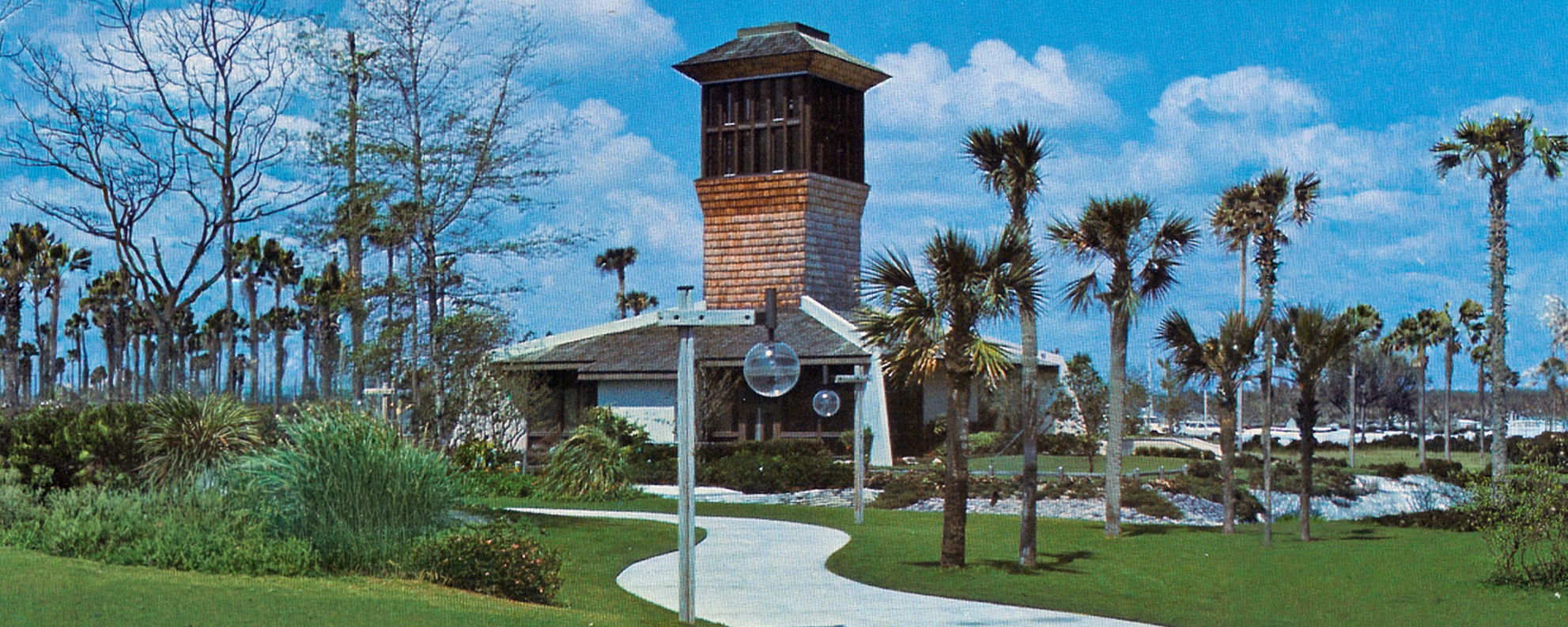
The grand opening of Palm Coast was held on October 29, 1970. The first structure built was a Welcome Center, anchored by a 64-foot observation tower that offered panoramic views of the surrounding pine flatwoods, freshwater lakes, the Intracoastal Waterway, and the Atlantic Ocean. Around it sat a dozen Mid-Century Modern model homes with names like Santa Rosa, DeSoto, and Delmar — concrete-block construction with gabled roofs, some with board-and-batten siding or faux brick accents.
The first nine holes of what would become the Palm Harbor Golf Course opened the following year. The first residential homes broke ground on the corner of Club House Drive and Casper Drive — the latter being the very first road built in Palm Coast.
The first “pioneers,” as ITT called them, moved into their homes in January 1972. Flagler County’s population at the time was still under 5,000. Palm Coast’s population, technically, was zero.
ITT’s marketing strategy was aggressive and aimed squarely at the Northeast and Midwest. Television commercials, fly-in tours, and direct mail campaigns sold the dream of affordable Florida sunshine to retirees and families in New York, New Jersey, Pennsylvania, Connecticut, Ohio, and beyond. By 1975, more than 38,000 lots had been sold, although actual home construction lagged significantly behind sales.
The famous “letter sections” — the alphabetized neighborhoods where every street in a section starts with the same letter (the F-section, the P-section, the R-section, and so on) — date to this era. The design was practical: it created a navigable grid, simplified utility planning, and gave ITT’s sales team an easy way to organize lots. More than 50 years later, Palm Coast residents still describe their addresses by section letter.
The ITT Years: Building a City From Scratch
For nearly three decades, ITT functioned as something close to a private government for Palm Coast. The company built and maintained the roads, ran the water and sewer utilities through a subsidiary called Atlantic Development Corporation (later Florida Water Services), funded the Hammock Dunes Bridge, paid for the I-95 interchange, and provided most of the leadership and services that an incorporated city would normally provide.
The development came to encompass roughly 42,000 acres of platted home sites — at one point the largest planned unit development in Florida history — including 46 miles of freshwater canals and 23 miles of saltwater canals, all connected to an extensive water management system designed to replenish the area’s water table.
In 1975, the Flagler County Board of County Commissioners established the Palm Coast Service District to coordinate some of those services formally. By 1990, the population had reached 18,556. The community had a hospital, schools, parks, and a recognizable identity.
But ITT was changing. Through the 1980s and into the 1990s, the corporation began divesting from its non-core businesses, including community development. ITT formally withdrew from Palm Coast in 1995. Florida Water Services was eventually sold off — first to Allete in 1996, then ultimately to the City of Palm Coast in 2003. The void left by ITT’s departure forced Palm Coast residents to confront a question they had been able to avoid for a quarter-century: who, exactly, was going to run this place?
1999: Becoming a City
The vote to incorporate Palm Coast as a city was scheduled for September 14, 1999 — but Hurricane Floyd forced a one-week postponement. When residents finally went to the polls on September 21, 1999, 65.6 percent of the nearly 12,000 voters who cast ballots said yes. Palm Coast would become a city.
The official incorporation date was December 31, 1999 — the last day of the millennium. Residents celebrated the end of the 1990s and the birth of their new city in a single evening. On October 1, 2000, all services were officially transferred from the former Palm Coast Service District to the new city government.
Jim Canfield was elected the first mayor. The city hired its first city manager, Dick Kelton, on April 17, 2000. From the beginning, Palm Coast adopted a council-manager form of government — a five-member City Council elected at large, with policy execution delegated to a professional city manager. Law enforcement was contracted to the Flagler County Sheriff’s Office, an arrangement that continues to this day.
The estimated population of Palm Coast on January 1, 2000 was 29,360.
The 2000s: The Fastest-Growing City in America
What happened next is one of the more remarkable stories in modern American demographics. By the mid-2000s, the U.S. Census Bureau had officially designated Palm Coast as the fastest-growing metropolitan area in the country. Between 2000 and 2010, the population more than doubled, reaching 75,180. Residential subdivisions filled in the long-platted ITT lots at a dizzying pace. Discount supercenters, national chains, and major retailers followed the rooftops.
In 2002, Florida Hospital-Flagler — later renamed AdventHealth Palm Coast — opened near the SR-100 and I-95 interchange, giving the city a full-service hospital for the first time. In 2006, Palm Coast was named a Tree City USA by the National Arbor Day Foundation, a recognition the city has worked hard to maintain through its protected oaks and tree-canopy ordinances. The 1,500-acre Town Center development was approved as the city’s eventual downtown, with offices, retail, medical, and institutional space planned around a central park.
Then came the 2008 financial crisis. Few places in Florida were hit as hard. Palm Coast’s economy had been built almost entirely on home construction and the housing boom, and when the bottom fell out, unemployment in the area spiked to 16.9 percent — the worst rate of any major Florida metro by December 2009. Construction stopped. Homes sat vacant. The city’s growth, for the first time in 40 years, briefly paused.
Recovery and a New Era of Growth
Palm Coast came back. By 2015, the city had completed a new City Hall, centralizing municipal services for the first time. Town Center continued to develop. Flagler Executive Airport expanded. The 2020 Census counted 89,258 residents — almost a 200 percent increase from the 32,832 counted in 2000.
Then came the post-pandemic boom. Between 2020 and 2025, Flagler County added roughly 25,000 residents, a 21.7 percent increase that made it the sixth-fastest-growing county in Florida. Most of that growth concentrated in Palm Coast itself. By July 2024, the U.S. Census Bureau estimated Palm Coast’s population at 106,729 — and current estimates put the city well past 110,000, just shy of the top 25 largest cities in the state.
In 2023, the Daytona Beach News-Journal reported that Palm Coast had surpassed Deltona to become the most populous city in the entire Deltona–Daytona Beach–Ormond Beach metropolitan statistical area. That same year, AdventHealth opened a second Palm Coast hospital — AdventHealth Palm Coast Parkway — which treated 30,000 emergency department patients in its first year alone.
What Palm Coast Is Today
Modern Palm Coast spans roughly 90 square miles. The city sits on 70 miles of saltwater and freshwater canals, with more than 125 miles of connecting trails for walking and biking. It is home to over 4,500 businesses, 13 city parks, and three world-class golf courses, including the Jack Nicklaus-designed Ocean Course at Hammock Beach Resort. The median age is 51.6 — a reflection of the city’s enduring appeal to retirees — but the post-2020 boom has brought waves of younger families, remote workers, and small-business owners as well.
The pine forest is gone. The turpentine camps are gone. The 64-foot observation tower that marked the grand opening of ITT’s bold experiment is gone, too. But the bones of the city those founders laid out — the lettered sections, the canals, the golf courses, the parks, the wide medianed parkways named for old plantation grades — remain. Every Palm Coast resident, whether they know it or not, lives inside the dream of a 1969 marketing brochure that turned out, against all odds, to be mostly true.
A small Florida planned community has grown into one of the fastest-growing cities in America. And the story is still being written.