
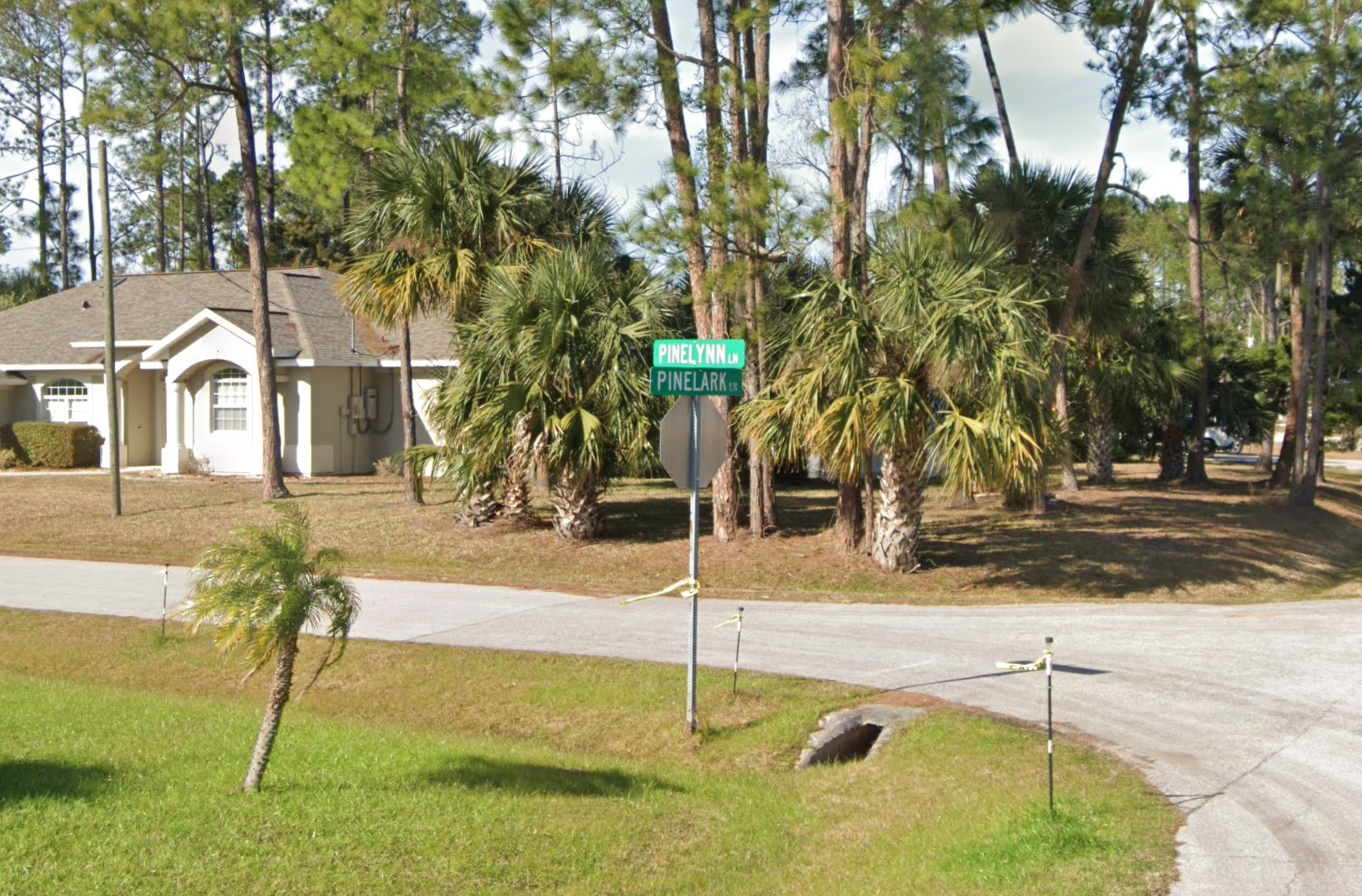
If you’ve spent any time in Palm Coast, you’ve probably noticed something strange about the street names. In one neighborhood, every street starts with B — Birchwood, Brookside, Bellingham, Belle Terre. Drive a few miles south and suddenly every street starts with P — Pine Lakes, Princeton, Powderhorn, Parkway. Cross over to the east side and you’re in the F section, where the streets are named Fellowship, Florida Park, Flagship, Fairwind.
The first time someone notices, it usually happens the same way: they’re trying to find a friend’s house and they keep ending up on the wrong street with a strangely similar name. The second time it happens, they Google it.
So here it is — the answer, the history, and the strange backstory of why Palm Coast streets all start with the same letter.
The Short Answer
Palm Coast’s streets are organized by lettered “sections.” Every road inside a given section starts with the same letter of the alphabet. The B section’s streets all start with B. The P section’s streets all start with P. The F section’s streets all start with F. And so on through most of the alphabet — A, B, C, E, F, K, L, P, R, S, U, W, Z, and even a double-letter LL and BL.
The system was designed in the late 1960s and early 1970s by ITT, the international conglomerate that originally developed Palm Coast. It was meant to make a brand-new, 90-square-mile master-planned city easier to navigate, sell, and build out. Whether or not it actually accomplished that is a question Palm Coast residents are still arguing about today.
The Long Answer Starts With ITT
To understand the lettered sections, you have to understand who built Palm Coast — and it wasn’t a city government. It was a corporation.
In 1969, International Telephone and Telegraph (ITT), a multinational with annual revenues over $7 billion, partnered with Levitt and Sons (the legendary suburban developer behind New York’s Levittown) to build something nobody had quite attempted before: a complete planned city, designed from scratch, carved out of 68,000 acres of pine forest and swamp in rural Flagler County.
The first homes went up in 1972. By 1975, ITT had sold more than 38,000 lots — most of them through aggressive direct-mail and television marketing campaigns aimed at retirees and families in the Northeast and Midwest. The challenge was enormous: how do you organize a city of tens of thousands of yet-to-be-built streets, lots, and neighborhoods so that buyers, builders, utility crews, mail carriers, and emergency responders can all find their way?
ITT’s answer was the lettered section system.
The 1974 ITT Memo That Started It All
The most detailed surviving explanation of the system comes from a 1974 internal ITT report written by a planner named Felter, who laid out the rules:
Streets within the same neighborhood should begin with the same letter. Long streets received long names; short streets received short names. To avoid duplicate or confusing names, sections were lettered alphabetically across the development. And in many cases, a second word was added to better cluster streets within a single neighborhood — Bunker Knoll and Bunker View, for example, signaling they belonged to the same micro-area within the B section.
Local Palm Coast historian Art Dycke summarized the philosophy bluntly in a 2017 interview: “Geranium could not be a street in the Z-section, because Palm Coast was laid out in sections A, B — the way the alphabet was. There was a great deal of order in this method.”
There was also, importantly, a practical sales motivation. ITT was selling tens of thousands of lots, often sight unseen, through brochures mailed to people in Connecticut, Pennsylvania, Ohio, and beyond. A buyer in Buffalo could be told “your lot is in the C section, on Cypress Point Lane,” and the section letter alone gave the sales team and the buyer a quick mental anchor for where the property sat within the larger city.
For ITT — a company with no precedent for what it was doing — that kind of order mattered.
What the Sections Look Like Today
There are roughly 16 lettered sections in modern Palm Coast, plus a handful of newer subdivisions that don’t follow the system at all. The most common sections residents talk about include:
B Section (Indian Trails) — On the west side of Palm Coast, this is one of the largest residential areas in the city, known for tree-lined streets, family-friendly parks, and a strong concentration of schools.
C Section and F Section (Palm Harbor) — On the eastern, Intracoastal-facing side of the city, these sections include Palm Coast’s saltwater canal neighborhoods, where homes back up to canals with direct access to the Intracoastal Waterway. The F section in particular was originally designed around its waterfront network.
P Section (Pine Grove and Belle Terre) — Centrally located, with easy access to Palm Coast Parkway and most of the city’s shopping. Established and walkable.
W Section (Pine Lakes) — One of Palm Coast’s older established neighborhoods, also centrally located.
R Section (Lehigh Woods) — A large residential area on the south side of the city, with easy I-95 access.
L Section (Matanzas Woods) — On the north side of Palm Coast, near nature preserves and golf courses.
E Section (Cypress Knoll) — Known for curved street layouts and a more established feel.
S and U Sections (Seminole Woods) — On the south end of Palm Coast, more rural in feel and closer to undeveloped land.
K, Z, and LL Sections (Quail Hollow) — On the western edge of the city, with the somewhat famous LL section being one of the few double-letter designations.
The section letter is a planning tool, not a lifestyle label. Plenty of established Palm Coast residents have lived in the same letter for decades and use it as shorthand. (“I’m over in the F section.” “We just bought in the P section.”)
The Unintended Consequences
The system worked — mostly. But not always.
Robert Cuff, a current Palm Coast City Councilman who was a land attorney for ITT in the early days, has talked openly about the chaos that sometimes ensued. In one memorable case he recalled, an ITT employee was trying to find a buyer’s lot among 70 nearly identical empty lots on a single street. There was no GPS. There were no street markers yet. Eventually the family and their guide settled for “close enough.”
Art Dycke remembered another resident who got hopelessly lost in the B section trying to find her own house — every street started the same way, every block looked similar, and the orderly system that ITT planners had drawn so carefully on paper turned out to be genuinely confusing in practice.
There’s also the issue of the alphabet itself not always lining up the way it “should.” If you look at a Palm Coast map today, you’ll notice that the lettered sections aren’t laid out in a clean A-B-C-D progression across the city. They’re scattered — the C section is on the east side, the B section is on the west, the L is to the north, the S is to the south. That’s because ITT plotted the sections in the order they were developed, not in geographic order. Some early sections were “deplotted” in the mid-1970s after a state agreement reduced the total number of lots ITT could sell to out-of-state buyers, and large portions of what would have been C, F, and other sections were turned back into vacant land. (Hammock Dunes, on the beach side, is the major exception — that area was developed instead.)
The result is a system that looks orderly on paper but feels like a small puzzle in practice — especially for newcomers, delivery drivers, and visiting relatives.
Why It Still Matters
More than 50 years after ITT first sketched out the plan, the lettered sections remain one of the most distinctive features of Palm Coast. Real estate listings reference them. Locals use them as neighborhood shorthand. Newcomers learn them within their first month. And when residents describe where they live, the section letter often comes before the actual street name.
It’s a small, weird, deeply Palm Coast thing — a daily reminder that this city wasn’t built the way most cities are built. There was no town square that grew outward over centuries. There was no merging of neighboring villages into one larger municipality. There was just a corporation, a planning department, a 1974 memo, and an alphabet.
Most of the time, the system works. Sometimes you get lost. And every now and then, someone Googles “why do all the streets in Palm Coast start with the same letter” — and finds out they’re living inside a 50-year-old experiment that, against all odds, is still running.