


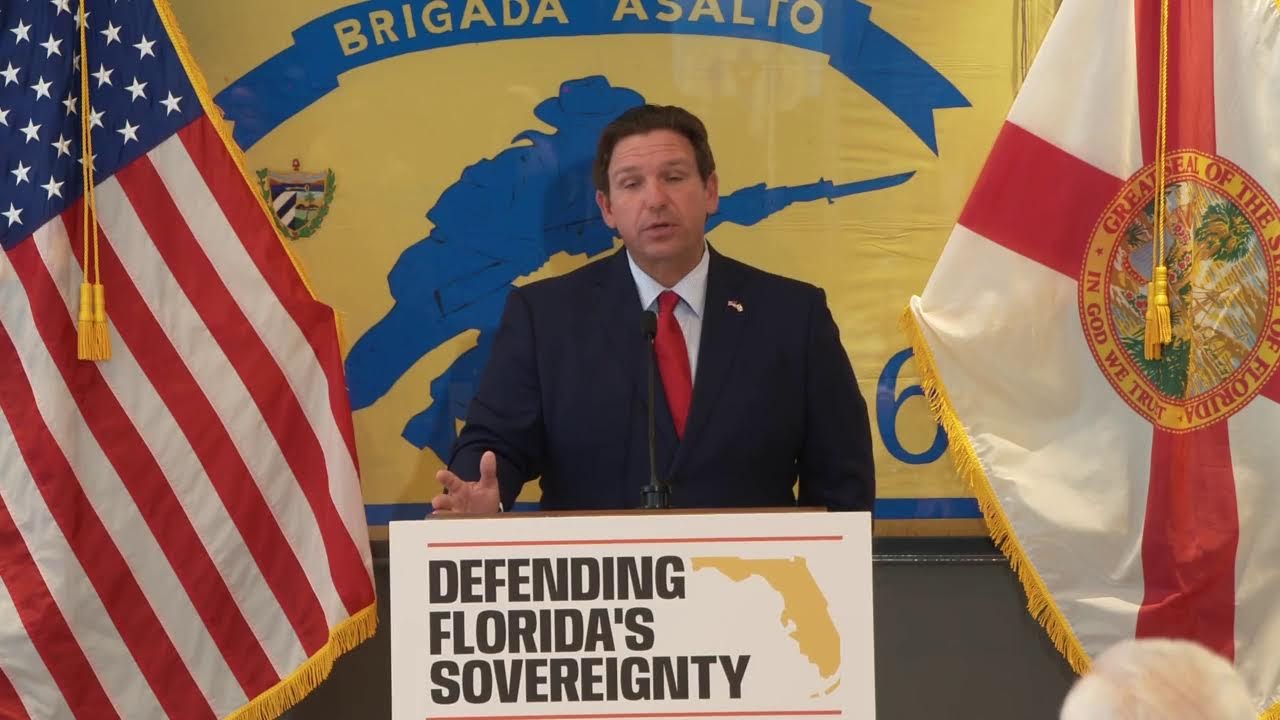
Florida Gov. Ron DeSantis on Friday signed the Foreign Interference Restriction and Enforcement Act, known as the FIRE Act, into law during a ceremony at the Bay of Pigs Museum and Library in Miami’s Little Havana neighborhood.
The law, HB 905, expands restrictions on Florida’s interactions with seven nations the state designates as “countries of concern“: China, Russia, Iran, North Korea, Cuba, Venezuela, and Syria. It takes effect July 1, 2026.
“Today, I signed the Foreign Interference Restriction and Enforcement Act to strengthen Florida’s defenses against foreign adversaries,” DeSantis said in a statement released by his office. “This legislation combats hostile foreign influence in Florida by establishing new restrictions on agreements and partnerships involving countries of concern such as Iran and Cuba, as well as penalties for violations.”
The bill’s House sponsor, Rep. Jenna Persons-Mulicka, R-Fort Myers, framed the law as a national security measure.
“The FIRE Act tells them we are paying attention and think twice before targeting our great state,” Persons-Mulicka said.
What the Law Does
HB 905 affects government officials, businesses, schools, and private contracts. The major provisions:
Adoption and surrogacy contracts are now prohibited if any party is a citizen or resident of a country of concern. The provision was added late in the legislative process and drew criticism from Democrats who said it could affect American families seeking to adopt children from foreign countries.
Public officials and employees cannot accept gifts or benefits from countries of concern or designated foreign terrorist groups.
Business activity with Cuba carries new penalties for violations of federal law. Local governments can revoke business tax receipts for entities found doing business with Cuba unlawfully, and knowingly making a false declaration about Cuba-related business activities is now a third-degree felony.
School voucher funds cannot go to K-12 or higher education institutions that promote or are affiliated with terrorist organizations.
Sister city and sister state agreements with countries of concern are terminated as of July 1, and the Florida-China Linkage Institute is repealed.
Public universities and colleges must report students on visas to the U.S. Department of Homeland Security if those students are found to be promoting terrorism, and institutions are required to expel such students.
Cuba and the Bay of Pigs
The signing ceremony’s location at the Bay of Pigs Museum, attended by veterans of Brigade 2506 and Cuban-American community leaders, underscored the law’s focus on Cuba.
“It is time for the Cuban communist dictatorship to be out to pasture once and for all,” DeSantis said. “If Cuba was free, it would be an amazingly successful country.”
The bill includes a provision allowing business with Cuba to resume if the country’s federal designation changes.
The signing came during a week of federal action targeting Cuba. On May 1, President Donald Trump signed an executive order blocking U.S. assets of individuals linked to the Cuban regime in strategic sectors including energy, defense, and finance. Last week, U.S. Secretary of State Marco Rubio announced sanctions against GAESA, the Cuban military conglomerate that controls a significant share of the Cuban economy.
The ‘Birth Tourism’ Provision
DeSantis pointed to the surrogacy provision as a response to what he described as foreign nationals using American surrogacy and birthing services to secure U.S. citizenship for their children under the 14th Amendment.
“It’s a really seedy thing,” DeSantis said. “We’re hoping that the Supreme Court is going to interpret the 14th Amendment so that we can put a stop to some of the people that are coming here for a month, having birth, and then going back to China.”
The reference was to a pending court case challenging Trump’s executive order seeking to limit birthright citizenship.
Persons-Mulicka cited the case of a Chinese billionaire reported to have had more than 100 children born in the United States through surrogacy and in vitro fertilization as among the cases prompting the provision.
What It Means for Flagler County
For Flagler County residents, the law’s most direct effects will be in education and ethics. Daytona State College’s Flagler/Palm Coast Campus is subject to the law’s provisions on student reporting and expulsion. Flagler Schools, which receives school voucher funds, will be subject to restrictions on funding institutions affiliated with terrorist organizations. Local public officials and employees are subject to the gift restrictions.
The law takes effect statewide on July 1, 2026.







Why this Law which relates to countires of concern, also bans/repells the right of Linkage Institute to issue out-of-state wavers to citizens of France, Canada and other countires not of concern?? Are there any transitional ammendments that can mitigate the effects of this Law on those students already studying under this waver?? They should not be seen as collateral damage. They would have not accepted such award if they knew of possibility of sudden loss due to unforseen sircusmetences!!!! Assist them in this process!