

Some cases never close.
In the recorded history of Flagler County, going back to at least 1981, there are roughly 15 homicides that remain unsolved.[1] Some have been cold for decades. Some are more recent. Some involve victims whose names we know. At least one involves a woman whose identity is still a mystery more than 30 years after her remains were discovered.
Behind each of these cases is a family that has waited years, sometimes generations, without answers. Without arrests. Without the small comfort that can come with seeing the person responsible held accountable. For some of these families, the wait has now stretched longer than the victim’s own lifetime.
If you have information about any case mentioned in this article, please call the Flagler County Sheriff’s Office at 386-313-4911 or CrimeStoppers of Northeast Florida at 888-277-TIPS. You can remain anonymous.
The Major Cold Cases
The following are some of the unsolved cases the Flagler County Sheriff’s Office Cold Case Unit has publicly acknowledged. Some have seen progress. Some remain entirely open. All are still being investigated.
Dennie Cayton (2013)

In 2013, the body of Dennie Cayton was found in a marsh area in Palm Coast.[3] Cayton had been stabbed to death.
Despite an active investigation at the time, the case went cold. When the FCSO Cold Case Unit launched in 2020, the Cayton case was one of the first prioritized for renewed attention. Evidence from the case was sent out for additional DNA processing. Cellular data from the original investigation was reexamined by the FCSO Digital Forensics Unit using modern analytical methods that did not exist in 2013.[3][5]
As of public reporting, the Cayton case remains unsolved. Anyone with information about the events leading up to or following the murder is asked to contact FCSO.
Andrea Ford (also known as Andrea Daniluk) and Dawn Petterson (Late 1990s)

In the late 1990s, two women were found shot to death in two separate locations along roadsides in Flagler County. Andrea Ford (also identified in records as Andrea Daniluk) and Dawn Petterson had been killed with firearms sharing similar ballistic characteristics, suggesting either the same weapon, the same shooter, or related circumstances.[3][5]
The two cases have been investigated together because of those ballistic similarities. The FCSO Cold Case Unit has sent evidence from both cases for additional DNA analysis using techniques that did not exist when the murders originally occurred.[3]
Both cases remain unsolved. The ballistic link suggests that solving one may help solve the other.
The 1993 Jane Doe
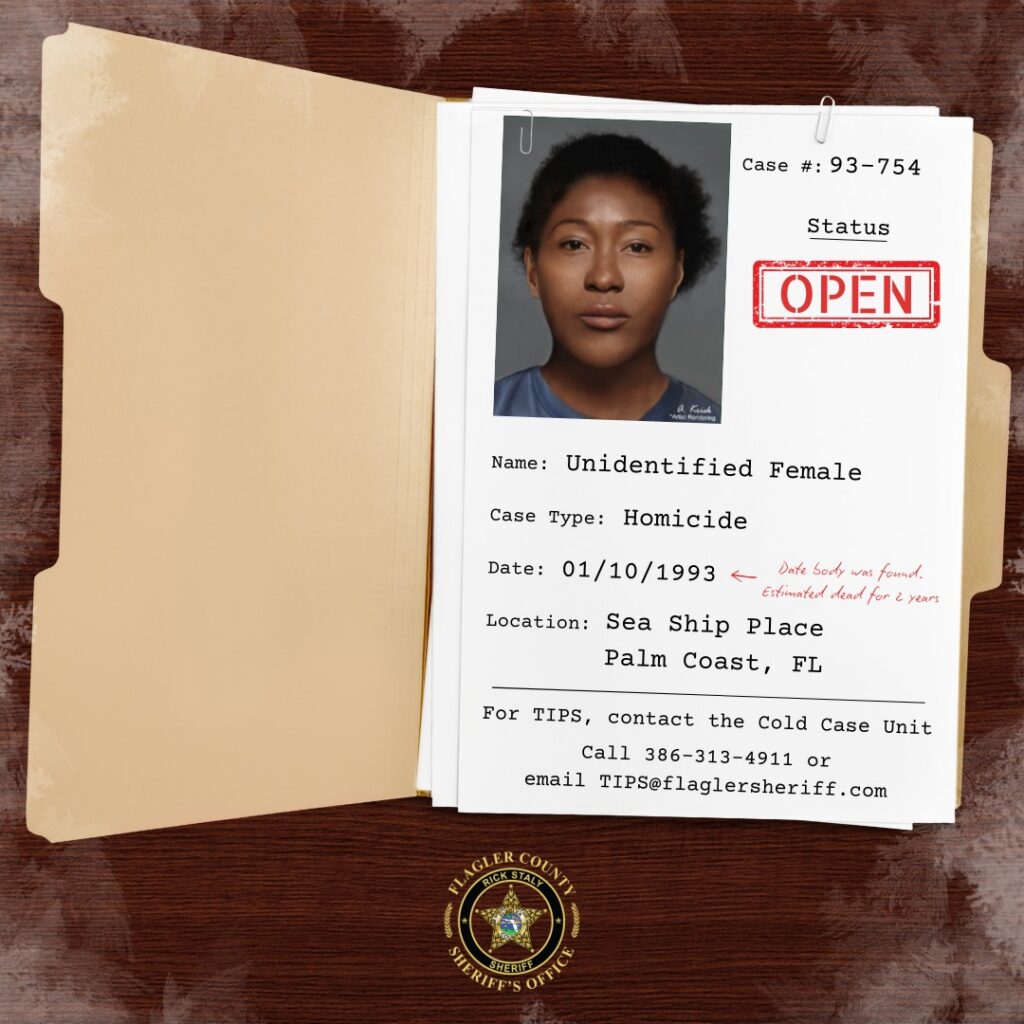
One of Flagler County’s most haunting cold cases is one in which the identity of the victim is still unknown.
In 1993, human remains were discovered in Flagler County. The woman has never been identified. Her death is being investigated as a possible homicide.[6]
In recent years, the FCSO Cold Case Unit has worked with forensic genealogy specialists to develop genetic leads. DNA testing eventually linked the unknown woman to two descendants of George Washington Coleman and Clarissa Minnick, a couple from the Edgefield or Aiken area of South Carolina.[6] Investigators have contacted at least 30 possible relatives in an effort to construct an extended family tree that might eventually identify her.[6]
A digital rendering of what the woman may have looked like has been released by the Sheriff’s Office, with assistance from the Palm Beach County Sheriff’s Office on case work.[6]
Despite the genealogical progress, the woman’s identity remains unknown more than 30 years after she was found. Somewhere, someone may still know who she was. A daughter, sister, mother, friend, or coworker who lost contact with her in the early 1990s and never knew what happened.
If you believe you may have known a woman from the Edgefield or Aiken, South Carolina area who disappeared in the early 1990s and was never accounted for, the Flagler County Sheriff’s Office wants to hear from you.
Robert Bruce McPhail (1997, Identified 2023)
For 26 years, the body of a man bound, shot, and stabbed multiple times before being dumped in the Intracoastal Waterway near Sea Ray Drive in September 1997 was known to investigators only as an unidentified victim.[6] In 1997, investigators commissioned a facial approximation by Betty Pat Gatliff of Skullpture Inc. to give the public a sense of what the man may have looked like.[6] The image circulated for years. No tips ever led to a positive identification.
In August 2023, the FCSO Cold Case Unit, working with forensic genealogy specialists, finally identified the victim. He was Robert Bruce McPhail, 58 years old at the time of his death.[6] The identification was made possible by genetic genealogy techniques that did not exist when McPhail’s body was first discovered.
But while the victim is now known, the case remains unsolved. McPhail was the victim of a violent murder. The methodical nature of the killing suggested premeditation. His body was deliberately disposed of in the water.
Whoever killed Robert Bruce McPhail in 1997 has never been identified, charged, or held accountable.
The McPhail case is also a reminder that cases that seem permanently cold can sometimes move forward. After 26 years, technology that didn’t exist made the unidentifiable identifiable. The same may eventually be true for the killer.
The Older Cases (1981 to the 1990s)
Beyond these named cases, the FCSO Cold Case Unit’s portfolio includes a number of older homicide cases dating back to as early as 1981.[3] Detective Cangialosi has noted that “one case was as far back as 1980.”[4]
These older cases are particularly difficult. Many of the original investigators have retired or passed away. Witnesses have died, moved away, or lost their memories of details that were once fresh. Original physical evidence may have degraded or been lost. Photographs are often in fragile condition. Audio and video evidence existed only on outdated tapes.[3]
Each case is being digitized, reviewed, and evaluated against modern standards. Each piece of physical evidence is being assessed for whether it can be reanalyzed with current methods.
The FCSO has not publicly named all of the cases in the older portfolio out of investigative discretion and respect for victims’ families.
The FCSO Cold Case Unit
For most of the agency’s history, the Flagler County Sheriff’s Office did not have a dedicated cold case unit. Unsolved cases were worked when time allowed, often by detectives juggling active investigations alongside historical files. Volunteers occasionally helped. Some progress was made.[2]
In late summer of 2020, Sheriff Rick Staly launched the FCSO Cold Case Unit, the first dedicated cold case investigative unit in the agency’s history.[3] Detective Andrew Cangialosi was selected as the first full-time cold case detective.[3]
Speaking to First Coast News at the time, Sheriff Staly explained the rationale: “I wanted a dedicated person to look at cold cases and see if we could solve them with new advances in science to not only hold the person accountable, but to give some closures to the family.”[4]
Time, in some cases, can be an asset to investigators. As Sheriff Staly told First Coast News, “Friends of potential suspects may not be so close now and willing to talk.”[4] Witnesses who were once afraid age out of fear. Relationships change. People who once protected someone may eventually have reasons to come forward.
How the Community Can Help
Cold cases are notoriously dependent on community participation. Information from witnesses, friends, neighbors, and family members of suspects has historically been the most important asset in solving these cases.
If you have any information about any of the cold cases described in this article, or about any other unsolved violent crime in Flagler County, the Flagler County Sheriff’s Office wants to hear from you.
To submit information directly to the FCSO Cold Case Unit:
- Call 386-313-4911
- Email TIPS@flaglersheriff.com
- Visit flaglersheriff.com/cold-case for more information on individual cases
To submit information anonymously through CrimeStoppers:
- Call CrimeStoppers of Northeast Florida at 888-277-TIPS (8477)
- Anonymous tips that lead to arrests are eligible for cash rewards of up to $5,000.[1]
Important note: The FCSO has specifically requested that crimes and incidents not be reported by email or social media.[1] Time-sensitive matters should always go to 911 or to the Sheriff’s main number.
Someone, somewhere, has the information that solves one of these cases. They may not know it. They may have known it for years. They may be reading this article right now.
The cases of Flagler County are still waiting.
Sources
[1] Flagler County Sheriff’s Office Cold Case Unit. Retrieved from flaglersheriff.com/cold-case.
[2] Palm Coast Observer. “FCSO launches Cold Case Unit to reexamine unsolved crimes.” October 13, 2020.
[3] Flagler County Sheriff’s Office press release. “FCSO Launches Cold Case Unit to Reexamine Unsolved Crimes.” October 2020.
[4] First Coast News. “Flagler County Sheriff’s Office establishes first cold case unit.” 2020.
[5] WNDB News Daytona Beach. “FCSO’s Cold Case Unit Making Progress In Old Cases.” October 12, 2020.
[6] ClickOrlando (WKMG). “Cold cases: Here are some of Florida’s unsolved crimes.” October 3, 2023.
[7] Florida Department of Law Enforcement Unsolved Cases database.
For information about specific cases or to submit a tip, contact the Flagler County Sheriff’s Office at 386-313-4911 or visit flaglersheriff.com/cold-case.